XiaoMa
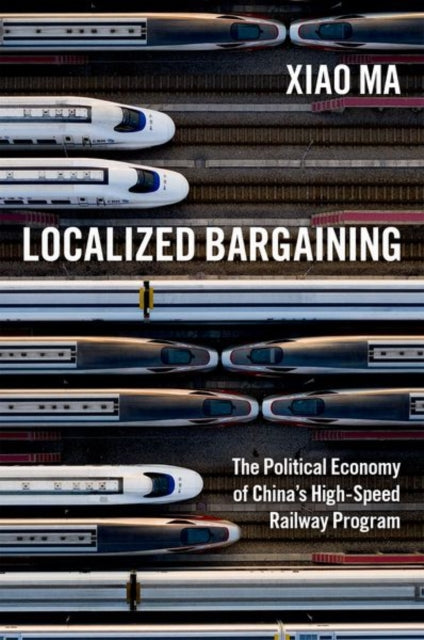
Localized Bargaining: The Political Economy of China's High-Speed Railway Program
Localized Bargaining: The Political Economy of China's High-Speed Railway Program
💎 Earn 140 Points (£1.40) on this item.
We can order this item for you. Delivery usually takes about 4 to 6 weeks.
This item is not held in our immediate stock. We will order it for you after checkout.
Estimated delivery: About 4 to 6 weeks
- Condition: Brand new
- UK Delivery times: Usually arrives within 2 - 3 working days
- UK Shipping: Fee starts at £2.39. Subject to product weight & dimension
Bulk ordering. Want 15 or more copies? Get a personalised quote and bigger discounts. Learn more about bulk orders.
Couldn't load pickup availability
- More about Localized Bargaining: The Political Economy of China's High-Speed Railway Program
Xiao Ma's book "Localized Bargaining" provides a novel theory of intergovernmental bargaining that explains the rollout of China's high-speed railway program. It shows how local governments play a complex role in the allocation of investment, leveraging institutional and extra-institutional sources of bargaining power in their competition for railway stations.
Format: Paperback / softback
Length: 248 pages
Publication date: 12 October 2022
Publisher: Oxford University Press Inc
China's high-speed railway network is one of the largest infrastructure programs in human history. Despite global media coverage, we know very little about the political process that led the government to invest in the railway program and the reasons for the striking regional and temporal variation in such investments. In Localized Bargaining, Xiao Ma offers a novel theory of intergovernmental bargaining that explains the unfolding of China's unprecedented high-speed railway program. Drawing on a wealth of in-depth interviews, original data sets, and surveys with local officials, Ma details how the bottom-up bargaining efforts by territorial authorities—whom the central bureaucracies rely on to implement various infrastructure projects—shaped the allocation of investment in the railway system. Demonstrating how localities of different types invoke institutional and extra-institutional sources of bargaining power in their competition for railway stations, Ma sheds new light on how the nation's massive bureaucracy actually functions.
China's high-speed railway network is a massive infrastructure project that has garnered global attention. Despite extensive media coverage, there is still limited knowledge about the political process that led to the government's investment in this program and the factors that influenced the varying levels of investment across different regions and time periods. In his book Localized Bargaining, Xiao Ma presents a novel theory of intergovernmental bargaining that sheds light on the development of China's high-speed railway program. Through in-depth interviews, original data sets, and surveys with local officials, Ma explores how the bottom-up bargaining efforts of territorial authorities played a crucial role in shaping the allocation of investment in the railway system.
Ma's theory of localized bargaining suggests that the central bureaucracies rely on territorial authorities to implement various infrastructure projects. These authorities have the power to bargain with the central government to secure investments for their regions. Ma's research reveals that localities of different types invoke institutional and extra-institutional sources of bargaining power in their competition for railway stations. Institutional sources include government regulations, policies, and incentives, while extra-institutional sources include political connections, public opinion, and private sector interests.
One of the key findings of Ma's research is that the allocation of investment in the high-speed railway system was influenced by a complex interplay of factors, including economic development, population density, transportation needs, and political considerations. For example, regions with high economic growth rates and dense populations were more likely to receive significant investments in high-speed rail, while regions with less developed infrastructure and less populated areas were less likely to benefit from the program.
Ma's theory also highlights the role of local officials in the bargaining process. Local officials have the power to influence investment decisions by leveraging their political connections, public support, and private sector interests. They may also use their administrative authority to secure funding and resources for their projects. However, the ability of local officials to bargain effectively with the central government is often limited by the central government's control over investment decisions and the allocation of resources.
Overall, Ma's book Localized Bargaining provides valuable insights into the political process that led to the development of China's high-speed railway program and the factors that influenced the allocation of investment across different regions and time periods. His theory of localized bargaining offers a novel perspective on intergovernmental bargaining and sheds light on how the nation's massive bureaucracy functions. This book will be of interest to scholars, policymakers, and anyone interested in understanding the complex dynamics of infrastructure development and governance in China.
Weight: 350g
Dimension: 234 x 154 x 15 (mm)
ISBN-13: 9780197648223
UK and International shipping information
UK and International shipping information
UK Delivery and returns information:
- Delivery within 2 - 3 days when ordering in the UK.
- Shipping fee for UK customers from £2.39. Fully tracked shipping service available.
- Returns policy: Return within 30 days of receipt for full refund.
International deliveries:
Shulph Ink now ships to Australia, Belgium, Canada, France, Germany, Ireland, Italy, India, Luxembourg Saudi Arabia, Singapore, Spain, Netherlands, New Zealand, United Arab Emirates, United States of America.
- Delivery times: within 5 - 10 days for international orders.
- Shipping fee: charges vary for overseas orders. Only tracked services are available for most international orders. Some countries have untracked shipping options.
- Customs charges: If ordering to addresses outside the United Kingdom, you may or may not incur additional customs and duties fees during local delivery.