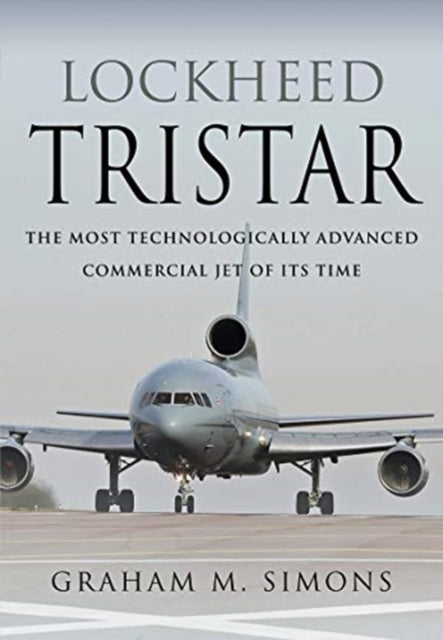
Graham M Simons
Lockheed TriStar: The Most Technologically Advanced Commercial Jet of Its Time
Lockheed TriStar: The Most Technologically Advanced Commercial Jet of Its Time
💎 Earn 106 Points (£1.06) on this item.
YOU SAVE £8.76
- Condition: Brand new
- UK Delivery times: Usually arrives within 2 - 3 working days
- UK Shipping: Fee starts at £2.39. Subject to product weight & dimension
Bulk ordering. Want 15 or more copies? Get a personalised quote and bigger discounts. Learn more about bulk orders.
Couldn't load pickup availability
- More about Lockheed TriStar: The Most Technologically Advanced Commercial Jet of Its Time
In April 1972, the Lockheed California Company delivered the L-1011 TriStar, the most technologically advanced commercial jet of its era, to Eastern Airlines. Lockheed made an impressive statement about the capabilities of its new medium-to-long-range, wide-body trijet airliner by achieving a 4-hour, 13-minute flight to Washington Dulles Airport with virtually no input from the two pilots in the cockpit. The L-1011 had faced design challenges and financial difficulties, but remained in production until 1984, with 250 examples built. However, the toll on Lockheed was too great and it withdrew from the commercial aircraft business.
Format: Hardback
Length: 256 pages
Publication date: 22 October 2021
Publisher: Pen & Sword Books Ltd
In April 1972, after six grueling years of design and development, the then Lockheed California Company (now Lockheed Martin) delivered the most technologically advanced commercial jet of its era, the L-1011 TriStar, to its first client, Eastern Airlines. To mark the moment, Lockheed decided to make an impressive statement about the capabilities of its new medium-to-long-range, wide-body trijet airliner. It did so in spectacular fashion. Overseen by two test pilots, a total of 115 crew members, VIPs, Lockheed employees, and selected reporters boarded a TriStar at Lockheed's Palmdale plant in California. The subsequent 4-hour, 13-minute flight to Washington Dulles Airport was achieved with virtually no input from the two pilots in the cockpit, the TriStar's Automatic Flight Control System being engaged from takeoff roll to landing. It was, Lockheed proudly claimed, the first cross-country flight without the need for human hands on the controls. As Lockheed themselves note, in a similar fashion to other iconic passenger airliners before it, the L-1011 had faced daunting challenges on the way. Divergent needs from competing airlines led to design challenges. Financial difficulties ravaged its engine's manufacturer, Rolls-Royce, while a recession, fueled by the world's first oil crisis, lessened the demand for commercial airliners. Lockheed, though, battled through these challenges, which even included international allegations of bribery, with the result that the TriStar, famed for its large, curved nose, low-set wings, and graceful swept tail, remained in production until 1984, by which time 250 examples had been built. The toll on Lockheed, however, was too great, and after the TriStar, it withdrew from the commercial aircraft business. In this revealing insight into the history of commercial aviation, we explore the challenges faced by Lockheed and the TriStar, as well as the impact of this iconic aircraft on the industry. We also delve into the legacy of the L-1011, which continues to inspire and influence the design of modern commercial jets.
In April 1972, after six grueling years of design and development, the then Lockheed California Company (now Lockheed Martin) delivered the most technologically advanced commercial jet of its era, the L-1011 TriStar, to its first client, Eastern Airlines. To mark the moment, Lockheed decided to make an impressive statement about the capabilities of its new medium-to-long-range, wide-body trijet airliner. It did so in spectacular fashion. Overseen by two test pilots, a total of 115 crew members, VIPs, Lockheed employees, and selected reporters boarded a TriStar at Lockheed's Palmdale plant in California. The subsequent 4-hour, 13-minute flight to Washington Dulles Airport was achieved with virtually no input from the two pilots in the cockpit, the TriStar's Automatic Flight Control System being engaged from takeoff roll to landing. It was, Lockheed proudly claimed, the first cross-country flight without the need for human hands on the controls. As Lockheed themselves note, in a similar fashion to other iconic passenger airliners before it, the L-1011 had faced daunting challenges on the way, Divergent needs from competing airlines led to design challenges. Financial difficulties ravaged its engine's manufacturer, Rolls-Royce, while a recession, fueled by the world's first oil crisis, lessened the demand for commercial airliners. Lockheed, though, battled through these challenges, which even included international allegations of bribery, with the result that the TriStar, famed for its large, curved nose, low-set wings, and graceful swept tail, remained in production until 1984, by which time 250 examples had been built. The toll on Lockheed, however, was too great, and after the TriStar, it withdrew from the commercial aircraft business. In this revealing insight into the history of commercial aviation, we explore the challenges faced by Lockheed and the TriStar, as well as the impact of this iconic aircraft on the industry. We also delve into the legacy of the L-1011, which continues to inspire and influence the design of modern commercial jets.
Weight: 1126g
Dimension: 182 x 254 x 27 (mm)
ISBN-13: 9781526758828
This item can be found in:
UK and International shipping information
UK and International shipping information
UK Delivery and returns information:
- Delivery within 2 - 3 days when ordering in the UK.
- Shipping fee for UK customers from £2.39. Fully tracked shipping service available.
- Returns policy: Return within 30 days of receipt for full refund.
International deliveries:
Shulph Ink now ships to Australia, Belgium, Canada, France, Germany, Ireland, Italy, India, Luxembourg Saudi Arabia, Singapore, Spain, Netherlands, New Zealand, United Arab Emirates, United States of America.
- Delivery times: within 5 - 10 days for international orders.
- Shipping fee: charges vary for overseas orders. Only tracked services are available for most international orders. Some countries have untracked shipping options.
- Customs charges: If ordering to addresses outside the United Kingdom, you may or may not incur additional customs and duties fees during local delivery.