Shulph Ink
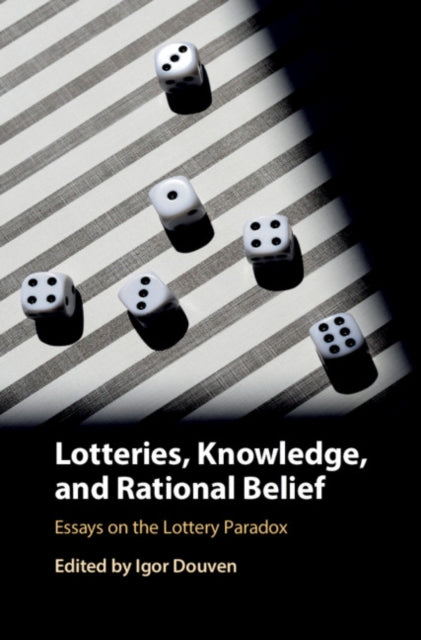
Lotteries, Knowledge, and Rational Belief: Essays on the Lottery Paradox
Lotteries, Knowledge, and Rational Belief: Essays on the Lottery Paradox
💎 Earn 410 Points (£4.10) on this item.
We can order this item for you. Delivery usually takes about 4 to 6 weeks.
This item is not held in our immediate stock. We will order it for you after checkout.
Estimated delivery: About 4 to 6 weeks
YOU SAVE £4.87
- Condition: Brand new
- UK Delivery times: Usually arrives within 2 - 3 working days
- UK Shipping: Fee starts at £2.39. Subject to product weight & dimension
Bulk ordering. Want 15 or more copies? Get a personalised quote and bigger discounts. Learn more about bulk orders.
Couldn't load pickup availability
- More about Lotteries, Knowledge, and Rational Belief: Essays on the Lottery Paradox
The lottery paradox challenges the idea that we believe something categorically if we believe it to a high enough degree, leading to a philosophical debate over fifty years. This volume offers new essays that provide compelling reasons for rethinking the debate's fundamentals.
Format: Hardback
Length: 311 pages
Publication date: 04 February 2021
Publisher: Cambridge University Press
Beliefs can be categorized into two distinct forms: categorical and graded. Categorical beliefs are those that we hold with absolute certainty, while graded beliefs are those that we hold with a degree of uncertainty. The relationship between these two types of belief has been a subject of intense philosophical debate for over fifty years.
The most straightforward answer to the question of how the two types of belief hang together is that we believe something categorically if we believe it to a high enough degree. However, this claim is known to give rise to a paradox commonly known as the lottery paradox. This paradox arises when we combine certain seemingly near-platitudes about belief with the idea that we believe something categorically.
One of the key assumptions underlying the lottery paradox is that we should believe something categorically if and only if we have a high degree of belief in it. This assumption is known as the coherence thesis. However, there are compelling reasons to question the coherence thesis.
One argument against the coherence thesis is that it fails to account for the fact that we can believe something categorically even if we have only a low degree of belief in it. For example, we might believe that there is a 1 in 10,000 chance that the sun will rise tomorrow, but we might still believe that it will rise tomorrow categorically. This suggests that the coherence thesis is too narrow and that we need to consider other factors in determining whether we believe something categorically.
Another argument against the coherence thesis is that it fails to account for the fact that we can believe something categorically even if we have good reason to doubt it. For example, we might believe that there is a 1 in 10,000 chance that the sun will rise tomorrow, but we might also have good reason to doubt that this is the case. In such cases, we might still believe that the sun will rise tomorrow categorically, but we might also have some degree of uncertainty about it.
To resolve the lottery paradox, philosophers have proposed a range of different solutions. Some philosophers argue that we should revise our understanding of the coherence thesis to account for these cases. Others argue that we should reject the coherence thesis altogether and instead adopt a more nuanced understanding of belief.
This volume offers a collection of newly commissioned essays on the lottery paradox, all of which provide compelling reasons for rethinking many of the fundamentals of the debate. The essays cover a wide range of topics, including the nature of belief, the coherence thesis, the probability of belief, and the role of evidence in determining belief.
Overall, the lottery paradox highlights the complex and nuanced nature of belief and the need for a more comprehensive understanding of it. The essays in this volume provide valuable insights into the debate and offer new perspectives on how we can resolve the paradox.
Weight: 556g
Dimension: 159 x 235 x 24 (mm)
ISBN-13: 9781108421911
UK and International shipping information
UK and International shipping information
UK Delivery and returns information:
- Delivery within 2 - 3 days when ordering in the UK.
- Shipping fee for UK customers from £2.39. Fully tracked shipping service available.
- Returns policy: Return within 30 days of receipt for full refund.
International deliveries:
Shulph Ink now ships to Australia, Belgium, Canada, France, Germany, Ireland, Italy, India, Luxembourg Saudi Arabia, Singapore, Spain, Netherlands, New Zealand, United Arab Emirates, United States of America.
- Delivery times: within 5 - 10 days for international orders.
- Shipping fee: charges vary for overseas orders. Only tracked services are available for most international orders. Some countries have untracked shipping options.
- Customs charges: If ordering to addresses outside the United Kingdom, you may or may not incur additional customs and duties fees during local delivery.