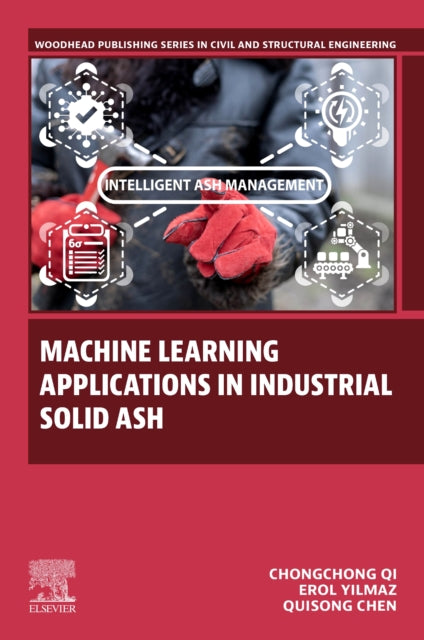
ChongchongQi,Qiusong Chen,Erol Yilmaz
Machine Learning Applications in Industrial Solid Ash
Machine Learning Applications in Industrial Solid Ash
💎 Earn 848 Points (£8.48) on this item.
- Condition: Brand new
- UK Delivery times: Usually arrives within 2 - 3 working days
- UK Shipping: Fee starts at £2.39. Subject to product weight & dimension
Bulk ordering. Want 15 or more copies? Get a personalised quote and bigger discounts. Learn more about bulk orders.
Couldn't load pickup availability
- More about Machine Learning Applications in Industrial Solid Ash
Machine Learning Applications in Industrial Solid Ash provides an introduction to ML for solid ash applications, covering generation, management, and recycling. It discusses ML approaches for solid ash generation, clustering analysis, origin identification, reactivity prediction, leaching potential modelling, and metal recovery evaluation. It also explores potential future trends and challenges in the field.
Format: Paperback / softback
Length: 314 pages
Publication date: 01 December 2023
Publisher: Elsevier - Health Sciences Division
Machine Learning Applications in Industrial Solid Ash: A Comprehensive Guide
Solid ash, a byproduct of industrial processes, poses significant challenges in terms of generation, management, and recycling. To address these challenges, machine learning (ML) has emerged as a powerful tool. This book provides a comprehensive overview of ML applications in solid ash management and recycling, covering the status of solid ash generation and management, foundational knowledge on ML in solid ash management, and ML approaches currently used to address problems in solid ash management and recycling.
The book begins by discussing the status of solid ash generation and management. Solid ash is generated from various industrial processes, including coal-fired power plants, cement manufacturing, and waste incineration. The generation of solid ash can have negative environmental impacts, including air pollution, water pollution, and soil contamination. To manage solid ash, various methods are used, including landfilling, incineration, and recycling. However, these methods are not always effective and can be costly.
ML approaches can help to improve the management of solid ash. ML algorithms can be used to analyze large and complex datasets, which can help to identify patterns and trends in solid ash generation and management. This information can then be used to develop new strategies for managing solid ash. For example, ML algorithms can be used to predict the reactivity of solid ash, which can help to determine the appropriate disposal method.
ML approaches can also be used to improve the recycling of solid ash. Solid ash can be recycled into various products, such as cement, concrete, and asphalt. However, the recycling process can be complex and expensive. ML algorithms can be used to optimize the recycling process, which can help to reduce the cost of recycling and increase the amount of recycled material.
The book also discusses the challenges associated with ML in solid ash management and recycling. One of the challenges is the lack of data. Solid ash is a complex material, and there is limited data available on its properties and behavior. This can make it difficult to develop accurate ML algorithms. Another challenge is the complexity of the ML algorithms. ML algorithms can be complex and difficult to implement, which can make it difficult for organizations to adopt them.
To address these challenges, the book provides a number of recommendations. One recommendation is to increase the amount of data available on solid ash. This can be done by conducting research and collecting data from various sources. Another recommendation is to develop simpler and more efficient ML algorithms. This can be done by using machine learning frameworks and libraries.
In addition to the recommendations, the book also provides a number of case studies. Case studies include the use of ML to predict the reactivity of solid ash, the use of ML to optimize the recycling process, and the use of ML to identify the origin of solid ash. These case studies demonstrate the potential of ML in solid ash management and recycling.
In conclusion, machine learning has huge potential to reshape the whole status for solid ash management and recycling. This book provides a comprehensive overview of ML applications in solid ash management and recycling, covering the status of solid ash generation and management, foundational knowledge on ML in solid ash management, and ML approaches currently used to address problems in solid ash management and recycling. By increasing the amount of data available on solid ash and developing simpler and more efficient ML algorithms, we can help to improve the management of solid ash and increase the amount of recycled material.
Weight: 450g
Dimension: 229 x 152 (mm)
ISBN-13: 9780443155246
This item can be found in:
UK and International shipping information
UK and International shipping information
UK Delivery and returns information:
- Delivery within 2 - 3 days when ordering in the UK.
- Shipping fee for UK customers from £2.39. Fully tracked shipping service available.
- Returns policy: Return within 30 days of receipt for full refund.
International deliveries:
Shulph Ink now ships to Australia, Belgium, Canada, France, Germany, Ireland, Italy, India, Luxembourg Saudi Arabia, Singapore, Spain, Netherlands, New Zealand, United Arab Emirates, United States of America.
- Delivery times: within 5 - 10 days for international orders.
- Shipping fee: charges vary for overseas orders. Only tracked services are available for most international orders. Some countries have untracked shipping options.
- Customs charges: If ordering to addresses outside the United Kingdom, you may or may not incur additional customs and duties fees during local delivery.