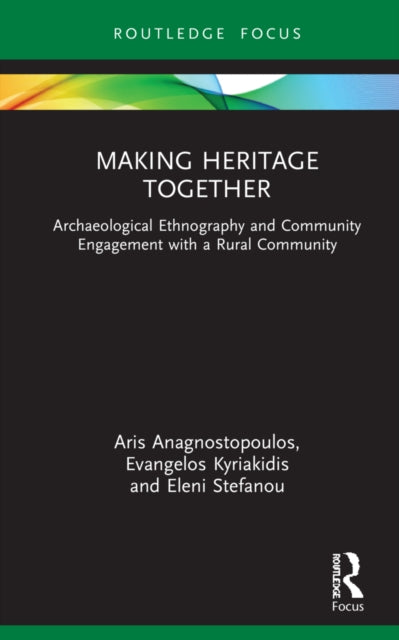
Aris Anagnostopoulos,Evangelos Kyriakidis,Eleni Stefanou
Making Heritage Together: Archaeological Ethnography and Community Engagement with a Rural Community
Making Heritage Together: Archaeological Ethnography and Community Engagement with a Rural Community
We can order this item for you. Delivery usually takes about 4 to 6 weeks.
This item is not held in our immediate stock. We will order it for you after checkout.
Estimated delivery: About 4 to 6 weeks
YOU SAVE £4.84
- Condition: Brand new
- UK Delivery times: Usually arrives within 2 - 3 working days
- UK Shipping: Fee starts at £3.89. Subject to product weight & dimension
Bulk ordering. Want 15 or more copies? Get a personalised quote and bigger discounts. Learn more about bulk orders.
Couldn't load pickup availability
- More about Making Heritage Together: Archaeological Ethnography and Community Engagement with a Rural Community
This book emphasizes the importance of local context in designing and implementing public archaeology projects, and the necessity of establishing methods to understand, collaborate, and interact with culturally specific groups and publics. It advocates for the implementation of archaeological ethnographic research as a method of creating instances and spaces for collaborative knowledge production, contributing to a greater understanding of how rural communities can be successfully engaged in the management of their own heritage.
Format: Hardback
Length: 130 pages
Publication date: 28 February 2022
Publisher: Taylor & Francis Ltd
This book offers a comprehensive exploration of the theoretical and local contexts underpinning public archaeology projects. It delves into the methodological approaches employed and presents the outcomes achieved. Furthermore, it provides in-depth reviews of specific public archaeology actions, showcasing collaborative, research-based heritage management practices. The authors emphasize the significance of local context in designing and implementing public archaeology initiatives, while also advocating for the development of methods to effectively understand, collaborate, and engage with culturally specific groups and publics. They propose the implementation of archaeological ethnographic research as a means to create instances and spaces for collaborative knowledge production.
The volume makes a substantial contribution to our understanding of how rural communities can effectively participate in the management of their heritage. It will be of great interest to archaeologists and other heritage professionals seeking to maximize the inclusivity and impact of small-scale projects with limited resources while achieving sustainable processes of collaboration with local stakeholders.
The book is organized into several chapters, each addressing different aspects of public archaeology. The first chapter provides an introduction to the field, defining public archaeology and its goals. It also highlights the importance of collaboration and community engagement in heritage management.
The second chapter explores the theoretical frameworks and principles that guide public archaeology projects. It discusses the role of cultural heritage in society, the ethical considerations involved in archaeological research, and the various methods and approaches used in public archaeology.
The third chapter focuses on the local contexts in which public archaeology projects are implemented. It examines the historical, social, and cultural factors that shape the interpretation and management of heritage sites. It also explores the challenges and opportunities that arise when working with diverse communities and stakeholders.
The fourth chapter discusses the methodological approaches employed in public archaeology projects. It covers topics such as survey, excavation, and artifact analysis, as well as the use of digital technologies and other innovative methods.
The fifth chapter presents the outcomes of public archaeology projects. It showcases successful examples of collaboration between archaeologists, community members, and other stakeholders, highlighting the benefits and challenges of these partnerships.
The sixth chapter examines the role of public archaeology in education and outreach. It discusses the ways in which public archaeology projects can be used to promote cultural awareness, heritage preservation, and community development.
The final chapter provides a conclusion and reflection on the significance of public archaeology. It emphasizes the importance of ongoing research, collaboration, and community engagement in the management of heritage.
Overall, this book provides a valuable resource for archaeologists, heritage professionals, and anyone interested in the management and preservation of cultural heritage. It offers a comprehensive and insightful exploration of the theoretical and local contexts underpinning public archaeology projects, as well as the methodological approaches and outcomes achieved. By highlighting the value of collaboration and community engagement, the book contributes to a greater understanding of how rural communities can effectively participate in the management of their own heritage.
Weight: 310g
Dimension: 146 x 225 x 12 (mm)
ISBN-13: 9781032194745
UK and International shipping information
UK and International shipping information
We deliver throughout the United Kingdom and to 128 countries and territories worldwide, including the United States, Australia, Canada, Germany, Spain and France.