Arunabh Ghosh
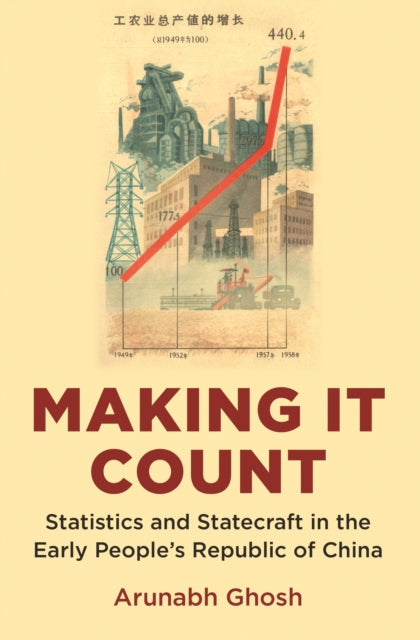
Making It Count: Statistics and Statecraft in the Early People's Republic of China
Making It Count: Statistics and Statecraft in the Early People's Republic of China
💎 Earn 140 Points (£1.40) on this item.
We can order this item for you. Delivery usually takes about 4 to 6 weeks.
This item is not held in our immediate stock. We will order it for you after checkout.
Estimated delivery: About 4 to 6 weeks
YOU SAVE £6.92
- Condition: Brand new
- UK Delivery times: Usually arrives within 2 - 3 working days
- UK Shipping: Fee starts at £2.39. Subject to product weight & dimension
Bulk ordering. Want 15 or more copies? Get a personalised quote and bigger discounts. Learn more about bulk orders.
Couldn't load pickup availability
- More about Making It Count: Statistics and Statecraft in the Early People's Republic of China
The book "Making It Count" explores how Chinese officials used statistics to define a new society in the early years of the Peoples Republic of China, highlighting the challenges of relying on Soviet-inspired methods of exhaustive enumeration and the eventual rejection of these methods in favor of random sampling and ethnographic enterprise.
Format: Paperback / softback
Length: 360 pages
Publication date: 11 January 2022
Publisher: Princeton University Press
In the early years of the People's Republic of China, a significant challenge emerged for the leaders as they embarked on a transformative journey towards a socialist society. The government, representing one of the world's largest nations, faced a profound lack of reliable statistical data about its own country. This lack of information posed a significant obstacle to their goal of implementing socialist planning and reengineering society and economy.
To address this "crisis in counting," a remarkable story unfolds in Arunabh Ghosh's book, "Making It Count." Ghosh delves into a wealth of sources from China, India, and the United States, exploring the choices made by political leaders, statisticians, academics, statistical workers, and even literary figures in their quest to know the nation through numbers.
The book reveals that in the early years of the People's Republic, China relied heavily on Soviet-inspired methods of exhaustive enumeration to gather statistical data. However, as time passed, it became increasingly untenable for China to continue this approach. The country sought to explore new methods and technologies to gain a deeper understanding of its population and society.
One significant turning point came with the unprecedented and unexpected exchanges between Chinese statisticians and Indian statisticians. The Chinese were eager to learn about the then-exciting new technology of random sampling, which offered a more efficient and accurate way of collecting data. This exchange marked a significant milestone in the history of statistics and data, as it facilitated the cross-pollination of ideas and knowledge between different regions and countries.
However, the Great Leap Forward (1958–61), a period of ambitious economic development initiatives, brought about a significant shift in the approach to statistics. During this time, probabilistic and exhaustive methods were rejected, and statistics was refashioned into an ethnographic enterprise. The focus shifted from quantitative analysis to qualitative understanding, with an emphasis on capturing the cultural and social nuances of the Chinese population.
Ghosh's book not only revises existing models of Cold War science but also globalizes wider developments in the history of statistics and data. By acknowledging the Soviet and Indian influences on China's statistical practices, Ghosh provides fresh perspectives on China's transition to socialism. The book anchors itself in debates about statistics and its relationship to state building, offering valuable insights into the complex processes that shaped China's development during this critical period.
In conclusion, "Making It Count" is a captivating and insightful book that sheds light on the history of efforts to resolve the "crisis in counting" in the early years of the People's Republic of China. Through a rich tapestry of sources and narratives, Arunabh Ghosh explores the choices made by political leaders, statisticians, academics, and cultural figures in their pursuit of knowledge and understanding. The book not only revises our understanding of China's statistical practices but also contributes to our broader understanding of the global history of statistics and data.
Dimension: 235 x 156 (mm)
ISBN-13: 9780691199719
This item can be found in:
UK and International shipping information
UK and International shipping information
UK Delivery and returns information:
- Delivery within 2 - 3 days when ordering in the UK.
- Shipping fee for UK customers from £2.39. Fully tracked shipping service available.
- Returns policy: Return within 30 days of receipt for full refund.
International deliveries:
Shulph Ink now ships to Australia, Belgium, Canada, France, Germany, Ireland, Italy, India, Luxembourg Saudi Arabia, Singapore, Spain, Netherlands, New Zealand, United Arab Emirates, United States of America.
- Delivery times: within 5 - 10 days for international orders.
- Shipping fee: charges vary for overseas orders. Only tracked services are available for most international orders. Some countries have untracked shipping options.
- Customs charges: If ordering to addresses outside the United Kingdom, you may or may not incur additional customs and duties fees during local delivery.