David Pedulla
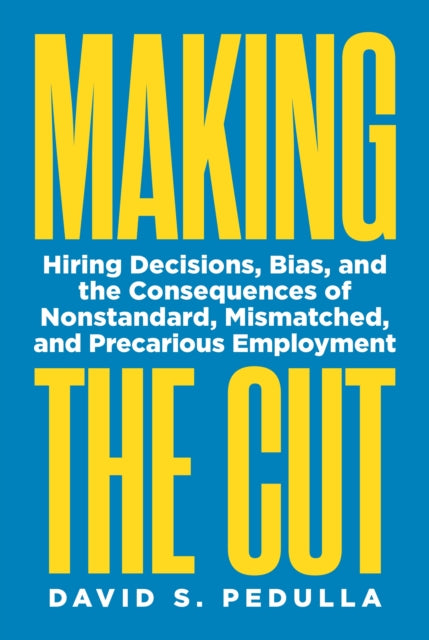
Making the Cut: Hiring Decisions, Bias, and the Consequences of Nonstandard, Mismatched, and Precarious Employment
Making the Cut: Hiring Decisions, Bias, and the Consequences of Nonstandard, Mismatched, and Precarious Employment
💎 Earn 88 Points (£0.88) on this item.
We can order this item for you. Delivery usually takes about 4 to 6 weeks.
This item is not held in our immediate stock. We will order it for you after checkout.
Estimated delivery: About 4 to 6 weeks
YOU SAVE £4.35
- Condition: Brand new
- UK Delivery times: Usually arrives within 2 - 3 working days
- UK Shipping: Fee starts at £2.39. Subject to product weight & dimension
Bulk ordering. Want 15 or more copies? Get a personalised quote and bigger discounts. Learn more about bulk orders.
Couldn't load pickup availability
- More about Making the Cut: Hiring Decisions, Bias, and the Consequences of Nonstandard, Mismatched, and Precarious Employment
Making the Cut examines how employers perceive and evaluate job applicants with nonstandard or precarious employment histories, focusing on how HR managers, recruiters, and talent acquisition specialists evaluate workers with nonstandard, mismatched, or precarious employment experience. It finds that hiring professionals extract distinct meanings from different types of employment experiences, the effects of nonstandard, mismatched, and precarious employment histories are not all the same, and the race and gender of workers intersect with their employment histories to shape which workers get called back for jobs.
Format: Paperback / softback
Length: 208 pages
Publication date: 09 August 2022
Publisher: Princeton University Press
Millions of workers today labor in nontraditional situations involving part-time work, temporary agency employment, and skills underutilization, or face the precariousness of long-term unemployment. To date, research has largely focused on how these experiences shape workers' well-being, rather than how hiring agents perceive and treat job applicants who have moved through these positions. Shifting the focus from workers to hiring agents, Making the Cut explores how key gatekeepers—HR managers, recruiters, and talent acquisition specialists—evaluate workers with nonstandard, mismatched, or precarious employment experience. Factoring in the social groups to which workers belong—such as their race and gender—David Pedulla shows how workers get jobs, how the hiring process unfolds, who makes the cut, and who does not. Drawing on a field experiment examining hiring decisions in four occupational groups and in-depth interviews with hiring agents in the United States, Pedulla documents and unpacks three important discoveries. Hiring professionals extract distinct meanings from different types of employment experiences; the effects of nonstandard, mismatched, and precarious employment histories for workers' job outcomes are not all the same; and the race and gender of workers intersect with their employment histories to shape which workers get called back for jobs. Indeed, hiring professionals use group-based stereotypes to weave divergent narratives or "stratified stories" about workers with similar employment experiences. The result is a complex set of inequalities in the labor market. Looking at bias and discrimination, social exclusion in the workplace, and the impact of these factors on workers' well-being, Making the Cut provides a comprehensive analysis of the challenges faced by workers with nonstandard or precarious employment histories and the policies and practices that can help to address these inequalities.
Millions of workers today labor in nontraditional situations involving part-time work, temporary agency employment, and skills underutilization, or face the precariousness of long-term unemployment.
To date, research has largely focused on how these experiences shape workers' well-being, rather than how hiring agents perceive and treat job applicants who have moved through these positions.
Shifting the focus from workers to hiring agents, Making the Cut explores how key gatekeepers—HR managers, recruiters, and talent acquisition specialists—evaluate workers with nonstandard, mismatched, or precarious employment experience.
Factoring in the social groups to which workers belong—such as their race and gender—David Pedulla shows how workers get jobs, how the hiring process unfolds, who makes the cut, and who does not.
Drawing on a field experiment examining hiring decisions in four occupational groups and in-depth interviews with hiring agents in the United States, Pedulla documents and unpacks three important discoveries.
Hiring professionals extract distinct meanings from different types of employment experiences; the effects of nonstandard, mismatched, and precarious employment histories for workers' job outcomes are not all the same; and the race and gender of workers intersect with their employment histories to shape which workers get called back for jobs.
Indeed, hiring professionals use group-based stereotypes to weave divergent narratives or "stratified stories" about workers with similar employment experiences.
The result is a complex set of inequalities in the labor market.
Looking at bias and discrimination, social exclusion in the workplace, and the impact of these factors on workers' well-being, Making the Cut provides a comprehensive analysis of the challenges faced by workers with nonstandard or precarious employment histories and the policies and practices that can help to address these inequalities.
Weight: 338g
Dimension: 155 x 234 x 15 (mm)
ISBN-13: 9780691241432
This item can be found in:
UK and International shipping information
UK and International shipping information
UK Delivery and returns information:
- Delivery within 2 - 3 days when ordering in the UK.
- Shipping fee for UK customers from £2.39. Fully tracked shipping service available.
- Returns policy: Return within 30 days of receipt for full refund.
International deliveries:
Shulph Ink now ships to Australia, Belgium, Canada, France, Germany, Ireland, Italy, India, Luxembourg Saudi Arabia, Singapore, Spain, Netherlands, New Zealand, United Arab Emirates, United States of America.
- Delivery times: within 5 - 10 days for international orders.
- Shipping fee: charges vary for overseas orders. Only tracked services are available for most international orders. Some countries have untracked shipping options.
- Customs charges: If ordering to addresses outside the United Kingdom, you may or may not incur additional customs and duties fees during local delivery.