Mark Shirk
Making War on the World: How Transnational Violence Reshapes Global Order
Making War on the World: How Transnational Violence Reshapes Global Order
💎 Earn 473 Points (£4.73) on this item.
YOU SAVE £22.32
- Condition: Brand new
- UK Delivery times: Usually arrives within 2 - 3 working days
- UK Shipping: Fee starts at £2.39. Subject to product weight & dimension
Bulk ordering. Want 15 or more copies? Get a personalised quote and bigger discounts. Learn more about bulk orders.
Couldn't load pickup availability
- More about Making War on the World: How Transnational Violence Reshapes Global Order
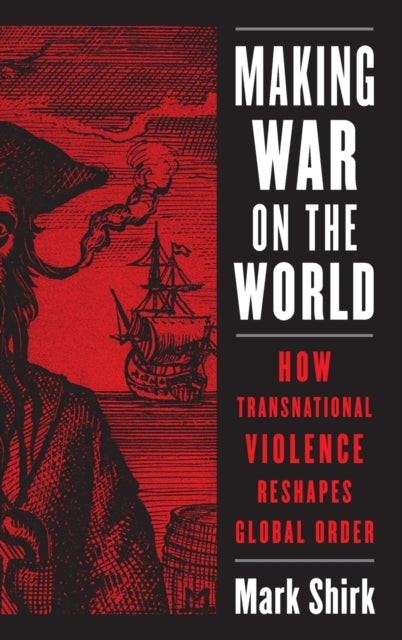
Mark Shirk's book "Making War on the World" explores how states respond to transnational violence by redrawing conceptual boundaries and developing new forms of control, surveillance, and rights. It argues that these responses have shaped the state and global order and highlights the role of pirates, anarchists, and terrorists in shaping it.
Format: Hardback
Length: 256 pages
Publication date: 01 March 2022
Publisher: Columbia University Press
The state plays a pivotal role in shaping politics, as it establishes and upholds boundaries that differentiate its sphere of influence from the outside world. However, states encounter numerous threats that transcend these geographical and conceptual boundaries, challenging their authority and legitimacy. Transnational violent actors, who operate beyond these limits, further undermine the states' claims to political power.
In his insightful book, "Making War on the World," Mark Shirk delves into historical and contemporary state responses to transnational violence. He examines a range of crises that have plagued the state system throughout different eras, including golden-age piracy in the eighteenth century, anarchist "propagandists of the deed" at the turn of the twentieth century, and the rise of al-Qaeda in recent years. Through his analysis, Shirk argues that states redefine conceptual boundaries, such as the distinction between "international" and "domestic," in order to comprehend and confront transnational threats.
In response to these challenges, states have developed innovative responses that involve new forms of control, surveillance, and rights. These responses have gradually shaped and transformed the state and global order. Shirk's book relies on extensive archival research and interviews with policy makers and experts, providing a comprehensive account of the role of pirates, anarchists, and terrorists in shaping global order.
One of the key insights of "Making War on the World" is that states are not passive actors in the global arena. Rather, they are active agents that use their power and influence to shape the world around them. Shirk highlights the creative ways in which states have responded to transnational violence, such as by expanding their surveillance capabilities, developing new military technologies, and negotiating international agreements.
Furthermore, the book explores the implications of these state responses for our understanding of state formation. Shirk argues that the state is not a fixed entity but rather a dynamic and evolving institution that responds to changing circumstances and challenges. He suggests that the study of state formation should not be limited to traditional theories of nation-building but should also consider the role of non-state actors and transnational networks in shaping global order.
In conclusion, "Making War on the World" is a thought-provoking book that offers a fresh perspective on the role of the state in shaping global order. By examining historical and contemporary state responses to transnational violence, Shirk demonstrates the dynamic and complex nature of the state and its interactions with the wider world. The book provides valuable insights into the challenges facing states and the strategies they employ to address them, and it will be of interest to scholars, policymakers, and anyone interested in understanding the complex dynamics of international relations.
Dimension: 229 x 152 (mm)
ISBN-13: 9780231201865
This item can be found in:
UK and International shipping information
UK and International shipping information
UK Delivery and returns information:
- Delivery within 2 - 3 days when ordering in the UK.
- Shipping fee for UK customers from £2.39. Fully tracked shipping service available.
- Returns policy: Return within 30 days of receipt for full refund.
International deliveries:
Shulph Ink now ships to Australia, Belgium, Canada, France, Germany, Ireland, Italy, India, Luxembourg Saudi Arabia, Singapore, Spain, Netherlands, New Zealand, United Arab Emirates, United States of America.
- Delivery times: within 5 - 10 days for international orders.
- Shipping fee: charges vary for overseas orders. Only tracked services are available for most international orders. Some countries have untracked shipping options.
- Customs charges: If ordering to addresses outside the United Kingdom, you may or may not incur additional customs and duties fees during local delivery.