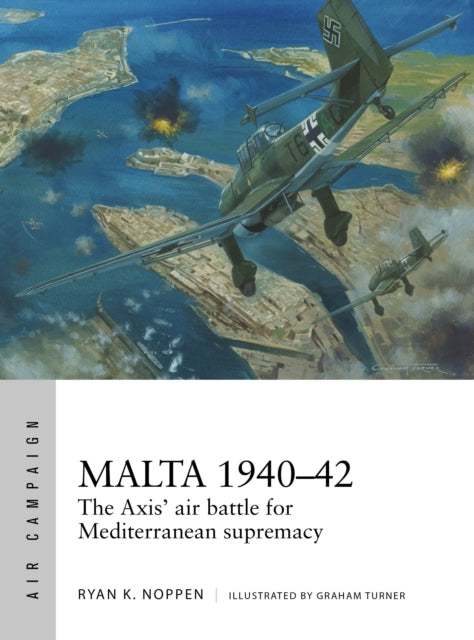
Ryan K. Noppen
Malta 1940-42: The Axis' air battle for Mediterranean supremacy
Malta 1940-42: The Axis' air battle for Mediterranean supremacy
💎 Earn 60 Points (£0.60) on this item.
YOU SAVE £4.97
- Condition: Brand new
- UK Delivery times: Usually arrives within 2 - 3 working days
- UK Shipping: Fee starts at £2.39. Subject to product weight & dimension
Bulk ordering. Want 15 or more copies? Get a personalised quote and bigger discounts. Learn more about bulk orders.
Couldn't load pickup availability
- More about Malta 1940-42: The Axis' air battle for Mediterranean supremacy
During World War II, the island of Malta was a crucial British stronghold in the central Mediterranean. Italy and Germany launched air campaigns to force a surrender or reduce the defenses, but technical and tactical problems caused the Italian campaign to fail. The German intervention came close to knocking Malta out of the war, but the island's strong defenses and the determination of its defenders ultimately saved it.
\n Format: Paperback / softback
\n Length: 96 pages
\n Publication date: 22 February 2018
\n Publisher: Bloomsbury Publishing PLC
\n
In 1940, the strategically vital island of Malta held a pivotal position in the central Mediterranean, serving as Britain's last stronghold amidst the Axis powers. The relentless attacks by the Axis forces wreaked havoc among their shipping, posing a significant threat to the British Empire. Recognizing the urgency of the situation, Italy and Germany launched air campaigns aimed at eliminating Malta from the war. Italy initiated its air campaign in 1940, with the primary objective of forcing a surrender or significantly weakening Malta's defenses to pave the way for an invasion. However, the campaign faced numerous technical and tactical challenges that ultimately hindered its success.
Despite Italy's initial efforts, the campaign encountered several setbacks. One of the key factors was the inadequate number of aircraft available to the Italian Air Force (Regia Aeronautica). The Regia Aeronautica had a limited fleet of aircraft, including outdated planes such as the Fiat CR.42 and the Savoia-Marchetti SM.79. These aircraft were not well-suited for the task of conducting long-range operations over the Mediterranean, which required a significant amount of fuel and time.
Furthermore, the Italian Air Force lacked the necessary expertise and experience to effectively employ its aircraft. Many of the pilots were inexperienced, and the aircraft were often flown in conditions that were not conducive to successful operations. The lack of coordination and communication between the ground and air forces also contributed to the campaign's failure.
Despite these challenges, the Italian Air Force continued to press its offensive against Malta. However, the tide began to shift in favor of the Allies as the war progressed. The introduction of new aircraft, such as the Supermarine Spitfire and the Lockheed P-38 Lightning, gave the British a significant advantage in the air. Additionally, the Allies were able to strengthen their defenses on Malta, including the construction of underground bunkers and the deployment of anti-aircraft guns.
As the Italian Air Force continued to struggle, Germany intervened in the campaign in 1941. Germany's Luftwaffe, under the command of Hermann Göring, launched a series of intense bombing raids on Malta. The raids were characterized by their intensity and frequency, and they caused significant damage to the island's infrastructure and population.
Despite the German intervention, Malta remained defiant. The island's strong defenses, combined with the determination of its people, proved to be a formidable obstacle to the Axis powers. The British were able to reinforce Malta with additional aircraft and supplies, and the island's resistance continued to frustrate the Axis forces.
In the end, the Axis powers' attempt to take the British colony of Malta ultimately failed. The technical and tactical problems faced by the Italian Air Force, coupled with the strong resistance of Malta and the intervention of Germany, proved to be too much for the Axis forces to overcome. Malta remained a vital stronghold for the British Empire throughout the war, and its successful defense played a significant role in the eventual Allied victory.
In conclusion, the Axis powers' attempt to take the British colony of Malta in 1940 was a significant military campaign that had far-reaching consequences. The campaign faced numerous technical and tactical challenges, including inadequate aircraft, inexperienced pilots, and lack of coordination between ground and air forces. Despite these obstacles, the Italian Air Force continued to press its offensive against Malta, but the tide began to shift in favor of the Allies as the war progressed. Germany's intervention in 1941 added further intensity to the campaign, but Malta's strong defenses and the determination of its people ultimately proved to be too much for the Axis powers to overcome. The failure of the Axis powers to take Malta had a significant impact on the course of the war, and it remains a testament to the resilience and determination of the British Empire and the people of Malta.
\n Weight: 312g\n
Dimension: 248 x 183 x 7 (mm)\n
ISBN-13: 9781472820600\n \n
UK and International shipping information
UK and International shipping information
UK Delivery and returns information:
- Delivery within 2 - 3 days when ordering in the UK.
- Shipping fee for UK customers from £2.39. Fully tracked shipping service available.
- Returns policy: Return within 30 days of receipt for full refund.
International deliveries:
Shulph Ink now ships to Australia, Belgium, Canada, France, Germany, Ireland, Italy, India, Luxembourg Saudi Arabia, Singapore, Spain, Netherlands, New Zealand, United Arab Emirates, United States of America.
- Delivery times: within 5 - 10 days for international orders.
- Shipping fee: charges vary for overseas orders. Only tracked services are available for most international orders. Some countries have untracked shipping options.
- Customs charges: If ordering to addresses outside the United Kingdom, you may or may not incur additional customs and duties fees during local delivery.