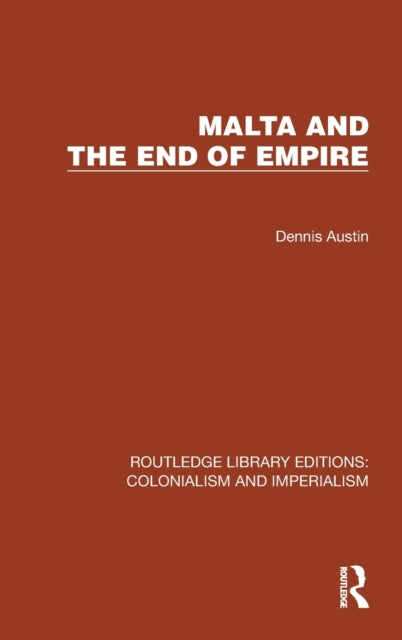
DennisAustin
Malta and the End of Empire
Malta and the End of Empire
We can order this item for you. Delivery usually takes about 4 to 6 weeks.
This item is not held in our immediate stock. We will order it for you after checkout.
Estimated delivery: About 4 to 6 weeks
- Condition: Brand new
- UK Delivery times: Usually arrives within 2 - 3 working days
- UK Shipping: Fee starts at £3.89. Subject to product weight & dimension
Bulk ordering. Want 15 or more copies? Get a personalised quote and bigger discounts. Learn more about bulk orders.
Couldn't load pickup availability
- More about Malta and the End of Empire
In 1956, the British and Maltese Governments asked the people of Malta, Gozo, and Comino to decide whether they wanted full integration with the United Kingdom, a proposal that ran contrary to colonial policy. This was the sole case in British colonial history.
Format: Hardback
Length: 136 pages
Publication date: 03 May 2023
Publisher: Taylor & Francis Ltd
Malta and the End of Empire (1971) delves into a significant yet overlooked chapter in history, recounting the moment in 1956 when the inhabitants of Malta, Gozo, and Comino were presented with a remarkable proposition by the British and Maltese Governments. This proposal sought to integrate Malta fully into the United Kingdom, a stark departure from the prevailing colonial policies of the time. While France and Portugal had also contemplated similar endeavors, this instance stands as a unique and pioneering moment in British colonial history. The film explores the complexities and ramifications of this proposal, examining the perspectives of the Maltese people, the British administration, and the broader international context. It sheds light on the political, social, and cultural forces that shaped this decision and its impact on Malta's identity and sovereignty. Through a combination of historical footage, interviews, and analysis, Malta and the End of Empire offers a thought-provoking exploration of a pivotal moment in the nation's history, challenging our understanding of empire and its legacies.
The film begins by setting the stage for this momentous decision. In 1956, Malta was a British colony with a distinct identity and culture, but it was also facing economic and social challenges. The British Government, recognizing the need for change, proposed the integration of Malta into the United Kingdom. This proposal was met with mixed reactions, with some Maltese citizens supporting it as a way to modernize and develop their country, while others opposed it as a threat to their cultural heritage and identity. The British administration, on the other hand, saw integration as a means of maintaining stability and security in the region, particularly in the face of growing communist influence.
As the debate raged, the British and Maltese Governments conducted extensive consultations with the Maltese people to gather their perspectives and concerns. The process was marked by intense negotiations and lobbying, with both sides presenting their arguments and evidence to support their positions. The Maltese people, for their part, were torn between their loyalty to the British Empire and their desire for self-determination. They were concerned about the potential loss of their cultural identity, language, and traditions if they became part of the United Kingdom. They also feared that integration would lead to increased economic and political dependence on Britain, which could undermine their sovereignty and independence.
Despite these concerns, the integration proposal ultimately gained support from a majority of Maltese citizens. The reasons for this support varied, but it was largely driven by a sense of national pride and a desire for economic and social advancement. Many Maltese saw integration as a way to gain access to the benefits of British infrastructure, education, and healthcare, which they believed would improve their quality of life. They also believed that integration would bring them closer to the rest of Europe, which would facilitate trade and cultural exchange.
However, the process of integration was not without its challenges. The Maltese people faced significant cultural and social changes as they adapted to a new political and economic system. They had to learn a new language, adopt British customs and traditions, and adjust to a more centralized government structure. There were also tensions and conflicts between different groups within the Maltese society. The film explores these challenges and their impact on the Maltese people, highlighting the resilience and adaptability. The Maltese people, despite the challenges they faced, remained committed to their identity and traditions. They continued to celebrate their culture, language, and heritage, and they worked to preserve and promote their unique cultural heritage. They also played a significant role in shaping the political and social landscape of Malta, advocating for greater autonomy and self-determination.
In conclusion, Malta and the End of Empire (1971) is a powerful and thought-provoking film that delves into a significant yet overlooked chapter in history. It offers a nuanced and comprehensive analysis of the moment in 1956 when the people of Malta, Gozo, and Comino were asked to decide whether they wanted full integration with the United Kingdom. Through a combination of historical footage, interviews, and analysis, the film sheds light on the complexities and ramifications of this proposal, examining the perspectives of the Maltese people, the British administration, and the broader international context. It challenges our understanding of empire and its legacies, highlighting the enduring impact of colonialism on the identities and sovereignties of nations. Malta and the End of Empire is a must-watch for anyone interested in history, politics, and the complexities of nation-building.
Weight: 372g
Dimension: 158 x 243 x 17 (mm)
ISBN-13: 9781032434025
UK and International shipping information
UK and International shipping information
We deliver throughout the United Kingdom and to 128 countries and territories worldwide, including the United States, Australia, Canada, Germany, Spain and France.