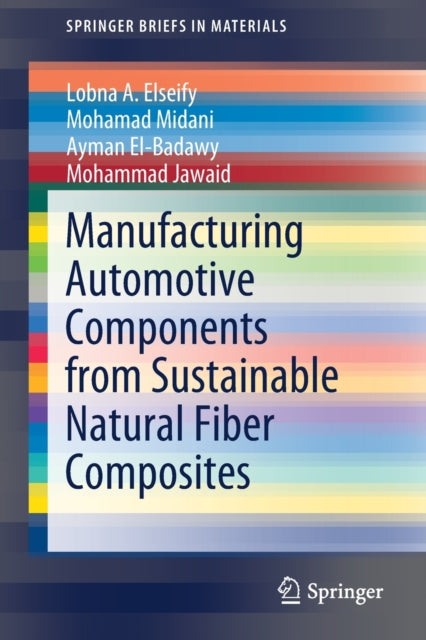
Lobna A. Elseify,Mohamad Midani,Ayman El-Badawy,Mohammad Jawaid
Manufacturing Automotive Components from Sustainable Natural Fiber Composites
Manufacturing Automotive Components from Sustainable Natural Fiber Composites
💎 Earn 227 Points (£2.27) on this item.
We can order this item for you. Delivery usually takes about 4 to 6 weeks.
This item is not held in our immediate stock. We will order it for you after checkout.
Estimated delivery: About 4 to 6 weeks
YOU SAVE £9.57
- Condition: Brand new
- UK Delivery times: Usually arrives within 2 - 3 working days
- UK Shipping: Fee starts at £2.39. Subject to product weight & dimension
Bulk ordering. Want 15 or more copies? Get a personalised quote and bigger discounts. Learn more about bulk orders.
Couldn't load pickup availability
- More about Manufacturing Automotive Components from Sustainable Natural Fiber Composites
This book explores the use of natural fiber composites (NFCs) in the automotive industry as a sustainable and lightweight alternative to conventional synthetic reinforcements. It provides a comprehensive review of NFCs from composite fabrication to recycling, covering key areas such as material selection, processing techniques, performance requirements, sustainability assessments, and future trends.
Format: Paperback / softback
Length: 83 pages
Publication date: 10 August 2021
Publisher: Springer Nature Switzerland AG
The automotive industry is undergoing a significant transformation, with the focus shifting from speed to low weight and sustainability. This shift has led major automakers and component suppliers to embrace natural fiber reinforcements for their composite components as a viable and eco-friendly alternative to traditional synthetic reinforcements. The primary objective of this book is to bridge the gap between academic literature and actual industry practices, offering a comprehensive and integrated review of the use of natural fiber composites (NFCs) in the automotive industry.
The book delves into various aspects of NFCs, including their history, material types, qualification programs, technical challenges, processing techniques, analysis of key components, sustainability assessments, and future trends. It serves as a valuable resource for academic researchers, providing them with a deep understanding of the current state-of-the-art in NFCs for automotive applications.
One of the key chapters in the book explores the history of NFCs in the automotive industry, tracing their development from early research efforts to their widespread adoption today. It discusses the key milestones and advancements that have shaped the NFC market, including the introduction of new materials, processing techniques, and performance standards.
The book also provides a detailed overview of the specific types of materials used in NFCs, including natural fibers such as hemp, flax, and kenaf, as well as synthetic fibers such as carbon fiber and aramid fiber. It discusses the advantages and disadvantages of each material, as well as their suitability for different automotive applications.
Material qualification programs are crucial in ensuring the quality and reliability of NFCs in automotive applications. The book discusses the various qualification programs and standards that have been developed to evaluate the performance and durability of NFCs, including ISO standards, ASTM standards, and automotive industry standards. It provides insights into the testing methodologies and criteria used to evaluate the properties of NFCs, such as mechanical strength, thermal resistance, and chemical resistance.
Technical challenges facing NFCs in the automotive industry include issues such as fiber reinforcement, matrix compatibility, and processing stability. The book explores these challenges in detail, providing insights into the research and development efforts underway to address them. It discusses the latest technologies and methodologies being used to improve the performance and reliability of NFCs, such as hybrid fiber reinforcement, nanocomposite matrices, and additive manufacturing.
Major technical challenges facing NFCs in the automotive industry include issues such as fiber reinforcement, matrix compatibility, and processing stability. The book explores these challenges in detail, providing insights into the research and development efforts underway to address them. It discusses the latest technologies and methodologies being used to improve the performance and reliability of NFCs, such as hybrid fiber reinforcement, nanocomposite matrices, and additive manufacturing.
Analysis of key NFC parts used in the automotive industry is another important aspect of the book. It discusses the performance requirements and design considerations for different components, such as body panels, interior components, and structural components. It provides examples of successful applications of NFCs in these areas, highlighting their advantages in terms of weight reduction, durability, and sustainability.
Sustainability assessments, including life cycle assessment and carbon footprint, are crucial in evaluating the environmental impact of NFCs in the automotive industry. The book discusses the methodologies and tools used to assess the sustainability of NFCs, including lifecycle analysis, carbon footprint analysis, and environmental impact assessment. It provides insights into the potential benefits and challenges of using NFCs in reducing greenhouse gas emissions and promoting sustainable development.
The book also explores future trends in the use of NFCs in the automotive industry. It discusses the emerging applications of NFCs, such as electric vehicles, autonomous vehicles, and hydrogen vehicles. It provides insights into the challenges and opportunities associated with these applications, as well as the research and development efforts underway to address them.
In conclusion, this book focuses on the use of natural fiber composites (NFCs) in the automotive industry, offering a comprehensive and integrated review of the current state-of-the-art in NFCs for automotive applications. It serves as a valuable resource for academic researchers, industry professionals, and policymakers interested in promoting sustainable and eco-friendly transportation solutions. The book provides a deep understanding of the history, materials, qualification programs, technical challenges, analysis of key components, sustainability assessments, and future trends of NFCs in the automotive industry, enabling readers to make informed decisions about the adoption of NFCs in their respective fields.
Weight: 163g
Dimension: 235 x 155 (mm)
ISBN-13: 9783030830243
Edition number: 1st ed. 2021
This item can be found in:
UK and International shipping information
UK and International shipping information
UK Delivery and returns information:
- Delivery within 2 - 3 days when ordering in the UK.
- Shipping fee for UK customers from £2.39. Fully tracked shipping service available.
- Returns policy: Return within 30 days of receipt for full refund.
International deliveries:
Shulph Ink now ships to Australia, Belgium, Canada, France, Germany, Ireland, Italy, India, Luxembourg Saudi Arabia, Singapore, Spain, Netherlands, New Zealand, United Arab Emirates, United States of America.
- Delivery times: within 5 - 10 days for international orders.
- Shipping fee: charges vary for overseas orders. Only tracked services are available for most international orders. Some countries have untracked shipping options.
- Customs charges: If ordering to addresses outside the United Kingdom, you may or may not incur additional customs and duties fees during local delivery.