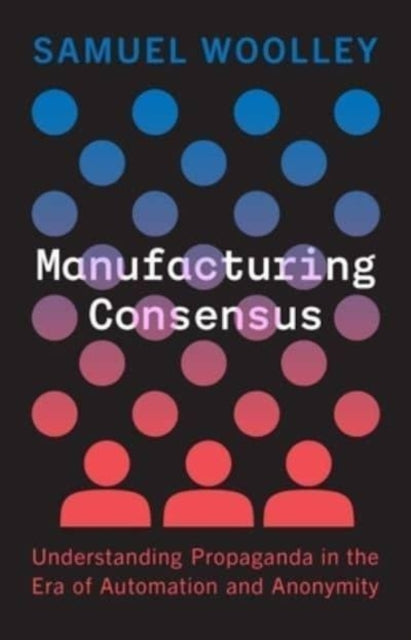
Samuel Woolley
Manufacturing Consensus: Understanding Propaganda in the Era of Automation and Anonymity
Manufacturing Consensus: Understanding Propaganda in the Era of Automation and Anonymity
💎 Earn 141 Points (£1.41) on this item.
YOU SAVE £1.68
- Condition: Brand new
- UK Delivery times: Usually arrives within 2 - 3 working days
- UK Shipping: Fee starts at £2.39. Subject to product weight & dimension
Bulk ordering. Want 15 or more copies? Get a personalised quote and bigger discounts. Learn more about bulk orders.
Couldn't load pickup availability
- More about Manufacturing Consensus: Understanding Propaganda in the Era of Automation and Anonymity
Social media has democratized propaganda, allowing nearly anyone to launch a sophisticated influence campaign. Samuel Woolley argues that social media allows groups to build the illusion of popularity through computational tools and human-driven efforts. He presents an extensive view of the evolution of computational propaganda and suggests pragmatic responses for policy makers, academics, and technologists.
Format: Hardback
Length: 232 pages
Publication date: 28 March 2023
Publisher: Yale University Press
Social media and emergent technology have revolutionized the landscape of propaganda, enabling a broader range of individuals and groups to launch sophisticated influence campaigns. Samuel Woolley argues that social media has democratized propaganda, allowing nearly anyone to launch a computationally enhanced influence campaign. With its anonymity and automation capabilities, social media enables diverse groups to create the illusion of popularity through tools like bots and human-driven efforts such as sockpuppets and partisan influencers. These technologies and strategies are used to create a bandwagon effect by bringing content into parallel discussions with legitimate users or molding discontent for political purposes.
Drawing on eight years of original international ethnographic research, Woolley provides an extensive view of the evolution of computational propaganda, offers insights into the future, and proposes pragmatic responses for policy makers, academics, technologists, and others.
The rise of social media has transformed the way propaganda is disseminated, allowing for a wider reach and more targeted messaging. Platforms like Facebook, Twitter, and Instagram have provided a platform for individuals and groups to share information, ideas, and opinions with a global audience. This has led to the emergence of new forms of propaganda, such as fake news, misinformation, and disinformation campaigns.
Fake news is a particularly concerning aspect of social media-driven propaganda. It involves the creation and dissemination of false or misleading information with the intention of influencing public opinion. Fake news can be spread quickly and widely through social media, and can have significant consequences for political and social outcomes. For example, fake news stories about election fraud or terrorist attacks can undermine public trust in institutions and lead to social unrest.
Misinformation is another form of social media-driven propaganda that can be just as damaging. It involves the spread of false or misleading information that is intended to confuse or mislead the public. Misinformation can be spread through social media, email, and other forms of communication, and can have significant consequences for public health, safety, and security. For example, misinformation about vaccines or medical treatments can lead to people avoiding necessary medical care or making poor health decisions.
Disinformation campaigns are a particularly insidious form of social media-driven propaganda. They involve the spread of false or misleading information with the intention of influencing public opinion or political outcomes. Disinformation campaigns can be launched by individuals, groups, or even state actors, and can be designed to target specific demographics or political ideologies. For example, disinformation campaigns during the 2016 US presidential election aimed to undermine public trust in the election system and influence the outcome of the election.
Social media has also enabled the emergence of new forms of propaganda that are more sophisticated and targeted than traditional forms of propaganda. For example, social media bots are computer programs that can automate the spread of propaganda on social media platforms. These bots can be programmed to target specific individuals or groups, and can spread propaganda quickly and widely. Social media bots can also be used to manipulate public opinion by creating the illusion of consensus or by amplifying certain messages.
Another form of social media-driven propaganda is the use of partisan influencers. Partisan influencers are individuals or groups who have a significant following on social media and who use their platform to promote a particular political ideology or political candidate. Partisan influencers can be highly effective in influencing public opinion, as they can use their platform to promote their messages and connect with their followers on a personal level.
Social media has also enabled the emergence of new forms of propaganda that are more personalized and targeted than traditional forms of propaganda. For example, social media algorithms can use data from users' social media profiles to target them with specific propaganda. This can include propaganda that is tailored to their political beliefs, interests, and behaviors. Social media algorithms can also be used to create echo chambers, where users are only exposed to propaganda that reinforces their existing beliefs.
The impact of social media-driven propaganda on public opinion is significant. Studies have shown that social media can influence public opinion in a variety of ways, including by shaping the way people think about issues, by influencing their emotions, and by influencing their behavior. For example, studies have shown that social media can influence people's voting behavior, by influencing their perceptions of political candidates and issues. Social media can also influence people's attitudes towards social issues, by shaping the way they think about and respond to these issues.
However, the impact of social media-driven propaganda on public opinion is not without its challenges. One of the challenges is the spread of false or misleading information. Social media platforms have been criticized for their role in the spread of fake news and misinformation, and for their failure to take sufficient measures to prevent the spread of these types of propaganda. Another challenge is the use of social media by state actors to manipulate public opinion and influence political outcomes. State actors can use social media to spread propaganda, to manipulate public opinion, and to influence political outcomes.
In response to these challenges, there have been calls for greater regulation of social media platforms. Some have argued that social media platforms should be required to take greater responsibility for the content that is posted on their platforms, and should be required to take measures to prevent the spread of false or misleading information. Others have argued that social media platforms should be required to take greater responsibility for the algorithms that they use to target users with propaganda.
In conclusion, social media and emergent technology have transformed the landscape of propaganda, enabling a broader range of individuals and groups to launch sophisticated influence campaigns. Social media has democratized propaganda, allowing nearly anyone to launch a computationally enhanced influence campaign. With its anonymity and automation capabilities, social media enables diverse groups to create the illusion of popularity through tools like bots and human-driven efforts such as sockpuppets and partisan influencers. The impact of social media-driven propaganda on public opinion is significant, but there are also challenges associated with the spread of false or misleading information and the use of social media by state actors to manipulate public opinion and influence political outcomes. In response to these challenges, there have been calls for greater regulation of social media platforms.
Weight: 376g
Dimension: 149 x 224 x 23 (mm)
ISBN-13: 9780300251234
UK and International shipping information
UK and International shipping information
UK Delivery and returns information:
- Delivery within 2 - 3 days when ordering in the UK.
- Shipping fee for UK customers from £2.39. Fully tracked shipping service available.
- Returns policy: Return within 30 days of receipt for full refund.
International deliveries:
Shulph Ink now ships to Australia, Belgium, Canada, France, Germany, Ireland, Italy, India, Luxembourg Saudi Arabia, Singapore, Spain, Netherlands, New Zealand, United Arab Emirates, United States of America.
- Delivery times: within 5 - 10 days for international orders.
- Shipping fee: charges vary for overseas orders. Only tracked services are available for most international orders. Some countries have untracked shipping options.
- Customs charges: If ordering to addresses outside the United Kingdom, you may or may not incur additional customs and duties fees during local delivery.