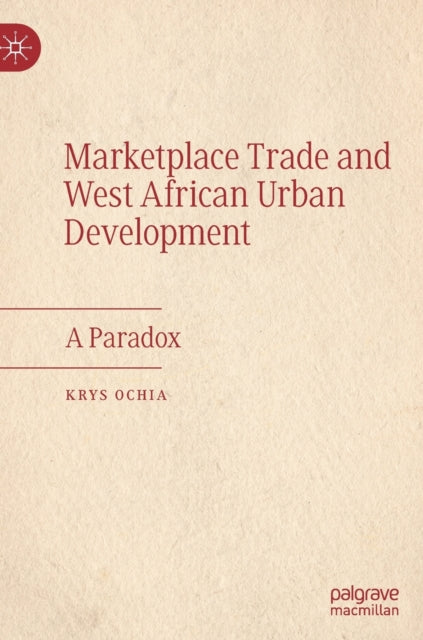
Krys Ochia
Marketplace Trade and West African Urban Development: A Paradox
Marketplace Trade and West African Urban Development: A Paradox
💎 Earn 371 Points (£3.71) on this item.
We can order this item for you. Delivery usually takes about 4 to 6 weeks.
This item is not held in our immediate stock. We will order it for you after checkout.
Estimated delivery: About 4 to 6 weeks
YOU SAVE £15.66
- Condition: Brand new
- UK Delivery times: Usually arrives within 2 - 3 working days
- UK Shipping: Fee starts at £2.39. Subject to product weight & dimension
Bulk ordering. Want 15 or more copies? Get a personalised quote and bigger discounts. Learn more about bulk orders.
Couldn't load pickup availability
- More about Marketplace Trade and West African Urban Development: A Paradox
This book explores how informal economy traders and marketplace institutions dominate the local economy in African cities, reducing the probability of entrepreneurship in the manufacturing sector. It stagnates the African informal sector while creating formal jobs overseas. However, there is limited knowledge of the men and women with permanent stalls in large urban marketplaces who are the major actors in distribute trade. Their daily out-of-stall contacts have significant unintended consequences on the urban mobility system, and researchers, planners, development practitioners, and policymakers have not focused their attention on this.
Format: Hardback
Length: 248 pages
Publication date: 21 December 2021
Publisher: Springer Nature Switzerland AG
This comprehensive book delves into the intricate dynamics of informal economy traders and marketplace institutions in African cities, shedding light on their profound influence on the local economy. According to the World Bank, the African continent bears a significant burden, as being African significantly decreases the likelihood of an individual venturing into entrepreneurship in the manufacturing sector by more than 95 percent. The export of unprocessed strategic raw materials and the import of vast quantities of finished goods stagnate the African informal sector, while simultaneously creating formal jobs abroad. This trend suggests that employment opportunities in distributive trade persist, and the marketplace institution plays a crucial role in mitigating urban unemployment and income inequality. However, there exists a limited understanding of the individuals who maintain permanent stalls in large urban marketplaces, functioning as temporary cities within cities. Despite their pivotal role in distributing trade, their daily out-of-stall contacts, stemming from the intricate social and economic relationships that shape the financial well-being of families, businesses, and the economy, remain largely unexplored and largely unknown. These contacts, which are the result of maintaining complex social and economic networks, hold significant unintended consequences for the urban mobility system.
Researchers, planners, development practitioners, and policymakers have overlooked the profound impacts of the powerful economic institution of marketplaces and traders in shaping transport planning processes and urban development policies. This paradoxical situation surrounding marketplace trade and urban development in West Africa highlights the need for a more comprehensive and inclusive approach to understanding the intricate relationships between these entities and urban development outcomes.
To address this gap, the book offers a comprehensive analysis of the role of informal economy traders and marketplace institutions in African cities. It explores the historical, cultural, and economic factors that contribute to the prevalence of informal trade, as well as the challenges and opportunities it presents. The book also examines the impact of these institutions on urban livelihoods, employment opportunities, and social mobility.
Furthermore, the book highlights the need for policymakers and development practitioners to consider the multifaceted impacts of informal economy traders and marketplace institutions in urban planning processes. It advocates for policies that promote inclusive economic growth, support entrepreneurship, and enhance the resilience of informal traders. The book also suggests strategies for integrating informal economy traders into the formal economy, while preserving their unique contributions to urban development.
In conclusion, this book provides a valuable contribution to the literature on urban development in Africa. By examining the complex interplay between informal economy traders and marketplace institutions, it sheds light on the challenges and opportunities facing African cities. It offers insights into the potential for promoting inclusive economic growth, enhancing social mobility, and improving urban livelihoods through a more nuanced and integrated approach to urban planning.
Weight: 473g
Dimension: 210 x 148 (mm)
ISBN-13: 9783030875558
Edition number: 1st ed. 2022
This item can be found in:
UK and International shipping information
UK and International shipping information
UK Delivery and returns information:
- Delivery within 2 - 3 days when ordering in the UK.
- Shipping fee for UK customers from £2.39. Fully tracked shipping service available.
- Returns policy: Return within 30 days of receipt for full refund.
International deliveries:
Shulph Ink now ships to Australia, Belgium, Canada, France, Germany, Ireland, Italy, India, Luxembourg Saudi Arabia, Singapore, Spain, Netherlands, New Zealand, United Arab Emirates, United States of America.
- Delivery times: within 5 - 10 days for international orders.
- Shipping fee: charges vary for overseas orders. Only tracked services are available for most international orders. Some countries have untracked shipping options.
- Customs charges: If ordering to addresses outside the United Kingdom, you may or may not incur additional customs and duties fees during local delivery.