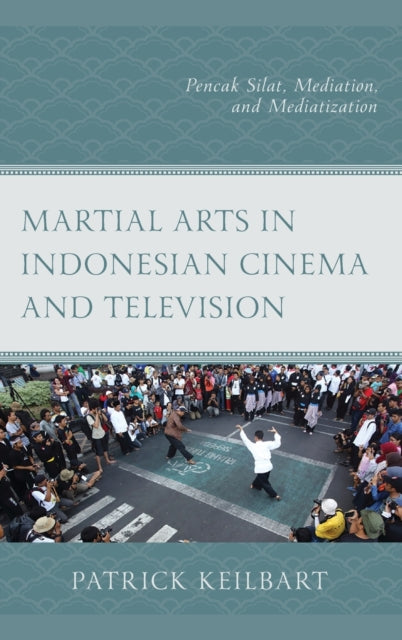
Patrick Keilbart
Martial Arts in Indonesian Cinema and Television: Pencak Silat, Mediation, and Mediatization
Martial Arts in Indonesian Cinema and Television: Pencak Silat, Mediation, and Mediatization
💎 Earn 584 Points (£5.84) on this item.
We can order this item for you. Delivery usually takes about 4 to 6 weeks.
This item is not held in our immediate stock. We will order it for you after checkout.
Estimated delivery: About 4 to 6 weeks
- Condition: Brand new
- UK Delivery times: Usually arrives within 2 - 3 working days
- UK Shipping: Fee starts at £2.39. Subject to product weight & dimension
Bulk ordering. Want 15 or more copies? Get a personalised quote and bigger discounts. Learn more about bulk orders.
Couldn't load pickup availability
- More about Martial Arts in Indonesian Cinema and Television: Pencak Silat, Mediation, and Mediatization
This book explores the Indonesian martial art Pencak Silat and its relationship with media practices, examining the potential influence of technology-based media on social advancement and cultural values. Through extensive fieldwork, it offers an ethnography of Pencak Silat and mediatization, contributing to martial arts studies and media studies.
Format: Hardback
Length: 364 pages
Publication date: 29 June 2021
Publisher: Lexington Books
This comprehensive book delves into the intricate world of Indonesian martial art, Pencak Silat, and its associated media practices. It goes beyond mere exploration by examining the potential influence of technology-based media on mediatization processes. Pencak Silat, a rich cultural system characterized by hierarchical structures, values, and beliefs, is intricately woven with embodied social learning, facilitating social advancement. This study makes significant contributions to martial arts studies and media studies, shedding light on the possibilities and limitations of media technologies in terms of their (dis-)embodiment and their embeddedness or detachment from specific socio-cultural contexts.
Given the widespread practice of Pencak Silat across Indonesia, encompassing a significant portion of the population, this thesis also holds significance for Indonesian studies. Through extensive fieldwork conducted between 2008 and 2016, the study provides a comprehensive analysis of martial arts and media in Indonesia, culminating in an ethnography of Pencak Silat and mediatization.
The book begins by providing an overview of Pencak Silat, its historical origins, and its significance within Indonesian culture. It then delves into the media practices associated with Pencak Silat, including film, television, and online platforms. The author examines how these media representations shape public perceptions, promote martial arts, and contribute to the broader mediatization process.
One of the key themes of the book is the (dis-)embodiment of media technologies. The author argues that media technologies, whether they are used for training, performance, or documentation, can either extend or reduce the body as a medium. For example, video recordings and online tutorials can provide valuable training opportunities for Pencak Silat practitioners, while social media platforms can facilitate the spread of martial arts knowledge and promote global connections.
However, the author also highlights the limitations of media technologies in terms of their ability to fully capture the essence of Pencak Silat. The physicality, movement, and sensory experiences of martial arts are difficult to replicate through digital media, and this can lead to misunderstandings and misrepresentations. The author emphasizes the importance of preserving the traditional practices and values of Pencak Silat while embracing the potential of technology to enhance communication and dissemination.
Another important aspect of the book is its examination of the embeddedness of media technologies in specific socio-cultural contexts. The author argues that media practices are not neutral or universal but are shaped by the cultural, social, and political dynamics of the societies in which they are produced and consumed. Pencak Silat, as a martial art with deep roots in Indonesian culture, is influenced by the country's history, religion, and social structures. The media representations of Pencak Silat, therefore, reflect these influences and contribute to the broader mediatization process.
The author also explores the role of media in promoting social change and empowerment. Pencak Silat, as a martial art that emphasizes self-defense, discipline, and respect, can serve as a tool for promoting gender equality, social justice, and community development. Through media representations, Pencak Silat practitioners can inspire and empower others, fostering a sense of community and belonging.
In conclusion, this book offers a comprehensive and insightful examination of Indonesian martial art, Pencak Silat, and its associated media practices. It demonstrates the potential of technology-based media to shape public perceptions, promote martial arts, and contribute to the broader mediatization process. At the same time, it raises important questions about the (dis-)embodiment of media technologies, their embeddedness in specific socio-cultural contexts, and their role in promoting social change and empowerment. This book will be of interest to scholars and practitioners in martial arts studies, media studies, and Indonesian studies, as well as anyone with an interest in the intersection of culture, technology, and social change.
Weight: 758g
Dimension: 228 x 161 x 28 (mm)
ISBN-13: 9781793627155
This item can be found in:
UK and International shipping information
UK and International shipping information
UK Delivery and returns information:
- Delivery within 2 - 3 days when ordering in the UK.
- Shipping fee for UK customers from £2.39. Fully tracked shipping service available.
- Returns policy: Return within 30 days of receipt for full refund.
International deliveries:
Shulph Ink now ships to Australia, Belgium, Canada, France, Germany, Ireland, Italy, India, Luxembourg Saudi Arabia, Singapore, Spain, Netherlands, New Zealand, United Arab Emirates, United States of America.
- Delivery times: within 5 - 10 days for international orders.
- Shipping fee: charges vary for overseas orders. Only tracked services are available for most international orders. Some countries have untracked shipping options.
- Customs charges: If ordering to addresses outside the United Kingdom, you may or may not incur additional customs and duties fees during local delivery.