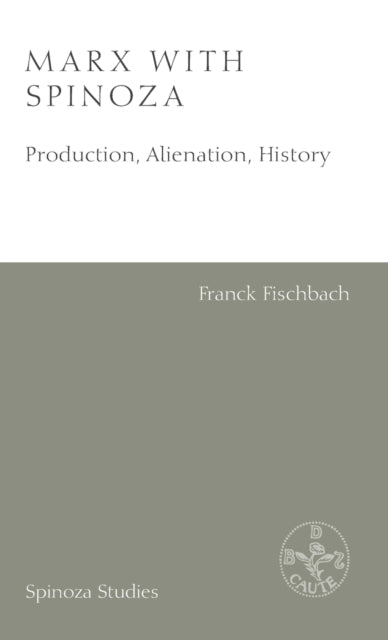
Franck Fischbach
Marx with Spinoza: Production, Alienation, History
Marx with Spinoza: Production, Alienation, History
💎 Earn 364 Points (£3.64) on this item.
We can order this item for you. Delivery usually takes about 4 to 6 weeks.
This item is not held in our immediate stock. We will order it for you after checkout.
Estimated delivery: About 4 to 6 weeks
YOU SAVE £22.13
- Condition: Brand new
- UK Delivery times: Usually arrives within 2 - 3 working days
- UK Shipping: Fee starts at £2.39. Subject to product weight & dimension
Bulk ordering. Want 15 or more copies? Get a personalised quote and bigger discounts. Learn more about bulk orders.
Couldn't load pickup availability
- More about Marx with Spinoza: Production, Alienation, History
A provocative study of the intersection of Spinoza and Marx that shows how their respective philosophies engage overlapping questions and problems. Offers the first translation of Fischbach's work into English and is the most important book published in France on Spinoza and Marx. Pairs these philosophers of production who are both critical philosophers of subjectivity. Presents a major study of the points of intersection in the thought of Spinoza and Marx. Develops original approaches to concepts such as alienation, history, and nature. Shows that by reading the two together, we may better understand both history and nature, as well as ourselves, making possible a new understanding of human nature.
Format: Hardback
Length: 168 pages
Publication date: 30 June 2023
Publisher: Edinburgh University Press
A thought-provoking exploration of the interplay between Spinoza and Marx reveals how their respective philosophies engage with overlapping questions and challenges. This book offers the first English translation of Franck Fischbach's seminal work, which is considered the most important publication on Spinoza and Marx in France. By juxtaposing these philosophers of production, who are both critical thinkers of subjectivity, the book presents a comprehensive study of the points of convergence in their thought. It develops innovative approaches to concepts such as alienation, history, and nature, offering a fresh perspective on human nature.
Contrary to initial impressions, Spinoza and Marx can be seen as two philosophers who share more than meets the eye. Spinoza, known for his fascination with eternal truths of nature, delved into the depths of understanding the fundamental essence of the universe. On the other hand, Marx, renowned for his interest in the history of capital, sought to unravel the intricacies of human society and its economic systems.
Franck Fischbach proposes that by reading Spinoza and Marx together, we can gain a deeper understanding of both history and nature, as well as ourselves. This interconnected approach allows for a novel understanding of human nature, transcending the traditional dichotomy between the two. Instead of perceiving history and nature as opposing forces, Fischbach suggests that history is merely the continuous transformation of nature. At the heart of this transformation lies a new understanding of alienation. Traditionally, alienation has been perceived as a loss of the self in a world of objects. However, Fischbach challenges this notion by suggesting that alienation is more accurately described as a loss of objects in a world that disconnects us from nature and social relations. This isolation, he argues, leads to a sense of loneliness and disconnection, leaving us as isolated subjects.
The isolated individual, as Spinoza put it, is not the condition of our liberation but rather the basis of our subjection. This realization prompts us to question the dominant narratives that perpetuate our sense of powerlessness and dependence. By recognizing the inherent connection between history, nature, and ourselves, we can cultivate a sense of agency and empowerment. We can break free from the chains of alienation and reclaim our place in the world, as active participants in the ongoing transformation of nature.
In conclusion, Spinoza and Marx: Philosophies of Production offers a groundbreaking exploration of the intersection of these two influential philosophers. By challenging traditional perspectives and developing innovative approaches, this book provides a valuable contribution to the study of human nature and social systems. It encourages us to reimagine our relationship with history, nature, and ourselves, and to embrace a sense of agency and empowerment that can lead to a more just and sustainable world.
Weight: 320g
Dimension: 222 x 140 x 19 (mm)
ISBN-13: 9781399507660
This item can be found in:
UK and International shipping information
UK and International shipping information
UK Delivery and returns information:
- Delivery within 2 - 3 days when ordering in the UK.
- Shipping fee for UK customers from £2.39. Fully tracked shipping service available.
- Returns policy: Return within 30 days of receipt for full refund.
International deliveries:
Shulph Ink now ships to Australia, Belgium, Canada, France, Germany, Ireland, Italy, India, Luxembourg Saudi Arabia, Singapore, Spain, Netherlands, New Zealand, United Arab Emirates, United States of America.
- Delivery times: within 5 - 10 days for international orders.
- Shipping fee: charges vary for overseas orders. Only tracked services are available for most international orders. Some countries have untracked shipping options.
- Customs charges: If ordering to addresses outside the United Kingdom, you may or may not incur additional customs and duties fees during local delivery.