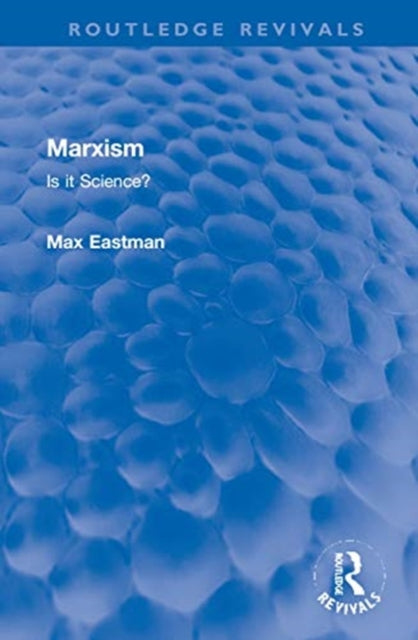
Max Eastman
Marxism: Is it Science?
Marxism: Is it Science?
💎 Earn 775 Points (£7.75) on this item.
We can order this item for you. Delivery usually takes about 4 to 6 weeks.
This item is not held in our immediate stock. We will order it for you after checkout.
Estimated delivery: About 4 to 6 weeks
- Condition: Brand new
- UK Delivery times: Usually arrives within 2 - 3 working days
- UK Shipping: Fee starts at £2.39. Subject to product weight & dimension
Bulk ordering. Want 15 or more copies? Get a personalised quote and bigger discounts. Learn more about bulk orders.
Couldn't load pickup availability
- More about Marxism: Is it Science?
Marxism: Is it Science? was published in 1941 and is divided into six parts to present Marxism and why the author considers it unscientific.
Format: Hardback
Length: 344 pages
Publication date: 01 December 2021
Publisher: Taylor & Francis Ltd
Marxism: Is It Science?
First published in 1941, Marxism: Is It Science? was written to present the author's criticisms of Marxism and, in doing so, to further exemplify his 'Method of Instruction' first proposed in an earlier work. The book is divided into six parts to provide six complete presentations of Marxism and why the author considers it unscientific. The six different approaches, varying in focus and complexity, work together to give the reader a detailed overview of Marxism and the author's critique of it.
Marxism, a socio-political and economic theory developed by Karl Marx and Friedrich Engels in the 19th century, has been a subject of intense debate and discussion. While Marxism has gained widespread popularity and influence, it has also faced significant criticism from various quarters. One of the most prominent criticisms of Marxism is its claim to be a scientific theory.
In Marxism: Is It Science?, the author aims to address this criticism by presenting his views on Marxism and why he considers it unscientific. The book is divided into six parts, each focusing on a different aspect of Marxism and its alleged unscientific nature.
Part 1: The Origins of Marxism
In this part, the author discusses the origins of Marxism and how it emerged as a response to the social and economic challenges of the 19th century. He argues that Marxism is not a scientific theory because it is based on a set of ideological assumptions and beliefs rather than empirical evidence. The author also criticizes Marxism for its lack of a coherent and consistent theoretical framework, which makes it difficult to test and validate its claims.
Part 2: The Dialectical Materialism of Marxism
In this part, the author discusses the dialectical materialism of Marxism, which is its central theoretical framework. He argues that dialectical materialism is not a scientific theory because it relies on the concept of historical materialism, which is not supported by empirical evidence. The author also criticizes dialectical materialism for its lack of a mechanism to explain the emergence and development of social structures and institutions.
Part 3: The Labor Theory of Value of Marxism
In this part, the author discusses the labor theory of value of Marxism, which is its economic theory. He argues that the labor theory of value is not a scientific theory because it is based on the concept of surplus value, which is not supported by empirical evidence. The author also criticizes the labor theory of value for its lack of a mechanism to explain the distribution of wealth and income in society.
Part 4: The Historical Materialism of Marxism
In this part, the author discusses the historical materialism of Marxism, which is its historical theory. He argues that historical materialism is not a scientific theory because it relies on the concept of class struggle, which is not supported by empirical evidence. The author also criticizes historical materialism for its lack of a mechanism to explain the development of human societies.
Part 5: The Critique of Capitalism of Marxism
In this part, the author discusses the critique of capitalism of Marxism, which is its political theory. He argues that the critique of capitalism is not a scientific theory because it relies on the concept of class struggle, which is not supported by empirical evidence. The author also criticizes the critique of capitalism for its lack of a mechanism to explain the development of social and economic inequality.
Part 6: The Future of Marxism
In this part, the author discusses the future of Marxism and its potential for development. He argues that Marxism has the potential to be a scientific theory if it is revised and updated to incorporate new empirical evidence and theoretical insights. The author also criticizes Marxism for its lack of a mechanism to explain the development of new social and economic structures and institutions.
In conclusion, Marxism: Is It Science? is a valuable contribution to the debate on Marxism and its alleged unscientific nature. The author presents his criticisms of Marxism in a clear and concise manner, using a variety of approaches to provide a detailed overview of Marxism and its alleged unscientific nature. While Marxism has gained widespread popularity and influence, it is important to recognize its limitations and to approach it with a critical and open mind.
Weight: 812g
Dimension: 234 x 156 (mm)
ISBN-13: 9780367751197
This item can be found in:
UK and International shipping information
UK and International shipping information
UK Delivery and returns information:
- Delivery within 2 - 3 days when ordering in the UK.
- Shipping fee for UK customers from £2.39. Fully tracked shipping service available.
- Returns policy: Return within 30 days of receipt for full refund.
International deliveries:
Shulph Ink now ships to Australia, Belgium, Canada, France, Germany, Ireland, Italy, India, Luxembourg Saudi Arabia, Singapore, Spain, Netherlands, New Zealand, United Arab Emirates, United States of America.
- Delivery times: within 5 - 10 days for international orders.
- Shipping fee: charges vary for overseas orders. Only tracked services are available for most international orders. Some countries have untracked shipping options.
- Customs charges: If ordering to addresses outside the United Kingdom, you may or may not incur additional customs and duties fees during local delivery.