Stefan Sandfeld
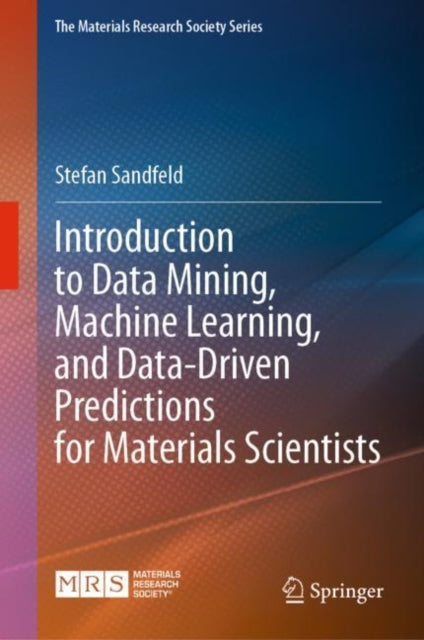
Materials Data Science: Introduction to Data Mining, Machine Learning, and Data-Driven Predictions for Materials Science and Engineering
Materials Data Science: Introduction to Data Mining, Machine Learning, and Data-Driven Predictions for Materials Science and Engineering
YOU SAVE £16.16
- Condition: Brand new
- UK Delivery times: Usually arrives within 2 - 3 working days
- UK Shipping: Fee starts at £3.89. Subject to product weight & dimension
Bulk ordering. Want 15 or more copies? Get a personalised quote and bigger discounts. Learn more about bulk orders.
Couldn't load pickup availability
- More about Materials Data Science: Introduction to Data Mining, Machine Learning, and Data-Driven Predictions for Materials Science and Engineering
This text is a comprehensive guide to data science, machine learning, and deep learning for materials science and engineering, with implementations in Python and NumPy. It covers statistics, machine learning, unsupervised learning, neural networks, and deep learning, providing a primer for students and a review for researchers.
Format: Hardback
Length: 618 pages
Publication date: 09 May 2024
Publisher: Springer International Publishing AG
This comprehensive text delves into the realm of data science, machine learning, and deep learning, offering a wealth of knowledge and applications relevant to materials science and engineering. It encompasses a wide range of topics, providing detailed explanations and practical examples using Python and NumPy. The book begins by introducing fundamental statistical concepts and probability distributions, including random variables, Bayes theorem, correlations, sampling techniques, and exploratory data analysis. These concepts are contextualized within the realm of materials science and engineering, making it an invaluable resource for both undergraduate and graduate students, as well as research scientists and practicing engineers.
The second part of the book focuses on statistical machine learning, providing a thorough introduction to fundamental concepts and exploring a diverse array of supervised learning techniques. These techniques encompass regression and classification tasks, with an emphasis on advanced methods such as kernel regression, support vector machines, and neural networks. The section on unsupervised learning delves into principal component analysis, manifold learning (t-SNE and UMAP), and clustering techniques. Additionally, feature engineering, feature importance, and cross-validation are introduced, providing valuable tools for data preprocessing and model selection.
The final part of the book aims to demystify neural networks and deep learning, presenting them as powerful tools for solving complex problems. The complexity of the material gradually increases, enabling the implementation of fully connected networks. Advanced techniques, such as generative adversarial networks (GANs), are implemented "from scratch" using Python and NumPy, providing a deep understanding of the underlying principles and enabling users to conduct their own experiments in this field.
Throughout the book, numerous examples and applications are provided to illustrate the concepts and techniques discussed. These examples range from materials characterization and property prediction to image processing and pattern recognition, showcasing the versatility field's wide-ranging applications. The book is well-organized, with clear explanations and concise code snippets that facilitate a seamless understanding of the material. It also includes a comprehensive bibliography and references for further reading, allowing readers to explore specific topics in greater detail.
In conclusion, this text serves as a valuable resource for anyone interested in advancing their knowledge and expertise in data science, machine learning, and deep learning, particularly in the context of materials science and engineering. Its comprehensive coverage, practical examples, and "from scratch" implementation using Python and NumPy make it an essential tool for students, researchers, and practitioners alike. By delving into the complexities of these fields, this book empowers readers to unlock the full potential of data-driven approaches and make meaningful contributions to the field of materials science and engineering.
Dimension: 235 x 155 (mm)
ISBN-13: 9783031465642
UK and International shipping information
UK and International shipping information
We deliver throughout the United Kingdom and to 128 countries and territories worldwide, including the United States, Australia, Canada, Germany, Spain and France.