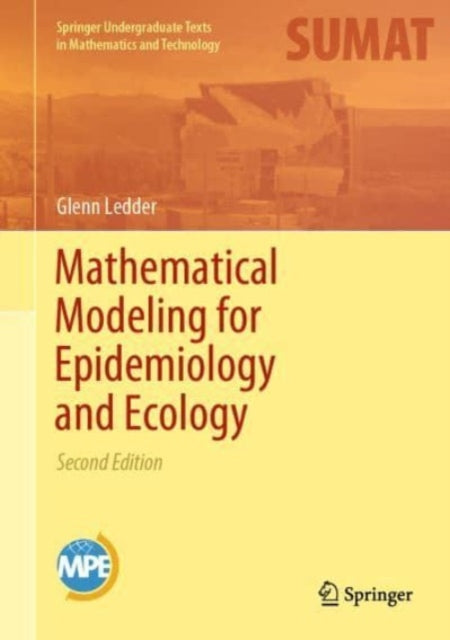
Glenn Ledder
Mathematical Modeling for Epidemiology and Ecology
Mathematical Modeling for Epidemiology and Ecology
💎 Earn 227 Points (£2.27) on this item.
YOU SAVE £9.57
- Condition: Brand new
- UK Delivery times: Usually arrives within 2 - 3 working days
- UK Shipping: Fee starts at £2.39. Subject to product weight & dimension
Bulk ordering. Want 15 or more copies? Get a personalised quote and bigger discounts. Learn more about bulk orders.
Couldn't load pickup availability
- More about Mathematical Modeling for Epidemiology and Ecology
Mathematical Modeling for Epidemiology and Ecology is a book that provides readers with the mathematical tools needed to understand and use mathematical models and read advanced mathematical biology books. It presents mathematics in biological contexts, focusing on the central mathematical ideas and the biological implications, with detailed explanations. The author assumes no mathematics background beyond elementary differential calculus, and the book is divided into two halves: empirical modeling and mechanistic modeling. The second half of the book focuses on analysis of dynamical systems, emphasizing tools to simplify analysis. The biological content is self-contained and includes many topics in epidemiology and ecology, with case studies and problem sets. New appendices contain mathematical details on optimization, numerical solution of differential equations, scaling, linearization, and sophisticated use of elementary algebra to simplify problems.
Format: Hardback
Length: 364 pages
Publication date: 05 April 2023
Publisher: Springer International Publishing AG
Mathematical Modeling for Epidemiology and Ecology is an essential guide for readers seeking to understand and apply mathematical models in the fields of epidemiology and ecology. Written by a renowned expert in the field, the book provides a comprehensive introduction to mathematical modeling, covering both basic principles and advanced techniques.
The first chapter of the book introduces the fundamental concepts of mathematical modeling, including linear algebra, differential equations, and optimization. It explains how these tools can be used to represent and analyze biological systems, such as populations, diseases, and ecosystems. The author emphasizes the importance of understanding the underlying assumptions and principles of each model, as well as the potential limitations and biases associated with different approaches.
Chapters on empirical modeling and mechanistic modeling follow, each providing a detailed treatment of key ideas and techniques in these areas. The author discusses the use of statistical models, such as regression analysis and logistic regression, to estimate the parameters of mathematical models and to make predictions about the outcomes of interest. He also explores the use of deterministic models, such as ordinary differential equations and stochastic differential equations, to simulate the behavior of biological systems and to analyze their dynamics.
The second half of the book focuses on the analysis of dynamical systems, emphasizing tools to simplify analysis, such as the Routh-Hurwitz conditions and asymptotic analysis. The author discusses the use of these tools to analyze the stability and behavior of biological systems, as well as to predict the effects of interventions and environmental changes. He also includes case studies and examples from epidemiology and ecology, such as the spread of diseases, the dynamics of populations, and the harvesting of natural resources.
One of the unique features of this book is its emphasis on linking problems. The problem sets feature linked problems where one biological setting appears in multi-step problems that are sorted into the appropriate section. This allows readers to gradually develop complete investigations of topics such as HIV immunology and harvesting of natural resources. Some problems use programs written by the author for Matlab or Octave, combining traditional mathematical exercises with computational exercises to give students a comprehensive understanding of the subject.
Overall, Mathematical Modeling for Epidemiology and Ecology is an invaluable resource for students, researchers, and practitioners in the fields of epidemiology and ecology. It provides a comprehensive and up-to-date introduction to mathematical modeling, covering both basic principles and advanced techniques. With its emphasis on linking problems and real-world applications, the book is sure to inspire and motivate readers to explore the exciting world of mathematical modeling in these fields.
Dimension: 254 x 178 (mm)
ISBN-13: 9783031094538
Edition number: 2nd ed. 2023
This item can be found in:
UK and International shipping information
UK and International shipping information
UK Delivery and returns information:
- Delivery within 2 - 3 days when ordering in the UK.
- Shipping fee for UK customers from £2.39. Fully tracked shipping service available.
- Returns policy: Return within 30 days of receipt for full refund.
International deliveries:
Shulph Ink now ships to Australia, Belgium, Canada, France, Germany, Ireland, Italy, India, Luxembourg Saudi Arabia, Singapore, Spain, Netherlands, New Zealand, United Arab Emirates, United States of America.
- Delivery times: within 5 - 10 days for international orders.
- Shipping fee: charges vary for overseas orders. Only tracked services are available for most international orders. Some countries have untracked shipping options.
- Customs charges: If ordering to addresses outside the United Kingdom, you may or may not incur additional customs and duties fees during local delivery.