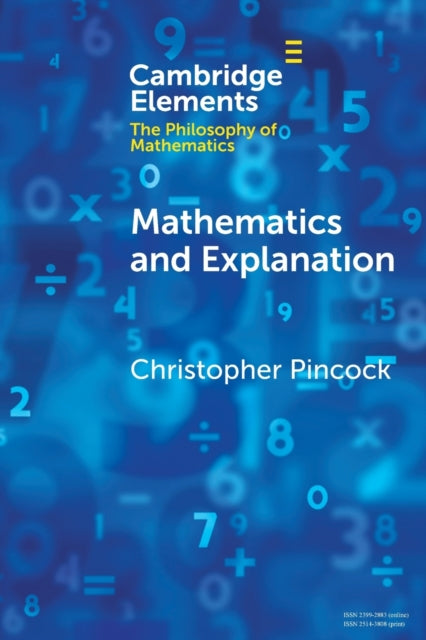
ChristopherPincock
Mathematics and Explanation
Mathematics and Explanation
💎 Earn 84 Points (£0.84) on this item.
We can order this item for you. Delivery usually takes about 4 to 6 weeks.
This item is not held in our immediate stock. We will order it for you after checkout.
Estimated delivery: About 4 to 6 weeks
YOU SAVE £1.01
- Condition: Brand new
- UK Delivery times: Usually arrives within 2 - 3 working days
- UK Shipping: Fee starts at £2.39. Subject to product weight & dimension
Bulk ordering. Want 15 or more copies? Get a personalised quote and bigger discounts. Learn more about bulk orders.
Couldn't load pickup availability
- More about Mathematics and Explanation
Mathematics is essential for scientific explanation, but traditional monist theories need to be more flexible to clarify how it can help. Pluralism about explanation is best equipped to explain how mathematics can help in science and mathematics itself. The mathematical elements of an explanation can be integrated into the physical world through evidence such as the explanatory power it would afford if it existed.
Format: Paperback / softback
Length: 75 pages
Publication date: 25 May 2023
Publisher: Cambridge University Press
This Element answers four questions. Can any traditional theory of scientific explanation make sense of the place of mathematics in explanation? If traditional monist theories are inadequate, is there some way to develop a more flexible, but still monist, approach that will clarify how mathematics can help to explain? What sort of pluralism about explanation is best equipped to clarify how mathematics can help to explain in science and in mathematics itself? Finally, how can the mathematical elements of an explanation be integrated into the physical world?
Some of the evidence for a novel scientific posit may be traced to the explanatory power that this posit would afford, were it to exist. Can a similar kind of explanatory evidence be provided for the existence of mathematical objects, and if not, why not?
Traditional theories of scientific explanation have struggled to account for the role of mathematics in explanation. Monist theories, which hold that everything in the universe is ultimately reducible to a single substance or principle, have been inadequate in explaining the explanatory power of mathematics. While some philosophers have proposed pluralist approaches to explanation, which allow for multiple explanations to coexist, these approaches have also failed to provide a clear account of how mathematics can help to explain.
One way to develop a more flexible, but still monist, approach to explanation is to adopt a pluralist metaphysics. Pluralist metaphysics holds that there are multiple fundamental levels of reality, each with its own set of laws and principles. This approach allows for the possibility that mathematics can explain at different levels of reality, such as the logical level or the physical level.
Another way to clarify how mathematics can help to explain is to develop a more precise understanding of the nature of mathematical objects. Mathematical objects are not physical objects, but they are abstract entities that exist in the mind of the mathematician. However, mathematical objects can have real effects on the physical world, such as when mathematical models are used to predict the behavior of natural systems.
To integrate the mathematical elements of an explanation into the physical world, it is necessary to develop a more coherent account of the relationship between mathematics and the physical world. This account may involve developing a new metaphysical framework that incorporates both mathematics and the physical world, or it may involve developing a more precise understanding of the relationship between mathematics and the physical world based on existing theories.
In conclusion, the place of mathematics in explanation is a complex and challenging issue that has been the subject of much debate and discussion. While traditional theories of scientific explanation have struggled to account for the explanatory power of mathematics, there are ways to develop a more flexible, but still monist, approach to explanation that can clarify how mathematics can help to explain. By adopting a pluralist metaphysics and developing a more precise understanding of the nature of mathematical objects, it is possible to integrate the mathematical elements of an explanation into the physical world. However, further research and development are necessary to fully understand the relationship between mathematics and the physical world.
Weight: 142g
Dimension: 150 x 229 x 8 (mm)
ISBN-13: 9781009017664
This item can be found in:
UK and International shipping information
UK and International shipping information
UK Delivery and returns information:
- Delivery within 2 - 3 days when ordering in the UK.
- Shipping fee for UK customers from £2.39. Fully tracked shipping service available.
- Returns policy: Return within 30 days of receipt for full refund.
International deliveries:
Shulph Ink now ships to Australia, Belgium, Canada, France, Germany, Ireland, Italy, India, Luxembourg Saudi Arabia, Singapore, Spain, Netherlands, New Zealand, United Arab Emirates, United States of America.
- Delivery times: within 5 - 10 days for international orders.
- Shipping fee: charges vary for overseas orders. Only tracked services are available for most international orders. Some countries have untracked shipping options.
- Customs charges: If ordering to addresses outside the United Kingdom, you may or may not incur additional customs and duties fees during local delivery.