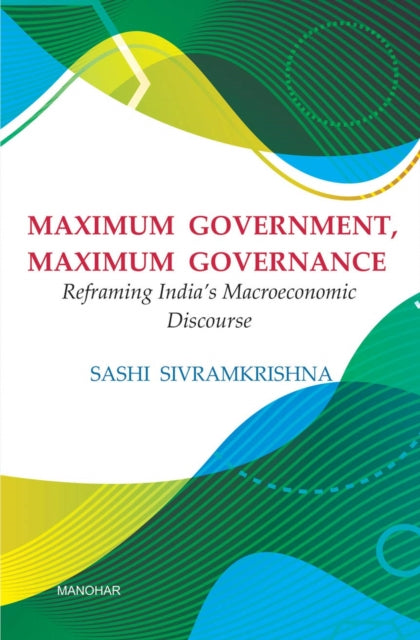
Sashi Sivramkrishna
Maximum Government, Maximum Governance: Reframing India's Macroeconomic
Maximum Government, Maximum Governance: Reframing India's Macroeconomic
💎 Earn 243 Points (£2.43) on this item.
- Condition: Brand new
- UK Delivery times: Usually arrives within 2 - 3 working days
- UK Shipping: Fee starts at £2.39. Subject to product weight & dimension
Bulk ordering. Want 15 or more copies? Get a personalised quote and bigger discounts. Learn more about bulk orders.
Couldn't load pickup availability
- More about Maximum Government, Maximum Governance: Reframing India's Macroeconomic
Austerity, fiscal consolidation, fiscal discipline, and fiscal deficit targets have become the buzzwords of contemporary macroeconomic policy, but neoliberal macroeconomics has dislodged full employment as the target of policy, replacing it with a low and stable inflation target. Monetary policy under the control of an independent central Bank became the primary instrument to assist free and globalized markets to propel economies towards full employment.
Format: Hardback
Length: 238 pages
Publication date: 15 September 2023
Publisher: Manohar Publishers and Distributors
Austerity, fiscal consolidation, fiscal discipline, and fiscal deficit targets have become the buzzwords of contemporary macroeconomic policy. By tracing the history of macroeconomic schools of thought, Maximum Government, Maximum Governance explores the origins, essence, shortcomings, and deception of mainstream neoliberal macroeconomics. Arguing that economies are financially constrained, neoliberal macroeconomics dislodged full employment as the target of policy, replacing it with a low and stable inflation target. Monetary policy under the control of an independent central bank became the primary instrument to assist free and globalized markets to propel economies towards full employment.
Austerity, Fiscal Consolidation, Fiscal Discipline, and Fiscal Deficit Targets: The Buzzwords of Contemporary Macroeconomic Policy
In recent years, austerity, fiscal consolidation, fiscal discipline, and fiscal deficit targets have become the center of attention in macroeconomic policy discussions. These terms have gained prominence as governments around the world seek to address economic challenges and achieve sustainable growth. However, the origins, essence, shortcomings, and deception of mainstream neoliberal macroeconomics have been a subject of debate for many years.
Maximum Government, Maximum Governance: Exploring the Origins, Essence, Shortcomings, and Deception of Mainstream Neoliberal Macroeconomics
One of the key concepts in neoliberal macroeconomics is the idea of maximum government. This concept suggests that governments should intervene in the economy to achieve full employment and price stability. However, the reality of neoliberal macroeconomics is quite different. Neoliberal macroeconomics dislodged full employment as the target of policy, replacing it with a low and stable inflation target. This shift in focus has had significant consequences for the global economy.
Monetary Policy under the Control of an Independent Central Bank: The Primary Instrument to Assist Free and Globalized Markets to Propel Economies Towards Full Employment
Monetary policy under the control of an independent central bank became the primary instrument to assist free and globalized markets to propel economies towards full employment. The central bank's role was to control the money supply and interest rates to achieve price stability and promote economic growth. However, the effectiveness of monetary policy has been questioned in recent years. Some argue that the central bank's policies have been too restrictive, leading to low inflation and slow economic growth. Others argue that the central bank's policies have been too loose, leading to high inflation and financial instability.
The Impact of Neoliberal Macroeconomics on the Global Economy
Neoliberal macroeconomics has had a significant impact on the global economy. It has led to the deregulation of financial markets, the privatization of public services, and the reduction of government spending. These policies have been criticized for their negative impact on the poor and middle class. For example, the deregulation of financial markets has led to the creation of financial bubbles, which have resulted in economic crises such as the global financial crisis of 2008. The privatization of public services has led to the reduction of public services and the increase in private sector profits. The reduction of government spending has led to the reduction of public services and the increase in private sector profits.
The Need for Alternative Macroeconomic Policies
In response to the shortcomings of neoliberal macroeconomics, there has been a growing need for alternative macroeconomic policies. These policies aim to address the social and economic inequalities that have been created by neoliberal policies. Alternative macroeconomic policies include progressive taxation, social welfare programs, and labor market reforms. Progressive taxation aims to redistribute wealth from the rich to the poor, while social welfare programs aim to provide support to the poor and middle class. Labor market reforms aim to increase job opportunities and improve the quality of work.
Conclusion
In conclusion, austerity, fiscal consolidation, fiscal discipline, and fiscal deficit targets have become the buzzwords of contemporary macroeconomic policy. While neoliberal macroeconomics has had some successes, it has also had significant shortcomings and deception. Alternative macroeconomic policies are needed to address the social and economic inequalities that have been created by neoliberal policies. By implementing these policies, we can create a more equitable and sustainable global economy.
Dimension: 254 x 203 (mm)
ISBN-13: 9789388540056
This item can be found in:
UK and International shipping information
UK and International shipping information
UK Delivery and returns information:
- Delivery within 2 - 3 days when ordering in the UK.
- Shipping fee for UK customers from £2.39. Fully tracked shipping service available.
- Returns policy: Return within 30 days of receipt for full refund.
International deliveries:
Shulph Ink now ships to Australia, Belgium, Canada, France, Germany, Ireland, Italy, India, Luxembourg Saudi Arabia, Singapore, Spain, Netherlands, New Zealand, United Arab Emirates, United States of America.
- Delivery times: within 5 - 10 days for international orders.
- Shipping fee: charges vary for overseas orders. Only tracked services are available for most international orders. Some countries have untracked shipping options.
- Customs charges: If ordering to addresses outside the United Kingdom, you may or may not incur additional customs and duties fees during local delivery.