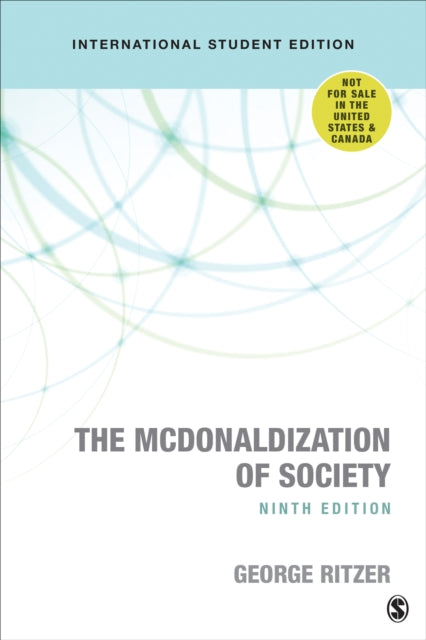
George Ritzer
McDonaldization of Society: Into the Digital Age
McDonaldization of Society: Into the Digital Age
💎 Earn 215 Points (£2.15) on this item.
YOU SAVE £1.99
- Condition: Brand new
- UK Delivery times: Usually arrives within 2 - 3 working days
- UK Shipping: Fee starts at £2.39. Subject to product weight & dimension
Bulk ordering. Want 15 or more copies? Get a personalised quote and bigger discounts. Learn more about bulk orders.
Couldn't load pickup availability
- More about McDonaldization of Society: Into the Digital Age
McDonaldization is a concept that explains how fast food restaurants have become the model for rationalization in the late 20th and early 21st centuries. It examines how these businesses have created a system of operation based on efficiency, calculability, predictability, and control, and how the same principles have been applied to other settings.
Format: Paperback / softback
Length: 272 pages
Publication date: 11 April 2018
Publisher: SAGE Publications Inc
In this essential work, Max Weber's rationalization thesis is brought to the late 20th and early 21st centuries, where Weber primarily focused on bureaucracies as the iron cages of rationalization in his era. However, the central premise of McDonaldization is that the fast food restaurant has emerged as the model for the rationalization process of today.
The book delves into the ways in which fast food businesses have established a system of operation that revolves around efficiency, calculability, predictability, and control. These principles have been applied to various settings and contexts, ranging from motel chains to big box stores, churches, child care centers, college rankings, health care providers, the Internet, and political participation. The author also explores attempts to resist and reverse the effects of McDonaldization, a term that has become integral to contemporary sociological theory.
McDonaldization is characterized by the standardization of products, services, and processes, as well as the reduction of individuality. This has led to a homogenization of culture, where the same standardized experiences and expectations are replicated across different locations and contexts. The book argues that this has had significant consequences for individuals and society as a whole, including the loss of local identity, the erosion of traditional values, and the increased dominance of corporate interests.
One of the key themes of McDonaldization is the role of technology in driving rationalization. The fast food restaurant industry has been at the forefront of adopting new technologies, such as automation, computerized ordering systems, and data analytics, to increase efficiency and reduce costs. These technologies have also enabled McDonald's to track and analyze customer behavior, allowing them to tailor their products and services to individual preferences.
However, McDonaldization has also been criticized for its negative effects on health and well-being. Fast food restaurants are often associated with high levels of obesity, diabetes, and other chronic health conditions, due to their high-fat, high-sugar, and low-nutrient content. The book argues that this has contributed to a broader societal health crisis, as individuals are increasingly relying on fast food as a staple of their diet, leading to a decline in overall health and well-being.
In response to these criticisms, there have been attempts to resist and reverse the effects of McDonaldization. One approach is to promote local and sustainable food systems, which prioritize the production and consumption of fresh, healthy, and locally sourced food. This includes initiatives such as farmers' markets, community gardens.
Another approach is to advocate for more ethical and responsible business practices, such as fair labor practices, environmental sustainability, and social responsibility. This includes initiatives such as the Fair Trade movement, which aims to ensure that workers in developing countries are paid fair wages and working conditions, and the Sustainable Development Goals, which aim to address global challenges such as poverty, inequality, and climate change.
In conclusion, McDonaldization is a powerful and influential concept that has transformed the way to understand the rationalization process in contemporary society. The book provides a comprehensive analysis of the ways in which fast food businesses have created a system of operation based on efficiency, calculability, predictability, and control, and how the same principles have been applied to various settings and contexts. It also explores the negative effects of McDonaldization on health and well-being, and the efforts to resist and reverse these effects. By understanding the principles of McDonaldization, we can better appreciate the challenges and opportunities facing contemporary society, and work towards creating a more sustainable and equitable future.
Weight: 496g
Dimension: 154 x 229 x 20 (mm)
ISBN-13: 9781544327549
Edition number: 9 Revised edition
This item can be found in:
UK and International shipping information
UK and International shipping information
UK Delivery and returns information:
- Delivery within 2 - 3 days when ordering in the UK.
- Shipping fee for UK customers from £2.39. Fully tracked shipping service available.
- Returns policy: Return within 30 days of receipt for full refund.
International deliveries:
Shulph Ink now ships to Australia, Belgium, Canada, France, Germany, Ireland, Italy, India, Luxembourg Saudi Arabia, Singapore, Spain, Netherlands, New Zealand, United Arab Emirates, United States of America.
- Delivery times: within 5 - 10 days for international orders.
- Shipping fee: charges vary for overseas orders. Only tracked services are available for most international orders. Some countries have untracked shipping options.
- Customs charges: If ordering to addresses outside the United Kingdom, you may or may not incur additional customs and duties fees during local delivery.