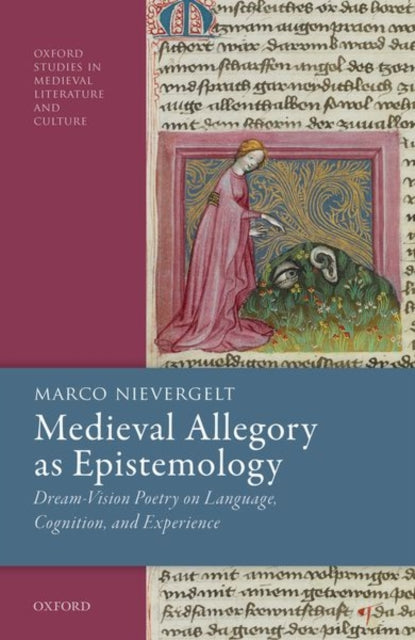
MarcoNievergelt
Medieval Allegory as Epistemology: Dream-Vision Poetry on Language, Cognition, and Experience
Medieval Allegory as Epistemology: Dream-Vision Poetry on Language, Cognition, and Experience
💎 Earn 703 Points (£7.03) on this item.
We can order this item for you. Delivery usually takes about 4 to 6 weeks.
This item is not held in our immediate stock. We will order it for you after checkout.
Estimated delivery: About 4 to 6 weeks
- Condition: Brand new
- UK Delivery times: Usually arrives within 2 - 3 working days
- UK Shipping: Fee starts at £2.39. Subject to product weight & dimension
Bulk ordering. Want 15 or more copies? Get a personalised quote and bigger discounts. Learn more about bulk orders.
Couldn't load pickup availability
- More about Medieval Allegory as Epistemology: Dream-Vision Poetry on Language, Cognition, and Experience
Late medieval dream-poetry used allegorical fiction to explore philosophical questions about human knowledge, focusing on three widely read poems: Jean de Meun's Roman de la Rose, Guillaume de Deguileville's Pélerinages trilogy, and William Langland's vision of Piers Plowman. This study assesses their cultural and intellectual significance in the context of broader developments in late medieval philosophy. Vernacular literature also played an important role in lending an enlarged cultural resonance to philosophical ideas.
Format: Hardback
Length: 576 pages
Publication date: 13 April 2023
Publisher: Oxford University Press
In Medieval Allegory as Epistemology, Marco Nievergelt explores the profound philosophical inquiries into the nature of human knowledge that were made possible by late medieval dream poetry. The focus of this study lies in three of the most widely read and influential poems of the later Middle Ages: Jean de Meun's Roman de la Rose, the Pélerinages trilogy of Guillaume de Deguileville, and William Langland's vision of Piers Plowman in its various versions. These poets grapple with a set of shared, closely related epistemological problems that emerged in Western Europe during the thirteenth century, in the wake of the reception of Aristotle's complete works on logic and the natural sciences. This study not only examines the intertextual and literary-historical relations linking the work of these three poets but also takes their shared interest in cognition and epistemology as a starting point to assess their wider cultural and intellectual significance in the context of broader developments in late medieval philosophy of mind, knowledge, and language.
Vernacular literature played a crucial role in lending an enlarged cultural resonance to philosophical ideas developed by scholastic thinkers. However, it is also demonstrated that allegorical narrative could prompt philosophical speculation on its own terms, deliberately interrogating the dominance and authority of scholastic discourses and institutions by using first-person fictional narrative as a tool for intellectual speculation.
Jean de Meun's Roman de la Rose is a masterpiece of medieval dream poetry that explores the nature of love and desire. The poem is filled with vivid imagery and symbolic language, which allows Nievergelt to delve into complex philosophical questions about the nature of knowledge and reality. Through the allegorical narrative of the rose, de Meun questions the reliability of human perception and the validity of our moral judgments. He suggests that our perceptions are often clouded by our emotions and desires, leading us to mistake the appearance of things for their true nature.
The Pélerinages trilogy of Guillaume de Deguileville is another influential work of medieval dream poetry. The trilogy consists of three books: The Pilgrim's Progress, The Life of St. Anthony, and The Pélerinage of the Soul. De Guileville uses the allegorical narrative of a pilgrim's journey to explore the nature of faith, repentance, and salvation. The pilgrim's journey is filled with trials and tribulations, which allow de Guileville to examine the limitations of human reason and the power of divine grace.
William Langland's vision of Piers Plowman is a sprawling epic poem that tells the story of a knight's journey through the world. The poem is filled with allegorical characters and symbols, which allow Langland to explore the nature of good and evil, justice, and redemption. Langland's vision of Piers Plowman is a complex and multifaceted exploration of the human condition, which raises questions about the nature of knowledge, truth, and morality.
In conclusion, Medieval Allegory as Epistemology provides a valuable insight into the philosophical significance of late medieval dream poetry. By examining the intertextual and literary-historical relations linking the work of these three poets, Nievergelt demonstrates how allegorical narrative can be used to explore complex philosophical questions about the nature of human knowledge and reality. The study also highlights the important role that vernacular literature played in lending an enlarged cultural resonance to philosophical ideas developed by scholastic thinkers. Through the use of first-person fictional narrative, allegorical narrative was able to prompt philosophical speculation on its own terms, deliberately interrogating the dominance and authority of scholastic discourses and institutions.
Weight: 980g
Dimension: 241 x 160 x 36 (mm)
ISBN-13: 9780192849212
This item can be found in:
UK and International shipping information
UK and International shipping information
UK Delivery and returns information:
- Delivery within 2 - 3 days when ordering in the UK.
- Shipping fee for UK customers from £2.39. Fully tracked shipping service available.
- Returns policy: Return within 30 days of receipt for full refund.
International deliveries:
Shulph Ink now ships to Australia, Belgium, Canada, France, Germany, Ireland, Italy, India, Luxembourg Saudi Arabia, Singapore, Spain, Netherlands, New Zealand, United Arab Emirates, United States of America.
- Delivery times: within 5 - 10 days for international orders.
- Shipping fee: charges vary for overseas orders. Only tracked services are available for most international orders. Some countries have untracked shipping options.
- Customs charges: If ordering to addresses outside the United Kingdom, you may or may not incur additional customs and duties fees during local delivery.