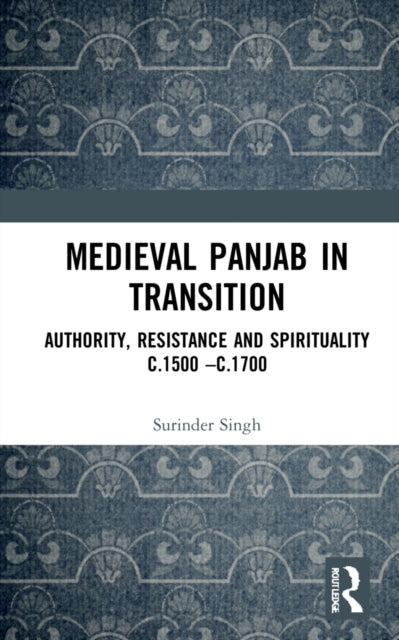
Surinder Singh
Medieval Panjab in Transition: Authority, Resistance and Spirituality c.1500 - c.1700
Medieval Panjab in Transition: Authority, Resistance and Spirituality c.1500 - c.1700
💎 Earn 887 Points (£8.87) on this item.
We can order this item for you. Delivery usually takes about 4 to 6 weeks.
This item is not held in our immediate stock. We will order it for you after checkout.
Estimated delivery: About 4 to 6 weeks
YOU SAVE £10.53
- Condition: Brand new
- UK Delivery times: Usually arrives within 2 - 3 working days
- UK Shipping: Fee starts at £3.89. Subject to product weight & dimension
Bulk ordering. Want 15 or more copies? Get a personalised quote and bigger discounts. Learn more about bulk orders.
Couldn't load pickup availability
- More about Medieval Panjab in Transition: Authority, Resistance and Spirituality c.1500 - c.1700
This book explores the historical transition in the undivided Panjab during the sixteenth and seventeenth centuries, highlighting the resistance against Mughal and Afghan suzerainty by local elements, including the autonomous tribes and hill chiefdoms. It also discusses the multicultural legacy of Panjab, with diverse strands of spirituality such as jogis, Sabiri and Qadiri silsilas, and popular verses of Shah Husain, Baba Lal, and Sultan Bahu. The book understands the upliftment of depressed castes as a defining feature of Sikhism and places egalitarian concern of the Sikh Gurus alongside the anti-caste protests of Namdev, Kabir, and Ravidas.
Format: Hardback
Length: 556 pages
Publication date: 09 June 2022
Publisher: Taylor & Francis Ltd
This comprehensive book delves into the intricate historical transformation of the undivided Panjab during the sixteenth and seventeenth centuries. It reveals a persistent resistance against the assertions of Mughal and Afghan suzerainty by local elements, particularly the autonomous tribes and hill chiefdoms. In the central plains, Dulla Bhatti, a prominent figure, rallied the toilers of his ancestral domain and led a relentless fight against the oppressive Mughal rule. His unwavering resistance became an enduring symbol of collective memory, inspiring generations to come.
Panjab's rich multicultural heritage unfolded through various spiritual threads. The jogis, deeply committed to monastic discipline and possessing supernatural abilities, gained acceptance through their tireless efforts towards social betterment. The Sabiri and Qadiri silsilas channeled their mystical energies towards the practice of prime recitation. The popular verses of Shah Husain, Baba Lal, and Sultan Bahu portrayed a harmonious relationship with God. The legendary lovers, who perished in the struggles against patriarchal forces, advocated for a fusion of dissent with spirituality.
In the vibrant city of Lahore, the material pursuits and cultural life were vividly depicted through a mosaic of descriptions. These accounts included episodes of social tension, reflecting the complex social dynamics of the time. The book also sheds light on the upliftment of depressed castes as a defining aspect of Sikhism. It recognizes the egalitarian concerns of the Sikh Gurus alongside the anti-caste protests of figures such as Namdev, Kabir, and Ravidas. The Sikh warrior bands, composed predominantly of members from depressed castes, played a pivotal role in challenging the Mughal state's foundations through their numerical majority.
This work draws upon a wealth of evidence from Persian chronicles, Mughal newsletters, Sufi writings, Sikh literature, and Punjabi folklore. It provides a comprehensive and detailed account of the historical transition in the Panjab, shedding light on the complex interplay of political, social, and cultural forces that shaped the region's history.
Weight: 1190g
Dimension: 216 x 138 (mm)
ISBN-13: 9781032298702
UK and International shipping information
UK and International shipping information
We deliver throughout the United Kingdom and to 128 countries and territories worldwide, including the United States, Australia, Canada, Germany, Spain and France.