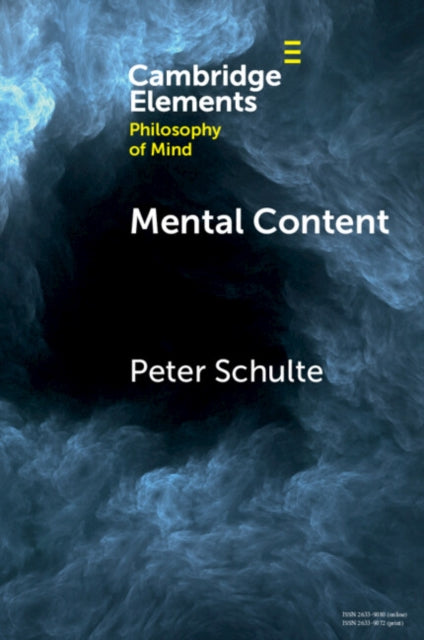
PeterSchulte
Mental Content
Mental Content
💎 Earn 84 Points (£0.84) on this item.
We can order this item for you. Delivery usually takes about 4 to 6 weeks.
This item is not held in our immediate stock. We will order it for you after checkout.
Estimated delivery: About 4 to 6 weeks
YOU SAVE £1.01
- Condition: Brand new
- UK Delivery times: Usually arrives within 2 - 3 working days
- UK Shipping: Fee starts at £2.39. Subject to product weight & dimension
Bulk ordering. Want 15 or more copies? Get a personalised quote and bigger discounts. Learn more about bulk orders.
Couldn't load pickup availability
- More about Mental Content
This Element provides an overview of contemporary theories of mental content, including causal, informational, teleological, structuralist, phenomenal intentionality, and anti-representationalist approaches. It also discusses recent developments in the debate, such as the "explanatory turn" and its implications for questions about representations in basic cognitive systems and the representational character of current empirical theories of cognition.
Format: Paperback / softback
Length: 75 pages
Publication date: 31 August 2023
Publisher: Cambridge University Press
This Element offers a comprehensive exploration of contemporary theories of mental content. It begins by clarifying key concepts and identifying the central questions that shape the ongoing debate. Subsequently, it presents and discusses the primary accounts of mental content, encompassing causal, informational, teleological, and structuralist approaches, as well as the phenomenal intentionality approach and the intentional stance theory. Additionally, the Element examines anti-representationalist accounts that challenge the existence or explanatory relevance of mental content. Finally, it considers recent developments in the debate, particularly the "explanatory turn," and its implications for understanding representations in basic cognitive systems and the representational nature of current empirical theories of cognition.
Introduction:
Contemporary theories of mental content have emerged as a central topic in the study of the mind and cognition. These theories seek to understand the nature of mental representations, the contents of which are thought to play a crucial role in our cognitive processes. In this Element, we will provide a comprehensive introduction to these theories, exploring their key concepts, assumptions, and debates.
Central Concepts:
Before delving into the various accounts of mental content, it is important to clarify some central concepts that will be discussed throughout the Element. These include mental representations, mental states, and mental content.
Mental Representations:
Mental representations are the cognitive structures that represent external objects, events, or states of affairs. They are the building blocks of our mental world and are thought to play a fundamental role in our cognitive abilities. Mental representations can be visual, auditory, spatial, or other sensory modalities, and they can vary in complexity and detail.
Mental States:
Mental states are the subjective experiences or states of mind that we have when we perceive, think, or feel something. They are the internal representations of external objects or events and are thought to be the source of our conscious experiences. Mental states can be conscious or unconscious, and they can vary in intensity, duration, and quality.
Mental Content:
Mental content refers to the properties or attributes of mental representations. It encompasses the information that mental representations contain, as well as the relationships between them. Mental content is often thought to be the most fundamental aspect of mental representations, as it determines their meaning and relevance to our cognitive processes.
Questions Dominating the Debate:
The debate surrounding contemporary theories of mental content is multifaceted and complex. Here are some of the questions that dominate the current debate:
Causal Approach:
The causal approach to mental content focuses on the relationship between mental representations and the external world. It assumes that mental representations are caused by external stimuli and that they have the ability to influence our behavior. The causal approach has been influential in the study of perception, attention, and memory, among other cognitive processes.
Informational Approach:
The informational approach to mental content focuses on the role of mental representations in storing and transmitting information. It assumes that mental representations are information-carrying devices that can be accessed and manipulated by our cognitive systems. The informational approach has been influential in the study of language, knowledge, and reasoning, among other cognitive processes.
Teleological Approach:
The teleological approach to mental content focuses on the function or purpose of mental representations. It assumes that mental representations are designed to fulfill certain goals or functions and that they have the ability to guide our behavior. The teleological approach has been influential in the study of motivation, decision-making, and consciousness, among other cognitive processes.
Structuralist Approach:
The structuralist approach to mental content focuses on the organization and structure of mental representations. It assumes that mental representations are composed of basic elements or components and that they are arranged in a specific way to represent the external world. The structuralist approach has been influential in the study of language, cognition, and artificial intelligence, among other cognitive processes.
Phenomenal Intentionality Approach:
The phenomenal intentionality approach to mental content focuses on the subjective experiences or sensations that accompany mental representations. It assumes that mental representations are not merely objective representations of the external world but are also experienced or perceived by the mind. The phenomenal intentionality approach has been influential in the study of perception, consciousness, and the nature of mental phenomena, among other cognitive processes.
Intentional Stance Theory:
The intentional stance theory to mental content focuses on the role of intentionality in mental representations. It assumes that mental representations are not merely objective representations of the external world but are also intentionally constructed or created by the mind. The intentional stance theory has been influential in the study of language, cognition, and the nature of mental phenomena, among other cognitive processes.
Anti-Representationalist Accounts:
In addition to the above-mentioned accounts of mental content, there are also anti-representationalist accounts that question either the existence or the explanatory relevance of mental content. These accounts argue that mental representations are not necessary for our cognitive processes and that they can be explained in terms of other cognitive mechanisms, such as perception, attention, and memory.
Recent Developments:
In recent years, there have been significant developments in the debate about mental content. One of these developments is the "explanatory turn," which emphasizes the explanatory role of mental representations in our cognitive processes. The explanatory turn has implications for questions about representations in basic cognitive systems and the representational character of current empirical theories of cognition.
Conclusion:
In conclusion, contemporary theories of mental content offer a rich and complex understanding of the nature of mental representations and their role in our cognitive processes. While there are many different accounts of mental content, they all share the common goal of explaining the contents of our mental world and the cognitive abilities that they enable. The debate surrounding mental content is ongoing, and there are many exciting developments and insights to be gained in the years to come.
Weight: 135g
ISBN-13: 9781009217255
This item can be found in:
UK and International shipping information
UK and International shipping information
UK Delivery and returns information:
- Delivery within 2 - 3 days when ordering in the UK.
- Shipping fee for UK customers from £2.39. Fully tracked shipping service available.
- Returns policy: Return within 30 days of receipt for full refund.
International deliveries:
Shulph Ink now ships to Australia, Belgium, Canada, France, Germany, Ireland, Italy, India, Luxembourg Saudi Arabia, Singapore, Spain, Netherlands, New Zealand, United Arab Emirates, United States of America.
- Delivery times: within 5 - 10 days for international orders.
- Shipping fee: charges vary for overseas orders. Only tracked services are available for most international orders. Some countries have untracked shipping options.
- Customs charges: If ordering to addresses outside the United Kingdom, you may or may not incur additional customs and duties fees during local delivery.