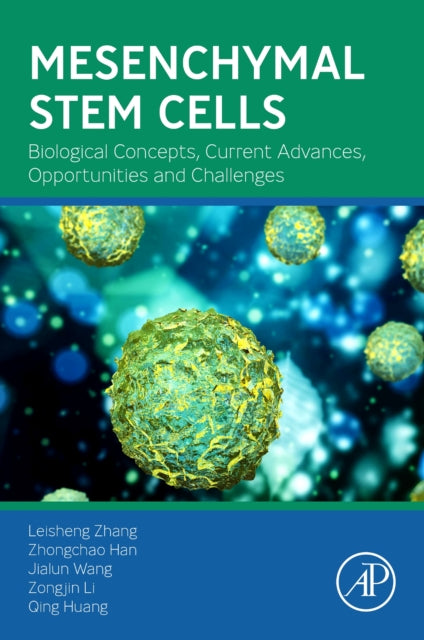
LeishengZhang,ZhongchaoHan,JialunWang,ZongjinLi,QingHuang
Mesenchymal Stem Cells: Biological Concepts, Current Advances, Opportunities and Challenges
Mesenchymal Stem Cells: Biological Concepts, Current Advances, Opportunities and Challenges
💎 Earn 628 Points (£6.28) on this item.
YOU SAVE £16.33
- Condition: Brand new
- UK Delivery times: Usually arrives within 2 - 3 working days
- UK Shipping: Fee starts at £2.39. Subject to product weight & dimension
Bulk ordering. Want 15 or more copies? Get a personalised quote and bigger discounts. Learn more about bulk orders.
Couldn't load pickup availability
- More about Mesenchymal Stem Cells: Biological Concepts, Current Advances, Opportunities and Challenges
Mesenchymal Stem Cells: Biological Concepts, Current Advances, Opportunities and Challenges is a comprehensive review that discusses the basic concepts, latest advances, clinical translational research, and regulatory policies of MSCs in the past 60 years, with implications for stem cell production and regenerative medicine.
Format: Paperback / softback
Length: 156 pages
Publication date: 26 May 2023
Publisher: Elsevier Science & Technology
Mesenchymal Stem Cells: Biological Concepts, Current Advances, Opportunities, and Challenges
Mesenchymal stem cells (MSCs) have emerged as a promising cell type for regenerative medicine due to their multipotent differentiation potential and ability to differentiate into various cell types. In the past 60 years, significant progress has been made in understanding the biological concepts, molecular mechanisms, and clinical applications of MSCs. This review aims to systematically summarize and discuss the latest advances in MSC research, including their biological concepts, differentiation potential, and therapeutic applications.
Biological Concepts:
MSCs are derived from the mesoderm, a mesenchymal tissue that gives rise to various cell types in the body. They are characterized by their ability to self-renew and differentiate into multiple lineages, including osteoblasts, adipocytes, chondrocytes, and neurons. MSCs are also known for their immunomodulatory properties, which make them attractive for use in immunotherapy and tissue repair.
Differentiation Potential:
MSCs have a wide range of differentiation potential, which makes them useful in various therapeutic applications. They can differentiate into osteoblasts, which are responsible for bone formation, adipocytes, which are involved in lipid metabolism, and chondrocytes, which are responsible for cartilage formation. MSCs can also differentiate into neurons, which are important for brain repair and regeneration.
Clinical Applications:
MSCs have been extensively studied in the field of regenerative medicine for the treatment of various diseases. They have been used in clinical trials for the treatment of spinal cord injuries, myocardial infarction, and osteoarthritis. MSCs have shown promising results in these trials, with some studies reporting improvements in patient outcomes and reduced inflammation.
Regulatory Policy:
The use of MSCs in clinical practice is regulated by various regulatory policies at both national and international levels. In the United States, the Food and Drug Administration (FDA) has approved the use of MSCs for the treatment of certain diseases, including spinal cord injuries and myocardial infarction. In Europe, the European Medicines Agency (EMA) has also approved the use of MSCs for the treatment of certain diseases.
Opportunities and Challenges:
Despite the promising results of MSC research, there are still some challenges that need to be addressed. One of the challenges is the lack of standardized protocols for MSC isolation and culture, which can lead to differences in the quality and potency of MSC products. Another challenge is the need for more large-scale clinical trials to further validate the safety and efficacy of MSC-based therapies.
Conclusion:
MSCs have emerged as a promising cell type for regenerative medicine due to their multipotent differentiation potential and ability to differentiate into various cell types. In the past 60 years, significant progress has been made in understanding the biological concepts, molecular mechanisms, and clinical applications of MSCs. This review highlights the latest advances in MSC research, including their biological concepts, differentiation potential, and therapeutic applications. With continued research and development, MSCs have the potential to revolutionize the field of regenerative medicine and provide new treatments for a wide range of diseases.
Weight: 272g
Dimension: 151 x 230 x 10 (mm)
ISBN-13: 9780323953467
This item can be found in:
UK and International shipping information
UK and International shipping information
UK Delivery and returns information:
- Delivery within 2 - 3 days when ordering in the UK.
- Shipping fee for UK customers from £2.39. Fully tracked shipping service available.
- Returns policy: Return within 30 days of receipt for full refund.
International deliveries:
Shulph Ink now ships to Australia, Belgium, Canada, France, Germany, Ireland, Italy, India, Luxembourg Saudi Arabia, Singapore, Spain, Netherlands, New Zealand, United Arab Emirates, United States of America.
- Delivery times: within 5 - 10 days for international orders.
- Shipping fee: charges vary for overseas orders. Only tracked services are available for most international orders. Some countries have untracked shipping options.
- Customs charges: If ordering to addresses outside the United Kingdom, you may or may not incur additional customs and duties fees during local delivery.