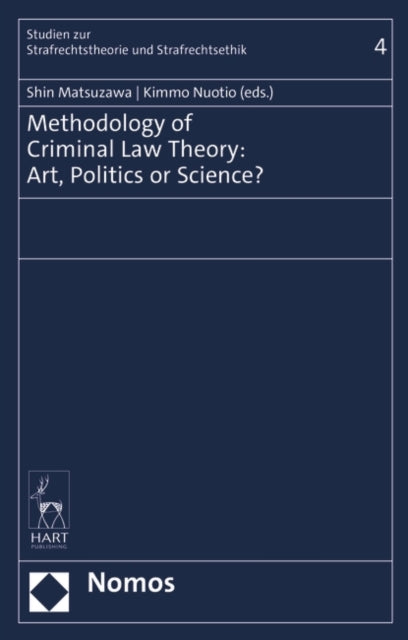
MATSUZAWA SHIN
METHODOLOGY OF CRIMINAL LAW THEORY
METHODOLOGY OF CRIMINAL LAW THEORY
YOU SAVE £9.42
- Condition: Brand new
- UK Delivery times: Usually arrives within 2 - 3 working days
- UK Shipping: Fee starts at £3.89. Subject to product weight & dimension
Bulk ordering. Want 15 or more copies? Get a personalised quote and bigger discounts. Learn more about bulk orders.
Couldn't load pickup availability
- More about METHODOLOGY OF CRIMINAL LAW THEORY
This book explores whether criminal law theory can be considered a branch of science and discusses the implications of this question for legal theory more broadly. It argues that criminal law scholarship can be viewed as a form of science and discusses the potential for systemic developments in criminal law theory.
Format: Hardback
Publication date: 17 June 2021
This book delves into the intriguing question of whether criminal law theory, or law theory more broadly, can be considered a branch of science. It explores a range of issues that are central to this debate, including the following:
Is criminal law scholarship, which plays a crucial role in shaping the legal system itself, a form of science? If so, in what sense?
Can criminal law theory undergo systematic developments over time? This question becomes increasingly relevant as interdisciplinary approaches gain prominence in the field.
Furthermore, the implications of this question extend beyond criminal law theory and have broader implications for our understanding of legal theory more generally.
This book represents a groundbreaking and innovative addition to the way we perceive criminal law and theory. It offers valuable insights and perspectives that challenge traditional notions and shed light on the complex interplay between law, science, and society.
The book begins by examining the historical and philosophical foundations of criminal law theory. It explores the various schools of thought that have shaped the development of criminal law, including classical criminal law, positivism, and critical legal studies. The authors argue that these schools of thought have different approaches to understanding the nature of law and the role of the criminal law in society.
Next, the book turns to the question of whether criminal law theory can be considered a form of science. The authors argue that criminal law theory can be viewed as a branch of science in the sense that it employs a rigorous scientific methodology. They highlight the importance of empirical evidence, logical reasoning, and the use of scientific models in developing and evaluating criminal law theories.
The authors also discuss the challenges and limitations of applying scientific methods to criminal law theory. They note that the nature of criminal law is complex and multifaceted, and that it often involves moral and ethical considerations that cannot be easily quantified or measured. They argue that while scientific methods can be useful in developing and evaluating criminal law theories, they should be used in conjunction with other approaches, such as legal philosophy and empirical research.
The book also explores the potential for systemic developments in criminal law theory. The authors argue that criminal law theory can evolve and change over time as society's needs and values change. They note that interdisciplinary approaches, such as the integration of social science research with legal theory, can contribute to the development of new and innovative criminal law theories.
Furthermore, the book discusses the implications of criminal law theory for our understanding of legal theory more generally. The authors argue that criminal law theory can provide valuable insights into the nature of law, the role of the state, and the relationship between law and society. They note that criminal law theory can also help us to identify and address the social and economic factors that contribute to crime and criminal behavior.
In conclusion, this book is a valuable addition to the field of criminal law and theory. It offers a comprehensive and interdisciplinary approach to the question of whether criminal law theory can be considered a branch of science. The authors provide a rich and nuanced analysis of the issues at hand, and their arguments are well-supported by empirical evidence and logical reasoning. This book will be of interest to scholars, practitioners, and policymakers alike, and it will contribute to our understanding of the complex and dynamic field of criminal law.
Weight: 438g
Dimension: 164 x 228 x 18 (mm)
ISBN-13: 9781509936830
UK and International shipping information
UK and International shipping information
We deliver throughout the United Kingdom and to 128 countries and territories worldwide, including the United States, Australia, Canada, Germany, Spain and France.