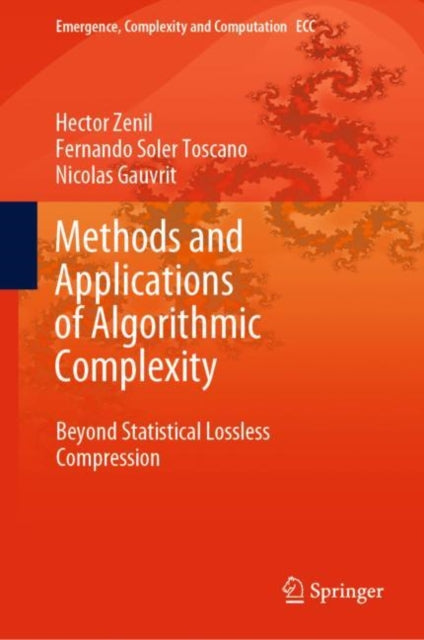
Hector Zenil,Fernando Soler Toscano,Nicolas Gauvrit
Methods and Applications of Algorithmic Complexity: Beyond Statistical Lossless Compression
Methods and Applications of Algorithmic Complexity: Beyond Statistical Lossless Compression
We can order this item for you. Delivery usually takes about 4 to 6 weeks.
This item is not held in our immediate stock. We will order it for you after checkout.
Estimated delivery: About 4 to 6 weeks
YOU SAVE £30.30
- Condition: Brand new
- UK Delivery times: Usually arrives within 2 - 3 working days
- UK Shipping: Fee starts at £3.89. Subject to product weight & dimension
Bulk ordering. Want 15 or more copies? Get a personalised quote and bigger discounts. Learn more about bulk orders.
Couldn't load pickup availability
- More about Methods and Applications of Algorithmic Complexity: Beyond Statistical Lossless Compression
This book explores a different pragmatic approach to algorithmic complexity, rooted in algorithmic probability, and seeks to relax necessary and sufficient conditions for numerical applicability. It presents evidence that these methods complement each other for different regimes and can make significant contributions to science, causation, scientific discovery, networks, and cognition. The author argues that the field can move beyond popular statistical lossless compression and introduce a model-driven approach to dealing with algorithmic complexity, particularly in analyzing evolving complex networks.
Format: Hardback
Length: 267 pages
Publication date: 17 May 2022
Publisher: Springer-Verlag Berlin and Heidelberg GmbH & Co. KG
This book delves into a distinct pragmatic approach to algorithmic complexity, drawing inspiration from the theoretical foundations of algorithmic probability. It explores the relaxation of necessary and sufficient conditions in the pursuit of numerical applicability, with some approaches offering greater risks in exchange for greater relevance and applicability.
In the field of applications of algorithmic (Kolmogorov) complexity, a diverse range of established and novel techniques coexist for the first time. These techniques span from the dominant ones, rooted in popular statistical lossless compression algorithms like LZW, to newer approaches that advance, complement, and also pose their limitations. Evidence suggests that these different methods complement each other for different regimes, highlighting the potential for synergy among them.
Despite the numerous challenges these methods face, some of them are better grounded in or motivated by the principles of algorithmic information. The authors propose that the field can make substantial contributions to science, causation, scientific discovery, networks, and cognition, among many other fields. Instead of remaining limited to being a technical curiosity of mathematical interest or being reduced to a statistical tool when collapsed into the application of popular lossless compression algorithms, this book aims to transcend these boundaries and offer a fresh methodological perspective on algorithmic complexity.
To illustrate this point, consider the example of graph theory and network science, which are classic subjects in mathematics widely investigated in the twentieth century. These fields have transformed research in numerous scientific domains, ranging from economics to medicine. However, it has become increasingly apparent that the challenge of analyzing these networks cannot be addressed solely through traditional methods.
In response to this challenge, this book introduces a different methodological approach to dealing with algorithmic complexity. It leverages the power of graph theory and network science to analyze complex systems and uncover insights that were previously elusive. By applying these techniques, researchers can gain a deeper understanding of the behavior and structure of networks, leading to improved decision-making and problem-solving in various fields.
Furthermore, the book emphasizes the importance of interdisciplinary collaboration in addressing complex algorithmic problems. It encourages researchers from different fields to work together, sharing their expertise and perspectives, to develop innovative solutions that transcend traditional boundaries. This collaboration not only enhances the effectiveness of research but also contributes to the broader development of science and technology.
In conclusion, this book offers a valuable contribution to the field of algorithmic complexity. By exploring a different pragmatic approach rooted in theoretical foundations, it provides a fresh perspective on dealing with complex systems. Through the application of established and novel techniques, it enables researchers to analyze complex networks and uncover insights that have the potential to transform various fields. Moreover, the book emphasizes the importance of interdisciplinary collaboration and highlights the potential for the field to make significant contributions to science, causation, scientific discovery, networks, and cognition.
Weight: 588g
Dimension: 235 x 155 (mm)
ISBN-13: 9783662649831
Edition number: 1st ed. 2022
UK and International shipping information
UK and International shipping information
We deliver throughout the United Kingdom and to 128 countries and territories worldwide, including the United States, Australia, Canada, Germany, Spain and France.