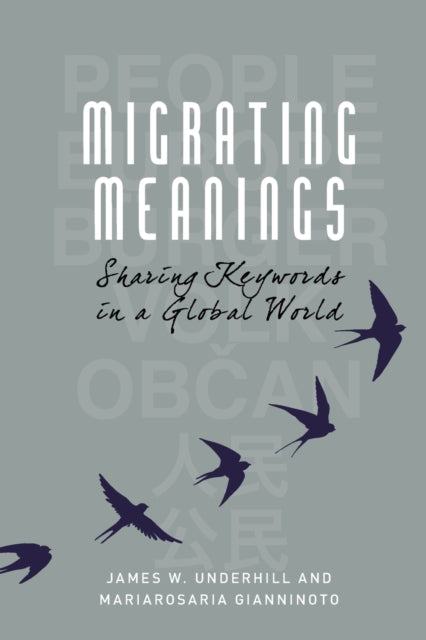
James W. Underhill,Mariarosaria Gianninoto
Migrating Meanings: Sharing Keywords in a Global World
Migrating Meanings: Sharing Keywords in a Global World
💎 Earn 115 Points (£1.15) on this item.
YOU SAVE £6.99
- Condition: Brand new
- UK Delivery times: Usually arrives within 2 - 3 working days
- UK Shipping: Fee starts at £3.89. Subject to product weight & dimension
Bulk ordering. Want 15 or more copies? Get a personalised quote and bigger discounts. Learn more about bulk orders.
Couldn't load pickup availability
- More about Migrating Meanings: Sharing Keywords in a Global World
The book explores the roots of four keywords for our times in English and their equivalents in Chinese, German, French, and Czech, to understand how other languages are adapting to English words and resisting anglo-concepts through their own traditions, stories, and worldviews.
Format: Paperback / softback
Length: 400 pages
Publication date: 28 February 2021
Publisher: Edinburgh University Press
With the increasing interconnectedness of our world through economic, political, and cultural globalization, it is essential to consider the role of English as a lingua franca for communication about our world. While English has become the dominant language in many parts of the world, its ability to accurately reflect the cultures and narratives of different nations and peoples is a matter of debate. This book seeks to explore the roots of four keywords that are particularly relevant to our times: the people, the citizen, the individual, and Europe. By examining these keywords in English and comparing them to equivalent keywords in Chinese, German, French, and Czech, the book aims to understand how other languages are adapting to English words and how their worldviews resist anglo-concepts through their own traditions, stories, and worldviews.
The first keyword, "the people," is a fundamental concept that encompasses the diversity of human societies. In English, the term "people" is often used to refer to a group of individuals who share a common identity, such as a nation or a community. However, in other languages, the term may have different meanings and connotations. For example, in Chinese, the term "ren" refers to a person's inner nature and moral character, while in German, the term "Volk" refers to a group of people with a shared ancestry and culture.
The second keyword, "the citizen," is closely related to the concept of the people. In English, the term "citizen" refers to a person who has the right to participate in the political process and to hold certain rights and responsibilities. However, in other languages, the term may have different meanings and connotations. For example, in Chinese, the term "minzu" refers to a group of people with a shared culture and history, while in German, the term "Bürger" refers to a person who is a member of a political community.
The third keyword, "the individual," is a concept that emphasizes the importance of personal autonomy and freedom. In English, the term "individual" is often used to refer to a person who is independent and self-sufficient. However, in other languages, the term may have different meanings and connotations. For example, in Chinese, the term "ge" refers to a person's inner nature and moral character, while in German, the term "Individualismus" refers to a belief in the importance of individualism.
The fourth keyword, "Europe," is a geographical and cultural region that has played a significant role in world history. In English, the term "Europe" is often used to refer to a group of countries that share a common history, language, and culture. However, in other languages, the term may have different meanings and connotations. For example, in Chinese, the term "Dongfang" refers to a region that includes China, Japan, and Korea, while in German, the term "Europa" refers to a region that includes Germany, France, and Italy.
To explore the roots of these keywords, the book draws on a wide range of sources, including literature, history, and cultural studies. It examines the ways in which English words have been borrowed and adapted by other languages, and how these adaptations have shaped their worldviews. For example, the book discusses the influence of Chinese philosophy on English words such as "ren" and "ge," and how these words have been used to express the values of harmony, balance, and respect for nature.
One of the key challenges facing English as a lingua franca is the fact that it is a language that is constantly evolving. As new technologies and cultural trends emerge, English words are being borrowed and adapted by other languages at a rapid pace. This can lead to misunderstandings and miscommunications, particularly when people from different cultures are trying to communicate with each other.
To address this challenge, the book suggests that we need to be more aware of the cultural and historical context of English words. We need to be able to understand the nuances and subtleties of the language, and to be able to use it in a way that is respectful and appropriate to the cultures and traditions of other people.
One way to achieve this is to learn other languages. By learning other languages, we can gain a deeper understanding of the world and the people who live in it. We can also learn to appreciate the diversity of languages and cultures, and to recognize the value of each language and culture.
In addition to learning other languages, we can also work to promote the use of English as a lingua franca. This can be done by providing education and training in English, and by promoting the use of English in international communication. We can also work to create a more inclusive and diverse society, where people from different cultures and backgrounds can feel welcome and valued.
However, promoting the use of English as a lingua franca also has its challenges. One of the biggest challenges is the fact that English is a language that is associated with power and privilege. This can lead to resentment and discrimination against people who do not speak English, particularly in countries where English is the official language.
To address this challenge, we need to work to promote language equality and diversity. We need to recognize the value of all languages and cultures, and to work to create a society where everyone can feel comfortable and valued.
In conclusion, with the increasing interconnectedness of our world, it is essential to consider the role of English as a lingua franca for communication about our world. While English has become the dominant language in many parts of the world, its ability to accurately reflect the cultures and narratives of different nations and peoples is a matter of debate. By exploring the roots of four keywords that are particularly relevant to our times, this book helps us to understand how other languages are adapting to English words and how their worldviews resist anglo-concepts through their own traditions, stories, and worldviews. By learning other languages and working to promote the use of English as a lingua franca, we can create a more inclusive and diverse society where everyone can feel welcome and valued.
Weight: 600g
Dimension: 155 x 231 x 25 (mm)
ISBN-13: 9781474481380
UK and International shipping information
UK and International shipping information
We deliver throughout the United Kingdom and to 128 countries and territories worldwide, including the United States, Australia, Canada, Germany, Spain and France.