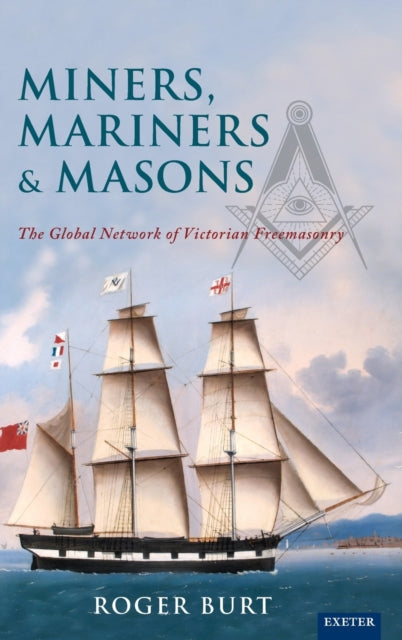
Roger Burt
Miners, Mariners & Masons: The Global Network of Victorian Freemasonry
Miners, Mariners & Masons: The Global Network of Victorian Freemasonry
We can order this item for you. Delivery usually takes about 4 to 6 weeks.
This item is not held in our immediate stock. We will order it for you after checkout.
Estimated delivery: About 4 to 6 weeks
YOU SAVE £10.87
- Condition: Brand new
- UK Delivery times: Usually arrives within 2 - 3 working days
- UK Shipping: Fee starts at £3.89. Subject to product weight & dimension
Bulk ordering. Want 15 or more copies? Get a personalised quote and bigger discounts. Learn more about bulk orders.
Couldn't load pickup availability
- More about Miners, Mariners & Masons: The Global Network of Victorian Freemasonry
Freemasonry was an important part of the Victorian era's economic and social life, but academic historians have paid little attention to it. This book is the first sustained study of its role in everyday social and economic life, why men joined, what it did for them and their families, and how it affected communities and local economies.
Format: Hardback
Length: 344 pages
Publication date: 08 January 2020
Publisher: University of Exeter Press
Freemasonry played a significant role in the economic and social life of the Victorian era, yet it has received limited and fragmented attention from academic historians. General histories of the period barely acknowledge its existence, while detailed studies primarily focus on its origins in the early eighteenth century and its subsequent institutional development. This book represents the first comprehensive and objective examination of Freemasonry's role in everyday social and economic life. It delves into the motivations behind men's membership, the benefits it provided to them and their families, and the profound impact it had on the development of communities and local economies.
Freemasonry emerged during the late medieval period in Europe, primarily as a guild of stonemasons. However, it quickly evolved into a more comprehensive organization that encompassed various professions and social classes. In the Victorian era, Freemasonry experienced a significant surge in popularity, particularly among the upper classes and the professional middle class.
One of the key reasons for Freemasonry's popularity in the Victorian era was its emphasis on morality, brotherhood, and social responsibility. Freemasons believed in the importance of these values and sought to promote them in their daily lives and communities. They also believed in the power of education and the pursuit of knowledge, and many Freemasonry lodges provided educational programs and scholarships for their members.
Freemasonry also played a significant role in the economic life of the Victorian era. Many Freemasonry lodges were involved in charitable work, providing assistance to the poor and needy. They also supported the development of infrastructure, such as roads, bridges, and hospitals, through their charitable contributions and labor. Freemasonry also provided a network of business connections and opportunities for its members, which helped to promote economic growth and development.
In addition to its economic and social contributions, Freemasonry also had a significant impact on the development of communities and local economies. Freemasonry lodges were often the center of social and cultural activities, providing a place for men to gather and socialize. They also played a role in promoting civic pride and community development, through their involvement in local charities and community projects.
However, Freemasonry was not without its controversies and criticisms. Some critics argued that Freemasonry was a secret society that was involved in conspiracy theories and political intrigue. Others argued that Freemasonry was exclusionary and discriminatory, particularly toward women and minorities.
Despite these criticisms, Freemasonry continued to thrive in the Victorian era. It remained a popular organization among the upper classes and the professional middle class, and it continued to make significant contributions to the economic and social life of the period.
In conclusion, Freemasonry played a significant role in the economic and social life of the Victorian era. It provided a network of business connections, charitable work, and social activities for its members, and it had a profound impact on the development of communities and local economies. While Freemasonry faced controversies and criticisms, it remained a popular and influential organization that continued to shape the social and cultural landscape of the Victorian era.
Weight: 680g
Dimension: 160 x 237 x 27 (mm)
ISBN-13: 9781905816163
UK and International shipping information
UK and International shipping information
We deliver throughout the United Kingdom and to 128 countries and territories worldwide, including the United States, Australia, Canada, Germany, Spain and France.