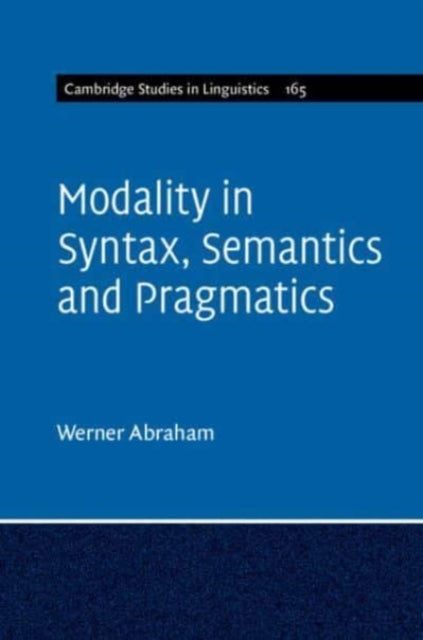
WernerAbraham
Modality in Syntax, Semantics and Pragmatics
Modality in Syntax, Semantics and Pragmatics
💎 Earn 122 Points (£1.22) on this item.
We can order this item for you. Delivery usually takes about 4 to 6 weeks.
This item is not held in our immediate stock. We will order it for you after checkout.
Estimated delivery: About 4 to 6 weeks
YOU SAVE £1.46
- Condition: Brand new
- UK Delivery times: Usually arrives within 2 - 3 working days
- UK Shipping: Fee starts at £2.39. Subject to product weight & dimension
Bulk ordering. Want 15 or more copies? Get a personalised quote and bigger discounts. Learn more about bulk orders.
Couldn't load pickup availability
- More about Modality in Syntax, Semantics and Pragmatics
When we say things like "If only we knew what he was up to!" we are expressing that we don't know and also that we wish to know. This is done through word order, subordinating subjunctions, sentences that are subordinated but nevertheless occur autonomously, and attitudinal discourse adverbs. This state of the art survey proposes a new model of modality that is cross-linguistically universal and argues that it is a constitutive part of human cognition.
Format: Paperback / softback
Length: 454 pages
Publication date: 06 April 2023
Publisher: Cambridge University Press
When we say things like "If only we knew what he was up to!" it goes beyond a simple message or a question to our addressee. We are expressing a simultaneous desire to know and a lack of knowledge. Various modes of encoding contribute to these modalities of expression. Word order, subordinating subjunctions, sentences that are subordinated but nevertheless occur autonomously, and attitudinal discourse adverbs play a significant role. These adverbs, far beyond lexical adverbials of modality, enable the speaker and the listener to presuppose full agreement, partial agreement under presupposed conditions, or negotiation of common ground.
In this state-of-the-art survey, we propose a new model of modality that draws on data from a variety of Germanic and Slavic languages. Our goal is to uncover what is cross-linguistically universal about modality and argue that it is a constitutive part of human cognition.
The model we propose incorporates multiple dimensions of modality, including temporal, spatial, and social aspects. It explores how language users convey their intentions, beliefs, and attitudes through the use of modal expressions and how these expressions are interpreted by the listener.
One key aspect of our model is the recognition of the role of context in modality interpretation. We argue that the context in which a statement is made can significantly influence the interpretation of the modal expressions used. For example, the use of the past tense in a statement can imply that the action is no longer relevant or possible, while the use of the future tense can suggest that the action is expected to occur.
Another important aspect of our model is the distinction between lexical and non-lexical modality. Lexical modality refers to the use of specific modal words or phrases, such as "must," "should," or "may," that carry a fixed meaning. Non-lexical modality, on the other hand, involves the use of contextual cues and inference to convey modality.
Our survey also examines the relationship between modality and other linguistic phenomena, such as tense, aspect, and mood. We argue that modality is closely intertwined with these other aspects of language and that they interact in complex ways to convey meaning.
In conclusion, our state-of-the-art survey proposes a new model of modality that draws on data from a variety of languages and explores the cross-linguistic universal aspects of modality. We argue that modality is a constitutive part of human cognition and that it plays a crucial role in communication and interpretation. By understanding the mechanisms and factors that influence modality, we can better appreciate the rich and complex nature of human language.
ISBN-13: 9781107605503
This item can be found in:
UK and International shipping information
UK and International shipping information
UK Delivery and returns information:
- Delivery within 2 - 3 days when ordering in the UK.
- Shipping fee for UK customers from £2.39. Fully tracked shipping service available.
- Returns policy: Return within 30 days of receipt for full refund.
International deliveries:
Shulph Ink now ships to Australia, Belgium, Canada, France, Germany, Ireland, Italy, India, Luxembourg Saudi Arabia, Singapore, Spain, Netherlands, New Zealand, United Arab Emirates, United States of America.
- Delivery times: within 5 - 10 days for international orders.
- Shipping fee: charges vary for overseas orders. Only tracked services are available for most international orders. Some countries have untracked shipping options.
- Customs charges: If ordering to addresses outside the United Kingdom, you may or may not incur additional customs and duties fees during local delivery.