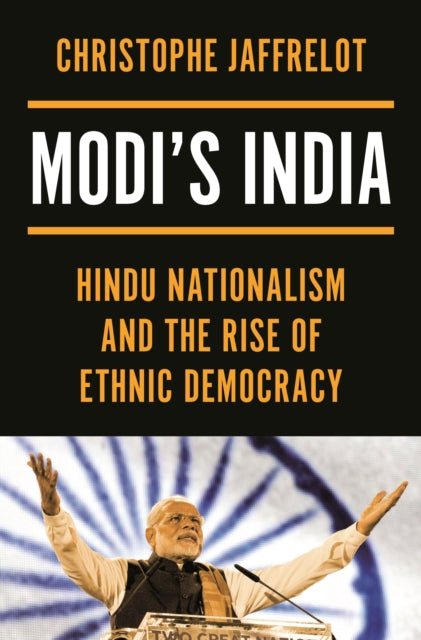
Christophe Jaffrelot
Modi's India: Hindu Nationalism and the Rise of Ethnic Democracy
Modi's India: Hindu Nationalism and the Rise of Ethnic Democracy
💎 Earn 88 Points (£0.88) on this item.
YOU SAVE £4.35
- Condition: Brand new
- UK Delivery times: Usually arrives within 2 - 3 working days
- UK Shipping: Fee starts at £2.39. Subject to product weight & dimension
Bulk ordering. Want 15 or more copies? Get a personalised quote and bigger discounts. Learn more about bulk orders.
Couldn't load pickup availability
- More about Modi's India: Hindu Nationalism and the Rise of Ethnic Democracy
Narendra Modi's Hindu nationalism has combined with national-populism to steer India toward authoritarianism and intolerance, resulting in a new form of democracy that equates the majoritarian community with the nation and relegates Muslims and Christians to second-class citizens.
Format: Paperback / softback
Length: 656 pages
Publication date: 11 April 2023
Publisher: Princeton University Press
Over the past two decades, India has witnessed a significant shift towards authoritarianism and intolerance under the leadership of Narendra Modi. Modi's rise to power was facilitated by his skillful combination of Hindu nationalism with a form of national-populism, which has proven to be highly effective in securing his electoral victories. In Gujarat, where he served as the Chief Minister for over 12 years, Modi successfully appealed to the aspirations of the Hindu community by promising development and economic growth. He also employed divisive tactics, polarizing the electorate along ethno-religious lines, to gain support.
This national-populism manifested itself in a highly personalized political style, with Modi directly engaging with voters through various channels of communication to saturate the public space. He used social media platforms, rallies, and town hall meetings to connect with citizens on a personal level, often addressing their concerns and grievances. This direct approach helped him build a strong emotional bond with his supporters, making him appear as a relatable and visionary leader.
However, Modi's leadership has had far-reaching consequences for India's democracy and society. Drawing on extensive original interviews conducted across India, Christophe Jaffrelot, a renowned French historian, provides a detailed account of how Modi's government has transformed India into an ethnic democracy. In this system, the majoritarian community, primarily Hindus, is equated with the nation, while Muslims and Christians are relegated to second-class citizens. Jaffrelot highlights the alarming rise in attacks against secularists, intellectuals, universities, and non-governmental organizations (NGOs) by vigilante groups affiliated with Hindu nationalist organizations. These attacks have been motivated by the promotion of Hindu nationalism, which seeks to establish India as a Hindu Rashtra (Hindu nation).
The political system of India has also undergone significant changes under Modi's leadership. Eager to govern not only in New Delhi but also in the states, the government has centralized power at the expense of federalism. This has led to the erosion of democratic institutions and the weakening of the checks and balances that were intended to ensure accountability and transparency. The Supreme Court of India, once considered a bastion of independence and justice, has been subjected to political pressure and has been accused of being influenced by the government. The court's decisions have been criticized for being inconsistent and politically motivated, undermining its credibility and authority.
Furthermore, Modi's government has been accused of suppressing dissent and stifling freedom of expression. Activists, journalists, and human rights defenders have faced increasing persecution and intimidation, with many facing legal charges and imprisonment. The government has used various laws and regulations to crack down on dissent, including the sedition law, the Unlawful Activities Prevention Act (UAPA), and the Information Technology Act (ITA). These laws have been used to silence critics and suppress the media, limiting the freedom of speech and expression in India.
The consequences of Modi's leadership have been profound and far-reaching. India, once known for its vibrant democracy and cultural diversity, has become increasingly polarized and intolerant. The country's secular fabric has been frayed, with religious minorities facing discrimination and marginalization. The government's policies have led to the marginalization of Muslims and Christians, with their rights and freedoms being curtailed. The country's education system has been politicized, with textbooks being altered to promote Hindu nationalism and undermine the teaching of secularism.
The situation in India has become increasingly concerning, with many observers fearing that the country is moving towards a state of authoritarianism. The government's suppression of dissent, its intolerance of religious and ethnic minorities, and its centralization of power have raised concerns about the future of democracy in India. It is essential that the international community takes notice of these developments and exerts pressure on the Indian government to uphold the principles of democracy, human rights, and the rule of law.
In conclusion, Narendra Modi's leadership in India has been marked by a combination of Hindu nationalism and national-populism, which has resulted in the country's transformation into an ethnic democracy. This has led to the suppression of dissent, the marginalization of religious and ethnic minorities, and the erosion of democratic institutions. The international community must take notice of these developments and exert pressure on the Indian government to uphold the principles of democracy, human rights, and the rule of law. Only through a democratic and inclusive India can the country achieve its potential and contribute to the global community in a positive way.
Weight: 952g
Dimension: 157 x 235 x 37 (mm)
ISBN-13: 9780691247908
UK and International shipping information
UK and International shipping information
UK Delivery and returns information:
- Delivery within 2 - 3 days when ordering in the UK.
- Shipping fee for UK customers from £2.39. Fully tracked shipping service available.
- Returns policy: Return within 30 days of receipt for full refund.
International deliveries:
Shulph Ink now ships to Australia, Belgium, Canada, France, Germany, Ireland, Italy, India, Luxembourg Saudi Arabia, Singapore, Spain, Netherlands, New Zealand, United Arab Emirates, United States of America.
- Delivery times: within 5 - 10 days for international orders.
- Shipping fee: charges vary for overseas orders. Only tracked services are available for most international orders. Some countries have untracked shipping options.
- Customs charges: If ordering to addresses outside the United Kingdom, you may or may not incur additional customs and duties fees during local delivery.