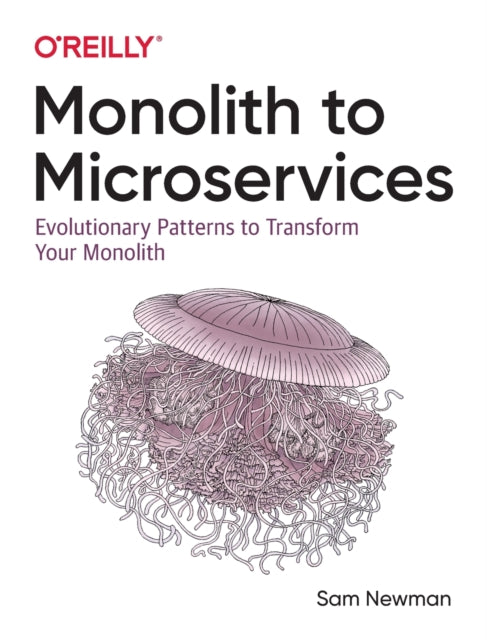
Sam Newman
Monolith to Microservices: Evolutionary Patterns to Transform Your Monolith
Monolith to Microservices: Evolutionary Patterns to Transform Your Monolith
💎 Earn 159 Points (£1.59) on this item.
YOU SAVE £13.14
- Condition: Brand new
- UK Delivery times: Usually arrives within 2 - 3 working days
- UK Shipping: Fee starts at £2.39. Subject to product weight & dimension
Bulk ordering. Want 15 or more copies? Get a personalised quote and bigger discounts. Learn more about bulk orders.
Couldn't load pickup availability
- More about Monolith to Microservices: Evolutionary Patterns to Transform Your Monolith
This book provides a practical guide for transitioning an existing monolithic system to a microservice architecture, covering multiple scenarios and strategies for a successful migration. It offers illustrative examples, migration patterns, and practical advice for organizations looking to transition to microservices, including determining whether to migrate, when to migrate, and where to begin.
Format: Paperback / softback
Length: 150 pages
Publication date: 22 November 2019
Publisher: O'Reilly Media, Inc, USA
The process of transitioning a monolithic system to a microservice architecture can be complex and challenging, but it can also lead to significant benefits for an organization. In this article, we will explore some of the key steps and strategies that can help you successfully migrate your monolithic system to a microservice-based architecture.
Step 1: Assess the Current State
The first step in any migration process is to assess the current state of your monolithic system. This includes understanding the architecture, technologies, and dependencies used, as well as the business requirements and goals.
During this assessment, you should identify any potential issues or challenges that may arise during the migration process. This could include technical limitations, cultural resistance, or organizational barriers.
Step 2: Define the Microservice Architecture
Once you have assessed the current state, you can define the microservice architecture that will meet your organization's needs. This includes identifying the different services that will make up the system, as well as the data and communication flows between them.
It is important to design the microservice architecture in a way that is modular, scalable, and resilient. This will help ensure that the system can handle growing traffic and changing business requirements.
Step 3: Break Down the Monolith
The next step is to break down the monolithic system into smaller, independent services. This involves identifying the different components of the system and decomposing them into smaller, more manageable pieces.
During this process, you should also identify any dependencies between the different services and ensure that they are properly managed. This could include using service discovery and dependency injection frameworks to manage the dependencies.
Step 4: Implement the Microservices
Once you have broken down the monolith, you can implement the microservices using the chosen technology stack. This includes developing the different services, testing them, and deploying them to the production environment.
During this process, you should also ensure that the services are properly integrated with each other and with any existing systems or databases. This could include using messaging protocols, such as HTTP or MQTT, to communicate between the services.
Step 5: Monitor and Manage the Microservices
Once the microservices are implemented, it is important to monitor and manage them effectively. This includes identifying any performance issues, security vulnerabilities, or operational problems, and taking appropriate action to address them.
It is also important to ensure that the microservices are continuously updated and improved. This could include using agile development practices, such as continuous integration and continuous delivery, to ensure that the system is always up-to-date and reliable.
Step 6: Transition to the Microservice Architecture
The final step in the migration process is to transition to the microservice architecture. This involves gradually migrating existing applications and services to the new architecture, while ensuring that the business is not disrupted.
During this transition, it is important to communicate with stakeholders and users to ensure that they are aware of any changes or disruptions that may occur. It is also important to provide training and support to ensure that users are able to use the new system effectively.
In conclusion, transitioning a monolithic system to a microservice architecture can be a complex and challenging process, but it can also lead to significant benefits for an organization. By following the steps outlined in this article, you can successfully migrate your monolithic system to a microservice-based architecture while maintaining business-as-usual.
Weight: 474g
Dimension: 176 x 234 x 13 (mm)
ISBN-13: 9781492047841
UK and International shipping information
UK and International shipping information
UK Delivery and returns information:
- Delivery within 2 - 3 days when ordering in the UK.
- Shipping fee for UK customers from £2.39. Fully tracked shipping service available.
- Returns policy: Return within 30 days of receipt for full refund.
International deliveries:
Shulph Ink now ships to Australia, Belgium, Canada, France, Germany, Ireland, Italy, India, Luxembourg Saudi Arabia, Singapore, Spain, Netherlands, New Zealand, United Arab Emirates, United States of America.
- Delivery times: within 5 - 10 days for international orders.
- Shipping fee: charges vary for overseas orders. Only tracked services are available for most international orders. Some countries have untracked shipping options.
- Customs charges: If ordering to addresses outside the United Kingdom, you may or may not incur additional customs and duties fees during local delivery.