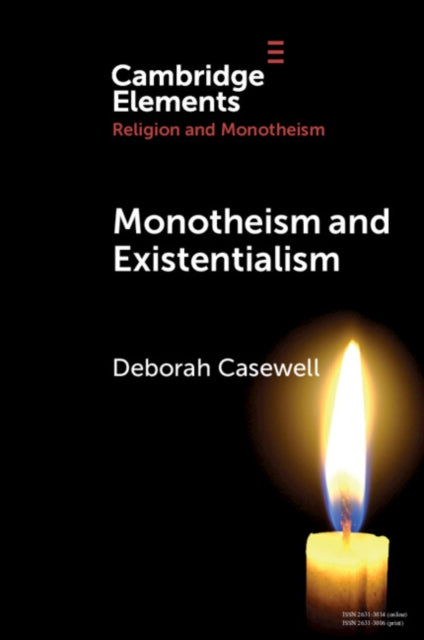
DeborahCasewell
Monotheism and Existentialism
Monotheism and Existentialism
💎 Earn 84 Points (£0.84) on this item.
We can order this item for you. Delivery usually takes about 4 to 6 weeks.
This item is not held in our immediate stock. We will order it for you after checkout.
Estimated delivery: About 4 to 6 weeks
YOU SAVE £1.01
- Condition: Brand new
- UK Delivery times: Usually arrives within 2 - 3 working days
- UK Shipping: Fee starts at £2.39. Subject to product weight & dimension
Bulk ordering. Want 15 or more copies? Get a personalised quote and bigger discounts. Learn more about bulk orders.
Couldn't load pickup availability
- More about Monotheism and Existentialism
Existentialism is closely linked to religion, particularly Christianity, and is influenced by monotheism. It emphasizes individuality, authenticity, despair, and defiance in a godless world. Existentialist thought explores key concepts such as freedom, authenticity, relationality, and ethics, and can have productive conversations with atheistic and theistic existentialists.
Format: Paperback / softback
Length: 75 pages
Publication date: 14 April 2022
Publisher: Cambridge University Press
Existentialism, a philosophical movement that has garnered significant attention and at times been subjected to parody, is often perceived as the philosophy of individuality, authenticity, despair, and defiance in a godless world. However, a comprehensive understanding of existentialism requires a reference to religion, particularly the monotheism of Christianity. Even the famous existentialist slogan, "existence precedes essence," is formulated in relation to monotheism. This Element aims to demonstrate that monotheism and existentialism are intricately intertwined: they react to each other, share content and concerns, and can be engaged in productive conversations regarding key concepts such as freedom, authenticity, relationality, and ethics.
Existentialism, as a philosophical movement, has its roots in the 19th century, particularly in the works of philosophers such as Soren Kierkegaard, Friedrich Nietzsche, and Jean-Paul Sartre. It emerged as a response to the dominant philosophical trends of the time, such as rationalism and empiricism, which emphasized the importance of logical reasoning and scientific observation. Existentialism, on the other hand, emphasized the subjective experience of the individual and the importance of freedom, authenticity, and responsibility.
One of the central tenets of existentialism is the notion that existence precedes essence. This means that the individual is not merely a product of their environment or their genetic makeup; rather, they are responsible for shaping their own existence through their choices and actions. Existentialism emphasizes the importance of authenticity, which means being true to oneself and living according to one's values and beliefs. This can be a challenging task, as it requires individuals to confront their fears, doubts, and uncertainties and to take risks in order to pursue their goals and dreams.
Another key concept in existentialism is freedom. Existentialists believe that individuals are fundamentally free and that their choices and actions have consequences for their own lives. This freedom, however, is not absolute; it is constrained by social, cultural, and ethical norms and by the limitations of human nature. Existentialists argue that individuals must take responsibility for their own lives and that they must make choices that align with their values and beliefs.
Relationality is another important concept in existentialism. Existentialists believe that individuals are fundamentally social beings and that their relationships with others are essential to their own well-being and fulfillment. This can be seen in the emphasis on empathy, compassion, and understanding that is often found in existentialist literature and philosophy. Existentialists argue that individuals must develop meaningful relationships with others and that these relationships can provide them with a sense of purpose, meaning, and fulfillment.
Ethics is another key concept in existentialism. Existentialists believe that individuals are responsible for their own actions and that they must make choices that are ethical and morally good. This can be a challenging task, as it requires individuals to confront the complexities of moral dilemmas and to make choices that align with their values and beliefs. Existentialists argue that individuals must be authentic to themselves and that they must live according to their own moral code, even if it goes against the norms and expectations of society.
Existentialism has had a significant impact on various fields, including philosophy, literature, art, and psychology. It has inspired many artists and writers to explore the themes of individuality, authenticity, and the human condition. It has also influenced the development of psychological theories such as existential therapy, which emphasizes the importance of self-awareness, authenticity, and personal growth.
Despite its popularity and influence, existentialism has also been criticized for its perceived nihilism and pessimism. Some critics argue that existentialism encourages individuals to reject traditional values and beliefs and to embrace a sense of hopelessness and despair. However, it is important to note that existentialism is not necessarily nihilistic or pessimistic. Rather, it emphasizes the importance of individual responsibility and the significance of making choices that align with one's values and beliefs.
In conclusion, existentialism is a philosophical movement that emphasizes the importance of individuality, authenticity, freedom, relationality, and ethics in a godless world. It is intricately intertwined with monotheism, particularly the monotheism of Christianity. Existentialism encourages individuals to take responsibility for their own lives and to make choices that align with their values and beliefs. It has had a significant impact on various fields and has inspired many artists and writers to explore the themes of individuality and the human condition. While existentialism has been criticized for its perceived nihilism and pessimism, it is important to note that it is not necessarily nihilistic or pessimistic. Rather, it emphasizes the importance of individual responsibility and the significance of making choices that align with one's values and beliefs.
ISBN-13: 9781108984799
Edition number: New ed
UK and International shipping information
UK and International shipping information
UK Delivery and returns information:
- Delivery within 2 - 3 days when ordering in the UK.
- Shipping fee for UK customers from £2.39. Fully tracked shipping service available.
- Returns policy: Return within 30 days of receipt for full refund.
International deliveries:
Shulph Ink now ships to Australia, Belgium, Canada, France, Germany, Ireland, Italy, India, Luxembourg Saudi Arabia, Singapore, Spain, Netherlands, New Zealand, United Arab Emirates, United States of America.
- Delivery times: within 5 - 10 days for international orders.
- Shipping fee: charges vary for overseas orders. Only tracked services are available for most international orders. Some countries have untracked shipping options.
- Customs charges: If ordering to addresses outside the United Kingdom, you may or may not incur additional customs and duties fees during local delivery.