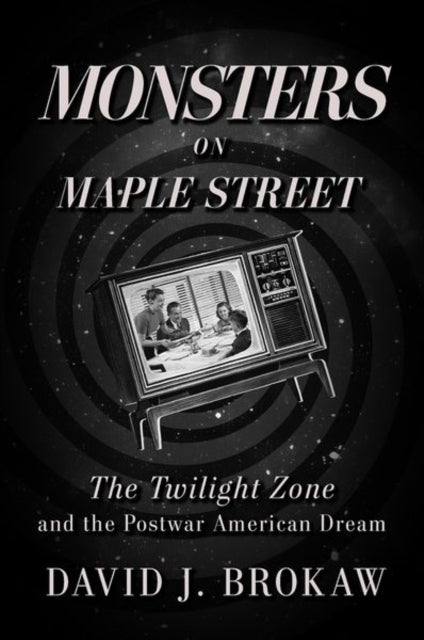
David J. Brokaw
Monsters on Maple Street: The Twilight Zone and the Postwar American Dream
Monsters on Maple Street: The Twilight Zone and the Postwar American Dream
💎 Earn 191 Points (£1.91) on this item.
YOU SAVE £33.77
- Condition: Brand new
- UK Delivery times: Usually arrives within 2 - 3 working days
- UK Shipping: Fee starts at £2.39. Subject to product weight & dimension
Bulk ordering. Want 15 or more copies? Get a personalised quote and bigger discounts. Learn more about bulk orders.
Couldn't load pickup availability
- More about Monsters on Maple Street: The Twilight Zone and the Postwar American Dream
The Twilight Zone was a television show that depicted an idealized version of American life, but it also exposed the social, economic, and political struggles of Cold War America. Rod Serling's show challenged conventional thinking and used science fiction, horror, and fantasy to explore topics such as sexuality, technology, war, labor, and the workplace, and white supremacy.
Format: Hardback
Length: 280 pages
Publication date: 08 August 2023
Publisher: The University Press of Kentucky
Post-World War II America has often been mythologized by successive generations as an exceptional period of prosperity and comfort. At a time when the Cold War was understood to be a battle of ideas as much as military prowess, the entertainment business relied heavily on subtle psychological marketing to promote the idea of the American Dream. The media of the 1950s and 1960s promoted an idealized version of American life sustained by the nuclear family and bolstered by a booming consumer economy. The seemingly wholesome and simple lifestyles portrayed on television screens, however, belied a torrent of social, economic, and political struggles occurring at the time. By the late 1950s, television writers were increasingly constrained to distract audiences from confronting counternarratives to the Dream. Among the programs that railed against this trend was Rod Serling's television masterpiece, The Twilight Zone. Now considered an enduring classic, the allegorical nature of the show provides a window into the many overlooked issues that plagued Cold War America.
In Monsters on Maple Street: The Twilight Zone and the Postwar American Dream, David J. Brokaw describes how the TV show reframed popular portrayals of white American wish fulfillments as nightmares, rather than dreams. Brokaw's close reading of the show's sociopolitical dimensions examines how the series' creators successfully utilized science fiction, horror, and fantasy to challenge conventional thinking – and avoid having their work censored – around topics such as sexuality, technology, war, labor and the workplace, and white supremacy. In doing so, Brokaw helps us understand how the series exposed the underbelly of the American Dream and left indelible impressions in the minds of its viewers for decades to come.
The Twilight Zone's ability to challenge conventional thinking was a significant factor in its success. The show's creators were able to use science fiction, horror, and fantasy to explore topics that were often taboo in mainstream media. For example, in the episode "The Monsters Are Due on Maple Street," the residents of a small town begin to experience strange occurrences that they attribute to extraterrestrial beings. Brokaw argues that this episode was a powerful critique of the paranoia and fear that characterized Cold War America. The show's creators were also able to use the horror and fantasy elements to explore social and political issues that were often ignored or marginalized. For example, in the episode "The Changing Man," a scientist is transformed into a monster by his own experiments, which explores the dangers of scientific progress and the potential for unintended consequences.
Another important aspect of The Twilight Zone's sociopolitical dimensions is its exploration of sexuality and gender roles. The show often featured characters who challenged traditional notions of masculinity and femininity, such as the episode "The Purple Testament," which features a woman who is able to control men with her mind. Brokaw argues that this episode was a powerful critique of the gender stereotypes that were prevalent in Cold War America, and helped to pave the way for greater acceptance of LGBTQ+ individuals in the years to come.
In addition to its exploration of sexuality and gender roles, The Twilight Zone also addressed issues of race and ethnicity. The show often featured characters who were marginalized or discriminated against, such as the episode "The Borderland," which features a Mexican-American family who are forced to cross the border illegally. Brokaw argues that this episode was a powerful critique of the racism and discrimination that were prevalent in Cold War America, and helped to raise awareness of the issues that marginalized communities faced.
Overall, Monsters on Maple Street: The Twilight Zone and the Postwar American Dream is a valuable contribution to the study of television and popular culture. Brokaw's close reading of the show's sociopolitical dimensions provides a window into the many overlooked issues that plagued Cold War America, and helps to shed light on the ways in which television was used to shape public opinion and promote the American Dream. The show's ability to challenge conventional thinking, explore taboo topics, and raise awareness of social and political issues makes it an enduring classic that continues to resonate with audiences today.
Weight: 572g
Dimension: 160 x 237 x 24 (mm)
ISBN-13: 9780813197845
UK and International shipping information
UK and International shipping information
UK Delivery and returns information:
- Delivery within 2 - 3 days when ordering in the UK.
- Shipping fee for UK customers from £2.39. Fully tracked shipping service available.
- Returns policy: Return within 30 days of receipt for full refund.
International deliveries:
Shulph Ink now ships to Australia, Belgium, Canada, France, Germany, Ireland, Italy, India, Luxembourg Saudi Arabia, Singapore, Spain, Netherlands, New Zealand, United Arab Emirates, United States of America.
- Delivery times: within 5 - 10 days for international orders.
- Shipping fee: charges vary for overseas orders. Only tracked services are available for most international orders. Some countries have untracked shipping options.
- Customs charges: If ordering to addresses outside the United Kingdom, you may or may not incur additional customs and duties fees during local delivery.