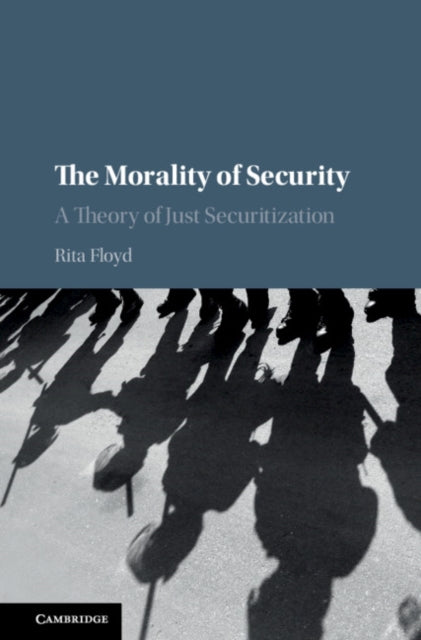
RitaFloyd
Morality of Security: A Theory of Just Securitization
Morality of Security: A Theory of Just Securitization
💎 Earn 448 Points (£4.48) on this item.
We can order this item for you. Delivery usually takes about 4 to 6 weeks.
This item is not held in our immediate stock. We will order it for you after checkout.
Estimated delivery: About 4 to 6 weeks
YOU SAVE £5.32
- Condition: Brand new
- UK Delivery times: Usually arrives within 2 - 3 working days
- UK Shipping: Fee starts at £2.39. Subject to product weight & dimension
Bulk ordering. Want 15 or more copies? Get a personalised quote and bigger discounts. Learn more about bulk orders.
Couldn't load pickup availability
- More about Morality of Security: A Theory of Just Securitization
Floyd's Just Securitization Theory combines security studies and philosophy's just war tradition to address when it is permissible to move an issue out of normal politics and treat it as a security issue, how security measures should be conducted, and when and how securitization should be reversed. It provides a normative framework for evaluating past and present securitizations, guiding practitioners in making informed decisions, and empowering the public to hold actors accountable for their views on security.
Format: Hardback
Length: 258 pages
Publication date: 18 April 2019
Publisher: Cambridge University Press
When is it permissible to move an issue out of normal politics and treat it as a security issue?
The question of when it is appropriate to elevate a matter from the realm of normal politics and treat it as a security issue is a complex and multifaceted one. It requires a careful examination of the specific circumstances surrounding the issue, as well as a consideration of the potential risks and consequences of taking such a stance. In some cases, it may be necessary to move an issue out of the political sphere and into the realm of security to protect the interests of a nation or its citizens. This can occur when there is a clear and imminent threat to national security, such as a terrorist attack or the proliferation of weapons of mass destruction. In such situations, governments may have the authority.
However, it is important to note that securitization should not be used as a tool to justify military intervention or other forms of coercion. Rather, it should be used as a means of responding to a genuine security threat in a responsible and proportionate manner. The use of force should always be a last resort and should be guided by international law and the principles of human rights.
To ensure that securitization is conducted in a responsible and ethical manner, there are several steps that can be taken. Firstly, governments should establish clear criteria for determining when an issue should be securitized. This should include a risk assessment that takes into account the potential harm to human rights and the rule of law. Additionally, governments should ensure that any measures taken to address a security threat are proportionate and targeted at the specific individuals or groups responsible for the threat.
Secondly, governments should involve the relevant stakeholders in the decision-making process. This includes the affected communities, civil society organizations, and the international community. By engaging with these stakeholders, governments can ensure that the measures taken are fair and just and that they do not have unintended consequences.
Thirdly, governments should be transparent about their decision-making process and the measures taken to address a security threat. This includes providing access to information and holding public hearings. By being transparent, governments can build trust with their citizens and other stakeholders and can ensure that they are held accountable for their actions.
Finally, governments should review and evaluate the effectiveness of their securitization measures on a regular basis. This includes assessing the impact on human rights and the rule of law, as well as the proportionality of the measures taken. By doing so, governments can ensure that they are continuously improving their approach to security and that they are not overstepping their powers.
In conclusion, the question of when it is permissible to move an issue out of normal politics and treat it as a security issue is a complex and multifaceted one. It requires a careful examination of the specific circumstances surrounding the issue, as well as a consideration of the potential risks and consequences of taking such a stance. Securitization should not be used as a tool to justify military intervention or other forms of coercion, but should be used as a means of responding to a genuine security threat in a responsible and proportionate manner. To ensure that securitization is conducted in a responsible and ethical manner, governments should establish clear criteria for determining when an issue should be securitized, involve the relevant stakeholders in the decision-making process, be transparent about their decision-making process and the measures taken, and review and evaluate the effectiveness of their securitization measures on a regular basis. By doing so, governments can ensure that they are continuously improving their approach to security and that they are not overstepping their powers.
Weight: 502g
Dimension: 160 x 235 x 18 (mm)
ISBN-13: 9781108493895
UK and International shipping information
UK and International shipping information
UK Delivery and returns information:
- Delivery within 2 - 3 days when ordering in the UK.
- Shipping fee for UK customers from £2.39. Fully tracked shipping service available.
- Returns policy: Return within 30 days of receipt for full refund.
International deliveries:
Shulph Ink now ships to Australia, Belgium, Canada, France, Germany, Ireland, Italy, India, Luxembourg Saudi Arabia, Singapore, Spain, Netherlands, New Zealand, United Arab Emirates, United States of America.
- Delivery times: within 5 - 10 days for international orders.
- Shipping fee: charges vary for overseas orders. Only tracked services are available for most international orders. Some countries have untracked shipping options.
- Customs charges: If ordering to addresses outside the United Kingdom, you may or may not incur additional customs and duties fees during local delivery.