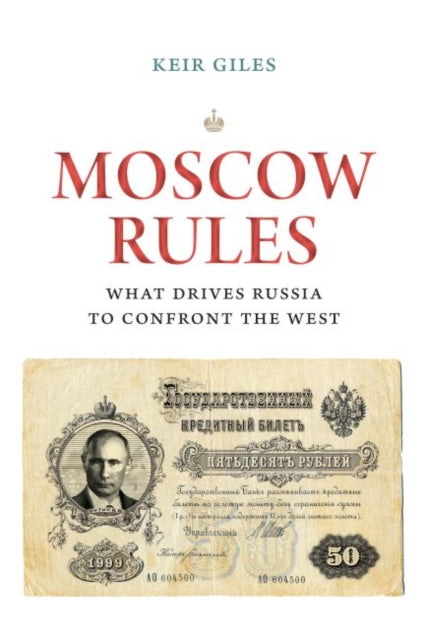
Keir Giles
Moscow Rules: What Drives Russia to Confront the West
Moscow Rules: What Drives Russia to Confront the West
💎 Earn 169 Points (£1.69) on this item.
We can order this item for you. Delivery usually takes about 4 to 6 weeks.
This item is not held in our immediate stock. We will order it for you after checkout.
Estimated delivery: About 4 to 6 weeks
- Condition: Brand new
- UK Delivery times: Usually arrives within 2 - 3 working days
- UK Shipping: Fee starts at £2.39. Subject to product weight & dimension
Bulk ordering. Want 15 or more copies? Get a personalised quote and bigger discounts. Learn more about bulk orders.
Couldn't load pickup availability
- More about Moscow Rules: What Drives Russia to Confront the West
Russia and the West have different perspectives on the world, and Western leaders often expect Russia to act as a "rational" Western nation, which can lead to repeated disappointment and crises. Keir Giles, a senior expert on Russia at Chatham House, explains how Russian leaders have used consistent doctrinal and strategic approaches to the rest of the world, which may seem deeply alien in the West but understanding them is essential for successful engagement with Moscow.
Format: Paperback / softback
Length: 256 pages
Publication date: 29 January 2019
Publisher: Brookings Institution
Russia and the West have a complex relationship that has been shaped by their respective histories, cultures, and ideologies. While the West has often viewed Russia as a "rational" Western nation, Russian leaders have historically approached the world through their own unique lens, shaped by their country's history and traditions. This can lead to misunderstandings and conflicts between the two sides.
One of the key reasons for this misunderstanding is that Western leaders tend to approach Russia with a set of assumptions and expectations that are not always valid. They may assume that Russia should behave in a certain way based on its membership in the G7 or its status as a nuclear power, for example, without taking into account the country's unique political and economic situation. This can lead to frustration and resentment on the Russian side, as they feel that their interests are not being taken seriously.
To better understand Russia's perspective, it is important to look at its history and its current political and economic situation. Russia has a long history of being a powerful empire, and its leaders have often sought to maintain their country's status and influence in the world. This has led to a focus on military strength, economic development, and geopolitical power.
In recent years, Russia has faced a number of challenges, including economic stagnation, political instability, and international sanctions. These challenges have led to a shift in Russia's foreign policy, with the country becoming more assertive and nationalistic. This has been particularly evident in Russia's relations with the West, where Russia has sought to assert its influence and challenge the dominance of the United States and other Western powers.
Despite these challenges, Russia remains a significant player in the global economy and politics. It has a large population, vast natural resources, and a strong military. It also has a rich cultural heritage that is celebrated around the world.
However, Russia's approach to the world has also been criticized for its authoritarianism and its disregard for human rights. Russia has been accused of interfering in the affairs of other countries, including Ukraine and Syria, and of using its military to support authoritarian regimes. This has led to tensions between Russia and the West, and has made it difficult for the two sides to work together on common issues.
To address these challenges, the West needs to engage with Russia in a more constructive and productive way. This means that the West needs to understand Russia's perspective and to work towards finding common ground. It also means that the West needs to be willing to address Russia's concerns and to take steps to address its authoritarianism and disregard for human rights.
One way that the West can engage with Russia is through diplomacy. Diplomacy can be a powerful tool for resolving conflicts and for building relationships. However, it requires a willingness to listen and to work towards a mutually beneficial solution.
Another way that the West can engage with Russia is through economic cooperation. Russia has a large economy, and the West can benefit from working with it to promote economic growth and development. This can include investing in Russian infrastructure, promoting trade, and providing technical assistance.
However, economic cooperation can also be a source of tension between the West and Russia. Russia has been accused of using its economic power to influence other countries, and of using its economic policies to protect its own interests. This has led to tensions between Russia and the West, and has made it difficult for the two sides to work together on common issues.
In addition to diplomacy and economic cooperation, the West can also engage with Russia through cultural exchange. Cultural exchange can help to build bridges between the two sides and to promote understanding and respect. This can include hosting cultural events, exchanging students and scholars, and promoting cultural tourism.
However, cultural exchange can also be a source of tension between the West and Russia. Russia has been accused of promoting its own cultural values and beliefs at the expense of other cultures, and of using its cultural influence to promote its own political agenda. This has led to tensions between Russia and the West, and has made it difficult for the two sides to work together on common issues.
In conclusion, Russia and the West have a complex relationship that has been shaped by their respective histories, cultures, and ideologies. While the West has often viewed Russia as a "rational" Western nation, Russian leaders have historically approached the world through their own unique lens, shaped by their country's history and traditions. This can lead to misunderstandings and conflicts between the two sides.
To better understand Russia's perspective, the West needs to engage with Russia in a more constructive and productive way. This means that the West needs to understand Russia's perspective and to work towards finding common ground. It also means that the West needs to be willing to address Russia's concerns and to take steps to address its authoritarianism and disregard for human rights. By doing so, the West can build a more stable and prosperous relationship with Russia in the future.
Weight: 394g
Dimension: 226 x 155 x 16 (mm)
ISBN-13: 9780815735748
UK and International shipping information
UK and International shipping information
UK Delivery and returns information:
- Delivery within 2 - 3 days when ordering in the UK.
- Shipping fee for UK customers from £2.39. Fully tracked shipping service available.
- Returns policy: Return within 30 days of receipt for full refund.
International deliveries:
Shulph Ink now ships to Australia, Belgium, Canada, France, Germany, Ireland, Italy, India, Luxembourg Saudi Arabia, Singapore, Spain, Netherlands, New Zealand, United Arab Emirates, United States of America.
- Delivery times: within 5 - 10 days for international orders.
- Shipping fee: charges vary for overseas orders. Only tracked services are available for most international orders. Some countries have untracked shipping options.
- Customs charges: If ordering to addresses outside the United Kingdom, you may or may not incur additional customs and duties fees during local delivery.