R. S. Rose
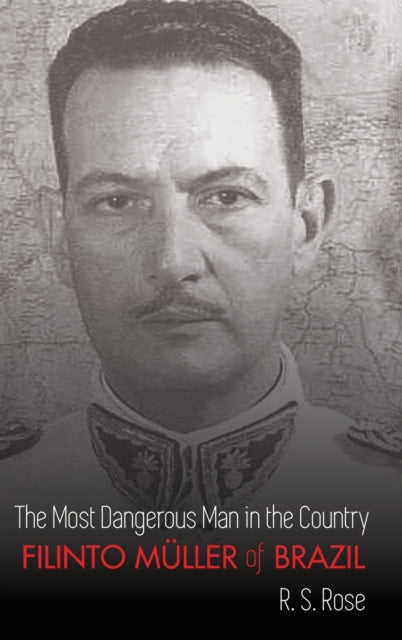
Most Dangerous Man in the Country: Filinto Mueller of Brazil
Most Dangerous Man in the Country: Filinto Mueller of Brazil
💎 Earn 336 Points (£3.36) on this item.
We can order this item for you. Delivery usually takes about 4 to 6 weeks.
This item is not held in our immediate stock. We will order it for you after checkout.
Estimated delivery: About 4 to 6 weeks
YOU SAVE £8.74
- Condition: Brand new
- UK Delivery times: Usually arrives within 2 - 3 working days
- UK Shipping: Fee starts at £2.39. Subject to product weight & dimension
Bulk ordering. Want 15 or more copies? Get a personalised quote and bigger discounts. Learn more about bulk orders.
Couldn't load pickup availability
- More about Most Dangerous Man in the Country: Filinto Mueller of Brazil
Filinto Müller was a controversial police chief and senator in Brazil, accused of police misconduct. This book examines his life and argues that he was responsible for the invention of modern-day death squads, the first in the Americas.
\n Format: Hardback
\n Length: 308 pages
\n Publication date: 22 December 2020
\n Publisher: Peter Lang Publishing Inc
\n
Filinto Müller, a prominent figure in Brazilian history, holds a dubious distinction as the most despised police chief and subsequently became a highly disliked senator. The weight of numerous accusations of police misconduct rested heavily upon Müller, largely due to the allegations leveled by yellow-journalist David Nasser. Spanning a remarkable 11 years of diligent research, this comprehensive volume delves into the entirety of Müller's life, drawing upon an exhaustive examination of 66,704 documents, 500 newspaper clippings, and 165 visual items. In addition, numerous interviews were conducted to shed further light on the subject. Despite the extensive investigation, this work has yielded limited archival evidence to support direct charges against Müller. Nevertheless, this book makes a compelling argument that Müller holds significant responsibility for the invention of modern-day death squads, a groundbreaking phenomenon in the Americas.
Filinto Müller's Life and Controversy
Filinto Müller's life was marked by a tumultuous journey that spanned various roles and controversies. Born in 1910 in the city of São Paulo, Brazil, Müller began his career as a police officer, rising through the ranks to become the head of the São Paulo Police Department in 1954. However, his tenure as police chief was marked by a series of scandals and controversies.
One of the most notable incidents occurred in 1957, when Müller was accused of ordering the assassination of left-wing politician and journalist Carlos Marighella. Marighella had been critical of Müller's handling of the police and had been investigating allegations of police corruption. Despite the lack of concrete evidence, Müller was arrested and charged with the murder. However, he was eventually acquitted due to a lack of conclusive proof.
Müller's reputation as a controversial figure continued to grow throughout his career. In 1960, he was elected to the Brazilian Senate, where he served for two terms. During his time in the Senate, Müller gained a reputation for his outspokenness and his opposition to left-wing political movements. He was also known for his support for the military government that ruled Brazil from 1964 to 1985.
Despite his political achievements, Müller's reputation as a controversial figure remained intact. He was accused of involvement in various human rights violations, including the torture and murder of political prisoners. In 1988, a commission of inquiry was formed to investigate these allegations, and Müller was eventually arrested and charged with multiple counts of torture and murder. He was sentenced to 25 years in prison, but he was released in 1991 due to a Supreme Court ruling that found his rights had been violated during his arrest and interrogation.
Filinto Müller's life and career are a testament to the complex and often controversial nature of Brazilian politics and society. His rise to power as a police chief and his subsequent political career were marked by a series of scandals, controversies, and allegations of wrongdoing. Despite his acquittal in some cases and his release from prison in others, Müller's legacy remains a subject of debate and discussion in Brazil and beyond.
The Invention of Modern-Day Death Squads
One of the most significant aspects of Müller's life and career is his role in the invention of modern-day death squads. Müller was a strong advocate of using violence and coercion to suppress political opposition and maintain order in Brazil. He believed that the only way to ensure stability and security in the country was through the use of force and that political opponents should be eliminated.
Müller's belief in the use of violence and coercion led him to establish a network of death squads that were responsible for the murder of thousands of political opponents and other individuals who were perceived to be threats to the government. These death squads were often composed of police officers and military personnel who were given carte blanche to carry out their missions without fear of prosecution or consequences.
Müller's invention of modern-day death squads was a groundbreaking phenomenon in the Americas. It marked a departure from traditional methods of political repression and marked a new era of authoritarianism in Brazil. Müller's death squads were a symbol of the government's willingness to use any means necessary to maintain power and suppress political opposition.
Despite the widespread condemnation and international outrage that followed the invention of modern-day death squads, Müller remained unrepentant. He believed that his actions were necessary to protect the country and that political opponents were a threat to the stability and security of Brazil.
Filinto Müller's invention of modern-day death squads was a significant turning point in Brazilian history. It marked a new era of authoritarianism and violence that would have long-lasting consequences for the country and its people. Müller's legacy remains a subject of debate and discussion, and his role in the invention of modern-day death squads is a reminder of the dangers of political repression and the need for democratic values and human rights to be upheld.
In conclusion, Filinto Müller's life and career are a testament to the complex and often controversial nature of Brazilian politics and society. His rise to power as a police chief and his subsequent political career were marked by a series of scandals, controversies, and allegations of wrongdoing. Despite his acquittal in some cases and his release from prison in others, Müller's legacy remains a subject of debate and discussion in Brazil and beyond. His invention of modern-day death squads was a groundbreaking phenomenon in the Americas that marked a new era of authoritarianism and violence. Müller's legacy serves as a reminder of the dangers of political repression and the need for democratic values and human rights to be upheld.
\n Weight: 530g\n
Dimension: 159 x 236 x 27 (mm)\n
ISBN-13: 9781433178825\n
Edition number: New ed\n
UK and International shipping information
UK and International shipping information
UK Delivery and returns information:
- Delivery within 2 - 3 days when ordering in the UK.
- Shipping fee for UK customers from £2.39. Fully tracked shipping service available.
- Returns policy: Return within 30 days of receipt for full refund.
International deliveries:
Shulph Ink now ships to Australia, Belgium, Canada, France, Germany, Ireland, Italy, India, Luxembourg Saudi Arabia, Singapore, Spain, Netherlands, New Zealand, United Arab Emirates, United States of America.
- Delivery times: within 5 - 10 days for international orders.
- Shipping fee: charges vary for overseas orders. Only tracked services are available for most international orders. Some countries have untracked shipping options.
- Customs charges: If ordering to addresses outside the United Kingdom, you may or may not incur additional customs and duties fees during local delivery.