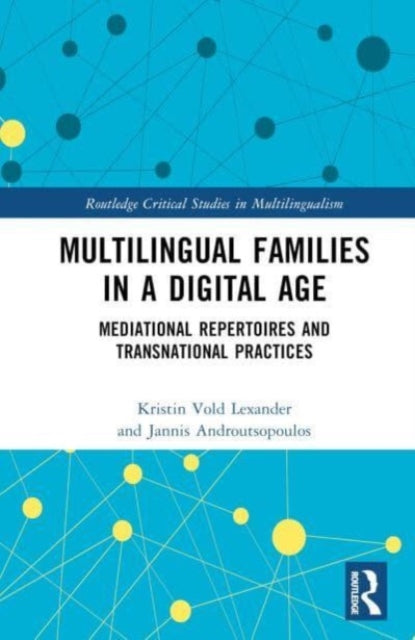
Kristin VoldLexander,Jannis Androutsopoulos
Multilingual Families in a Digital Age: Mediational Repertoires and Transnational Practices
Multilingual Families in a Digital Age: Mediational Repertoires and Transnational Practices
💎 Earn 811 Points (£8.11) on this item.
We can order this item for you. Delivery usually takes about 4 to 6 weeks.
This item is not held in our immediate stock. We will order it for you after checkout.
Estimated delivery: About 4 to 6 weeks
YOU SAVE £9.63
- Condition: Brand new
- UK Delivery times: Usually arrives within 2 - 3 working days
- UK Shipping: Fee starts at £2.39. Subject to product weight & dimension
Bulk ordering. Want 15 or more copies? Get a personalised quote and bigger discounts. Learn more about bulk orders.
Couldn't load pickup availability
- More about Multilingual Families in a Digital Age: Mediational Repertoires and Transnational Practices
This book explores transnational family life in the digital age, focusing on how parents and children use media resources and language practices to maintain social relationships and construct transnational family bonds and identities. It draws on ethnographic studies of four Senegalese families in Norway and develops an integrated approach that considers linguistic choices, digital technologies, and families' language and media ideologies. Key themes include the integration of linguistic and media resources, creative practices of digital translanguaging, engagement in diaspora practices, and opportunities for the development of children's heritage language skills.
Format: Hardback
Length: 238 pages
Publication date: 19 May 2023
Publisher: Taylor & Francis Ltd
This captivating book delves into the intricate realm of transnational family life in the digital age, offering fresh perspectives and insights. It explores the diverse media resources and language practices employed by parents and children to nurture and sustain social relationships in the digital sphere, as well as to construct transnational family bonds and identities. The book aims to broaden the horizons of existing research on family multilingualism, particularly in the realm of digital communication, which has been relatively overlooked until now. Through ethnographic studies of four families of Senegalese background in Norway, Lexander and Androutsopoulos develop an integrated approach that seamlessly weaves together participants' linguistic choices for situated interaction, the technological affordances of digital technologies, and the families' language and media ideologies.
The book uncovers a wealth of key themes, including the integration of linguistic and media resources in family repertoires, the creative practices of digital translanguaging, engagement in diaspora practices, and the potential of digital communication to enhance children's heritage language skills. With an innovative approach to understanding 'doing family in the digital age, this book appeals to students and scholars across a wide range of disciplines, including multilingualism, sociolinguistics, digital communication, language and communication, and language and media.
The authors begin by providing a comprehensive overview of the digital landscape, highlighting the transformative impact of technology on family communication. They argue that digital communication has become an integral part of transnational family life, enabling families to maintain connections across vast geographical distances and cultural boundaries. The book then delves into the specific practices and strategies employed by parents and children to navigate the digital realm.
One of the key themes explored is the integration of linguistic and media resources in family repertoires. The authors argue that families use a variety of media platforms, such as social media, email, video calls, and messaging apps, to communicate and share information about their lives. Linguistic choices, such as the use of specific languages or dialects, are crucial in these interactions, as they help to establish and maintain family relationships.
The book also examines the creative practices of digital translanguaging, which involve the adaptation and re-purposing of language for digital communication. Parents and children employ a range of strategies, such as transliteration, code-switching, and the creation of new lexemes, to adapt their language to the digital medium. This translanguaging is not just a matter of adapting to technology; it is also a way for families to express their cultural identities and maintain their sense of belonging in a diverse and interconnected world.
Engagement in diaspora practices is another important theme explored in the book. The authors argue that digital communication plays a significant role in facilitating the participation of families in diaspora communities. Through social media and other online platforms, families can connect with others who share their cultural heritage and maintain a sense of belonging despite being geographically dispersed. This engagement in diaspora practices can help to preserve cultural traditions, promote intergenerational learning, and foster a sense of collective identity.
Opportunities of digital communication for the development of children's heritage language skills are also highlighted in the book. The authors argue that digital technologies can provide a rich environment for children to practice and develop their heritage language skills. Through interactive games, online language courses, and social media interactions, children can engage with their language in a meaningful and fun way, which can help to strengthen their language proficiency and promote language retention.
In conclusion, this book offers a valuable contribution to the field of multilingualism and family studies. By exploring the complex interplay between language, media, and technology in transnational family life, it provides new insights into the ways in which families navigate the digital landscape and construct their identities. The innovative approach adopted by the authors, combining ethnographic studies with a multidisciplinary lens, makes this book accessible to a wide range of scholars and students. The book will be of interest to those studying multilingualism, sociolinguistics, digital communication, language and communication, and language and media, as well as anyone interested in understanding the dynamics of family life in the digital age.
Dimension: 229 x 152 (mm)
ISBN-13: 9781032130248
This item can be found in:
UK and International shipping information
UK and International shipping information
UK Delivery and returns information:
- Delivery within 2 - 3 days when ordering in the UK.
- Shipping fee for UK customers from £2.39. Fully tracked shipping service available.
- Returns policy: Return within 30 days of receipt for full refund.
International deliveries:
Shulph Ink now ships to Australia, Belgium, Canada, France, Germany, Ireland, Italy, India, Luxembourg Saudi Arabia, Singapore, Spain, Netherlands, New Zealand, United Arab Emirates, United States of America.
- Delivery times: within 5 - 10 days for international orders.
- Shipping fee: charges vary for overseas orders. Only tracked services are available for most international orders. Some countries have untracked shipping options.
- Customs charges: If ordering to addresses outside the United Kingdom, you may or may not incur additional customs and duties fees during local delivery.