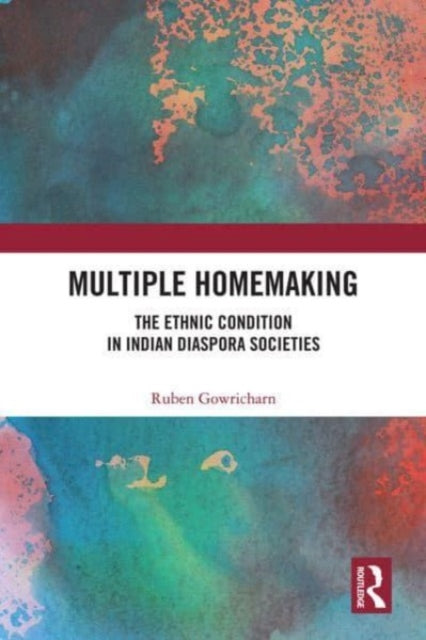
RubenGowricharn
Multiple Homemaking: The Ethnic Condition in Indian Diaspora Societies
Multiple Homemaking: The Ethnic Condition in Indian Diaspora Societies
💎 Earn 221 Points (£2.21) on this item.
We can order this item for you. Delivery usually takes about 4 to 6 weeks.
This item is not held in our immediate stock. We will order it for you after checkout.
Estimated delivery: About 4 to 6 weeks
YOU SAVE £2.63
- Condition: Brand new
- UK Delivery times: Usually arrives within 2 - 3 working days
- UK Shipping: Fee starts at £2.39. Subject to product weight & dimension
Bulk ordering. Want 15 or more copies? Get a personalised quote and bigger discounts. Learn more about bulk orders.
Couldn't load pickup availability
- More about Multiple Homemaking: The Ethnic Condition in Indian Diaspora Societies
This book explores the theoretical perspective of homemaking as the ethnic condition of Indian diaspora communities, using empirical case studies of the Surinami Hindustanis and Dutch Hindustanis. It emphasizes ethnogenesis, integration, and diasporic bonding, and examines concepts such as douglarization, groupism, citizenship, institutions, ethnification, social networks, and technology. It is valuable for studies of diaspora, globalization, transnational migration, multiculturalism, cultural studies, ethnic minority studies, sociology, politics, and international relations, and South Asian studies.
Format: Paperback / softback
Length: 182 pages
Publication date: 25 September 2023
Publisher: Taylor & Francis Ltd
This book offers a groundbreaking theoretical framework for understanding homemaking as a distinct ethnic condition within Indian diaspora communities. Drawing upon extensive empirical case studies, it delves into the diverse homemaking practices of two overseas Indian groups: the Surinami Hindustanis and the Dutch Hindustanis. By seamlessly integrating ethnogenesis, integration, and diasporic bonding, the author provides a fresh perspective on homemaking that encompasses these complex aspects. In contrast to the prevailing discourse on homemaking that often neglects the institutional and cultural dimensions, this book explicitly examines key concepts such as douglarization, groupism, citizenship, institutions, ethnification, social networks, and technology, as well as transnational flows.
Unique and thought-provoking, this book holds immense value in the fields of diaspora studies, globalization, transnational migration, multiculturalism, cultural studies, ethnic minority studies, sociology, politics, international relations, and South Asian studies. It offers valuable insights into the experiences and dynamics of Indian diaspora communities, shedding light on their unique homemaking practices and their intricate relationships with their homelands.
The book is organized into several chapters, each exploring different aspects of homemaking within the respective overseas Indian groups. The first chapter provides an introduction to the study, highlighting the significance of understanding homemaking as an ethnic condition within the Indian diaspora. It sets the stage for the subsequent chapters by providing a theoretical framework and defining key terms.
The second chapter focuses on the Surinami Hindustanis, a community of Indian immigrants who have settled in Suriname, South America. Through in-depth interviews and participant observation, the author explores the diverse homemaking practices of the Surinami Hindustanis and their connections to their homeland, India. The chapter highlights the importance of traditional gender roles, family structures, and community networks in shaping homemaking practices. It also examines the challenges faced by Surinami Hindustanis in maintaining their cultural identity and traditions in a foreign land.
The third chapter examines the Dutch Hindustanis, a community of Indian immigrants who have settled in the Netherlands, Europe. Similar to the Surinami Hindustanis, the Dutch Hindustanis also prioritize traditional gender roles and family structures. However, they have adapted their homemaking practices to the cultural norms and social structures of the Netherlands. The chapter explores the role of technology, social media, and transnational flows in maintaining connections with India and the broader Indian diaspora. It also examines the challenges faced by Dutch Hindustanis in balancing their careers and homemaking responsibilities.
In the fourth chapter, the author discusses the broader implications of the study for understanding homemaking as an ethnic condition within the Indian diaspora. They argue that homemaking practices are not solely influenced by individual factors but also by broader social, cultural, and economic factors. They suggest that homemaking can be viewed as a site of resistance and resilience against the pressures of globalization and transnational migration. The chapter also explores the role of homemaking in shaping cultural identity and heritage within the Indian diaspora.
The fifth chapter concludes the book by summarizing the key findings and offering recommendations for future research. The author emphasizes the need for more interdisciplinary studies that incorporate insights from various fields such as sociology, anthropology, cultural studies, and political science. They also call for greater recognition of the contributions of women and marginalized communities in shaping homemaking practices within the Indian diaspora.
Overall, this book is a pioneering work in the field of diaspora studies, providing a comprehensive and nuanced understanding of homemaking as an ethnic condition within Indian diaspora communities. It offers valuable insights into the experiences and dynamics of these communities, shedding light on their unique homemaking practices and their intricate relationships with their homelands. The book will be of interest to scholars, researchers, and practitioners in the fields of diaspora studies, globalization, transnational migration, multiculturalism, cultural studies, ethnic minority studies, sociology, politics, international relations, and South Asian studies.
Weight: 453g
Dimension: 234 x 156 (mm)
ISBN-13: 9781003107699
UK and International shipping information
UK and International shipping information
UK Delivery and returns information:
- Delivery within 2 - 3 days when ordering in the UK.
- Shipping fee for UK customers from £2.39. Fully tracked shipping service available.
- Returns policy: Return within 30 days of receipt for full refund.
International deliveries:
Shulph Ink now ships to Australia, Belgium, Canada, France, Germany, Ireland, Italy, India, Luxembourg Saudi Arabia, Singapore, Spain, Netherlands, New Zealand, United Arab Emirates, United States of America.
- Delivery times: within 5 - 10 days for international orders.
- Shipping fee: charges vary for overseas orders. Only tracked services are available for most international orders. Some countries have untracked shipping options.
- Customs charges: If ordering to addresses outside the United Kingdom, you may or may not incur additional customs and duties fees during local delivery.