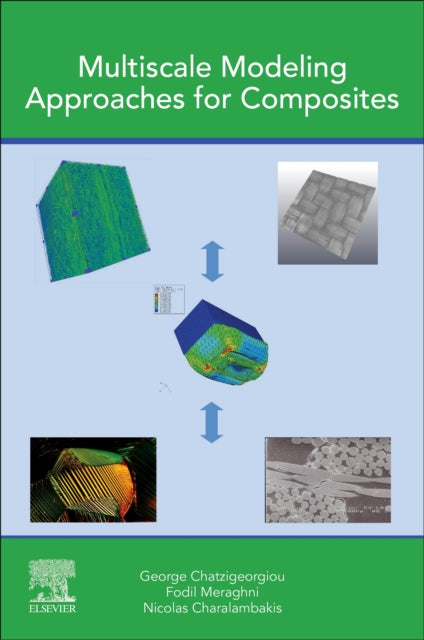
GeorgeChatzigeorgiou,FodilMeraghni,NicolasCharalambakis
Multiscale Modeling Approaches for Composites
Multiscale Modeling Approaches for Composites
💎 Earn 822 Points (£8.22) on this item.
YOU SAVE £5.52
- Condition: Brand new
- UK Delivery times: Usually arrives within 2 - 3 working days
- UK Shipping: Fee starts at £2.39. Subject to product weight & dimension
Bulk ordering. Want 15 or more copies? Get a personalised quote and bigger discounts. Learn more about bulk orders.
Couldn't load pickup availability
- More about Multiscale Modeling Approaches for Composites
Multiscale Modeling Approaches for Composites provides a comprehensive guide to multiscale modeling techniques for composite materials, covering theoretical foundations, micromechanic methods, and advanced topics with analytical and numerical examples.
Format: Paperback / softback
Length: 364 pages
Publication date: 19 January 2022
Publisher: Elsevier Science Publishing Co Inc
Here is the rephrased text:
Multiscale Modeling Approaches for Composites delves into the core principles of prevalent multiscale modeling techniques, offering comprehensive guidance for their practical implementation. Presented in a straightforward and pedagogical manner, the book showcases a range of homogenization methods, accompanied by numerous numerical illustrations. It begins by establishing the theoretical foundations of tensors and continuum mechanics concepts, progressing to actual micromechanic techniques for composite media and laminate plates. The final chapters delve into advanced topics in homogenization, encompassing Greens tensor, Hashin-Shtrikman bounds, and specialized problem types. Each chapter is accompanied by comprehensive analytical and numerical examples (Python and ABAQUS scripts) to enhance the understanding of the theory.
Introduction:
Multiscale Modeling Approaches for Composites serves as a comprehensive resource for those seeking to understand and apply multiscale modeling techniques in the field of composites. By presenting a range of homogenization methods and accompanying numerical examples, the book aims to provide a solid foundation for researchers and practitioners alike.
Chapter 1: Theoretical Foundations:
In this chapter, the book delves into the theoretical underpinnings of tensors and continuum mechanics concepts. It explains the fundamental principles of these subjects, including matrix representations, differential equations, and boundary conditions. The chapter also introduces the concept of homogenization, which is a crucial step in multiscale modeling. Homogenization involves the reduction of a complex composite material into a simplified model that captures the essential behavior of the original material.
Chapter 2: Homogenization Methods:
Chapter 2 presents a variety of homogenization methods for composite media and laminate plates. The methods are explained in a simple and concise manner, with an emphasis on their practical applications. The chapter includes examples of different homogenization techniques, such as the volume averaging method, the perturbation method, and the finite element method. Each method is discussed in detail, including its advantages, limitations, and potential applications.
Chapter 3: Micromechanic Techniques:
Chapter 3 focuses on actual micromechanic techniques for composite media and laminate plates. It discusses the principles of micromechanics, including the definition of stress and strain, the constitutive equations for composite materials, and the finite element method. The chapter also covers the modeling of composite materials with different microstructures, such as fiber-reinforced composites and matrix-reinforced composites.
Chapter 4: Advanced Topics in Homogenization:
Chapter 4 explores advanced topics in homogenization, including Greens tensor, Hashin-Shtrikman bounds, and special types of problems. These topics are of particular interest to researchers and practitioners working in the field of composites. The chapter provides a comprehensive overview of these topics, including their theoretical foundations, numerical implementations, and practical applications.
Conclusion:
In conclusion, Multiscale Modeling Approaches for Composites is a valuable resource for anyone interested in multiscale modeling techniques in the field of composites. The book provides a comprehensive introduction to the theoretical foundations of tensors and continuum mechanics concepts, as well as practical guidance for applying homogenization methods in composite media and laminate plates. The comprehensive analytical and numerical examples further enhance the understanding of the theory and its applications. By leveraging the knowledge and techniques presented in this book, researchers and practitioners can develop more accurate and efficient models for composite materials, leading to improved design and performance.
Weight: 450g
Dimension: 229 x 152 (mm)
ISBN-13: 9780128231432
This item can be found in:
UK and International shipping information
UK and International shipping information
UK Delivery and returns information:
- Delivery within 2 - 3 days when ordering in the UK.
- Shipping fee for UK customers from £2.39. Fully tracked shipping service available.
- Returns policy: Return within 30 days of receipt for full refund.
International deliveries:
Shulph Ink now ships to Australia, Belgium, Canada, France, Germany, Ireland, Italy, India, Luxembourg Saudi Arabia, Singapore, Spain, Netherlands, New Zealand, United Arab Emirates, United States of America.
- Delivery times: within 5 - 10 days for international orders.
- Shipping fee: charges vary for overseas orders. Only tracked services are available for most international orders. Some countries have untracked shipping options.
- Customs charges: If ordering to addresses outside the United Kingdom, you may or may not incur additional customs and duties fees during local delivery.