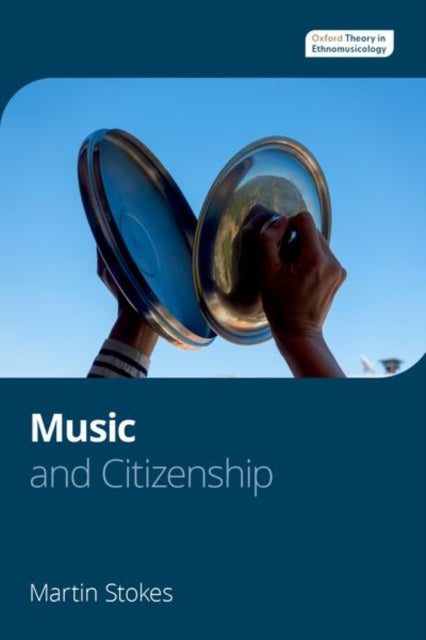
MartinStokes
Music and Citizenship
Music and Citizenship
💎 Earn 89 Points (£0.89) on this item.
We can order this item for you. Delivery usually takes about 4 to 6 weeks.
This item is not held in our immediate stock. We will order it for you after checkout.
Estimated delivery: About 4 to 6 weeks
YOU SAVE £1.07
- Condition: Brand new
- UK Delivery times: Usually arrives within 2 - 3 working days
- UK Shipping: Fee starts at £2.39. Subject to product weight & dimension
Bulk ordering. Want 15 or more copies? Get a personalised quote and bigger discounts. Learn more about bulk orders.
Couldn't load pickup availability
- More about Music and Citizenship
Critical citizenship practices and the language of today's populism have never been more sharply opposed. Martin Stokes' book Music and Citizenship argues that music has for a long time been entangled with debates about citizenship and citizenly identities, though this entanglement has been insufficiently recognized. It challenges the conventional understanding of citizenship in terms of nationalism and national identity and suggests a different space in which one might configure such relations, oriented to questions about musical ecology, sustainability, democracy, and inclusivity.
Format: Paperback / softback
Length: 192 pages
Publication date: 07 December 2023
Publisher: Oxford University Press Inc
Critical citizenship practices and the language of today's populism have never been more sharply opposed. Today's insistent efforts to anchor citizenship narratives in national belonging now confront a variety of flexible or differentiated citizenships - plural, performative, and decentered practices of rights claiming mutually defining the political, its subjects, and its others on a variety of scales. They confront, too, critiques of citizenship in totalitarian or neoliberal governmentality that derive from Foucault, Agamben, and Arendt and have become pressing today in proliferating states of emergency and exception and the growing ranks of non-citizens. How should these debates be configured now? And what place does music have in them?
In Music and Citizenship, author Martin Stokes argues that music has for a long time been entangled with debates about citizenship and citizenly identities, though for various reasons this entanglement has been insufficiently recognized. Citizenship and citizenly identity debates, for their part, have important implications for the way we think about music in relation to politics, identity, and scholarly practice. Stokes's particular claim is that ethnomusicology has for too long configured relationships between music, society, and reflective and critical practice in terms of identity paradigms. The rejection of these identity paradigms in recent years has taken the form of a post- or anti-humanism that is equally problematic. This book challenges the conventional understanding of citizenship in terms of nationalism and national identity through the examination of case studies from across Latin America, Africa, Asia, and Europe. In this way, this volume departs from an earlier ethnomusicology preoccupied with belonging and cultural partisanship.
The book begins by exploring the ways in which music has been used to construct and contest citizenship narratives in different historical and cultural contexts. It then moves on to consider the ways in which music can be used to promote or challenge democratic values and practices. Stokes argues that music has the potential to be a powerful tool for promoting social justice and equality, but that it can also be used to reinforce existing power structures and inequalities. He provides examples of how music has been used to support or oppose political movements, to promote or challenge cultural norms, and to promote or challenge social identities.
One of the key themes of the book is the relationship between music and citizenship in the context of globalization. Stokes argues that the increasing interconnectedness of the world has led to the emergence of new forms of citizenship that are not necessarily tied to national identity. He provides examples of how music has been used to promote or challenge global citizenship, and how it can be used to promote or challenge the values and practices of global capitalism.
Another key theme of the book is the relationship between music and citizenship in the context of the digital age. Stokes argues that the digital age has created new opportunities for music to be used as a tool for promoting social justice and equality, but that it has also created new challenges for music producers and consumers. He provides examples of how music has been used to promote or challenge digital rights, and how it can be used to promote or challenge social identities.
Throughout the book, Stokes draws on a wide range of theoretical and empirical sources to support his arguments. He draws on the work of scholars such as Michel Foucault, Hannah Arendt, Antonio Gramsci, and Frantz Fanon to explore the relationship between music and citizenship in the context of different historical and cultural contexts. He also draws on the work of ethnomusicologists such as David Harvey, Simon Frith, and Paul Oliver to explore the relationship between music and citizenship in the context of the digital age.
One of the strengths of the book is its ability to bring together a wide range of theoretical and empirical sources to support its arguments. This allows Stokes to provide a comprehensive and nuanced understanding of the relationship between music and citizenship in the context of different historical and cultural contexts. It also allows Stokes to provide a critical analysis of the ways in which music has been used to promote or challenge social justice and equality, and how it can be used to promote or challenge the values and practices of global capitalism.
Another strength of the book is its ability to engage with a wide range of readers. While the book is primarily aimed at scholars and students of music, it is also accessible to a wider audience. Stokes's clear and concise writing style makes it easy to follow, and his use of examples and case studies makes it easy to relate to the issues he discusses.
In conclusion, Music and Citizenship is a valuable contribution to the field of ethnomusicology and to the broader field of studies of music and politics. It provides a comprehensive and nuanced understanding of the relationship between music and citizenship in the context of different historical and cultural contexts, and it provides a critical analysis of the ways in which music has been used to promote or challenge social justice and equality, and how it can be used to promote or challenge the values and practices of global capitalism. The book is well-written, accessible, and engaging, and it will be of interest to scholars and students of music, politics, and social justice.
Weight: 228g
Dimension: 139 x 210 x 13 (mm)
ISBN-13: 9780197555194
This item can be found in:
UK and International shipping information
UK and International shipping information
UK Delivery and returns information:
- Delivery within 2 - 3 days when ordering in the UK.
- Shipping fee for UK customers from £2.39. Fully tracked shipping service available.
- Returns policy: Return within 30 days of receipt for full refund.
International deliveries:
Shulph Ink now ships to Australia, Belgium, Canada, France, Germany, Ireland, Italy, India, Luxembourg Saudi Arabia, Singapore, Spain, Netherlands, New Zealand, United Arab Emirates, United States of America.
- Delivery times: within 5 - 10 days for international orders.
- Shipping fee: charges vary for overseas orders. Only tracked services are available for most international orders. Some countries have untracked shipping options.
- Customs charges: If ordering to addresses outside the United Kingdom, you may or may not incur additional customs and duties fees during local delivery.