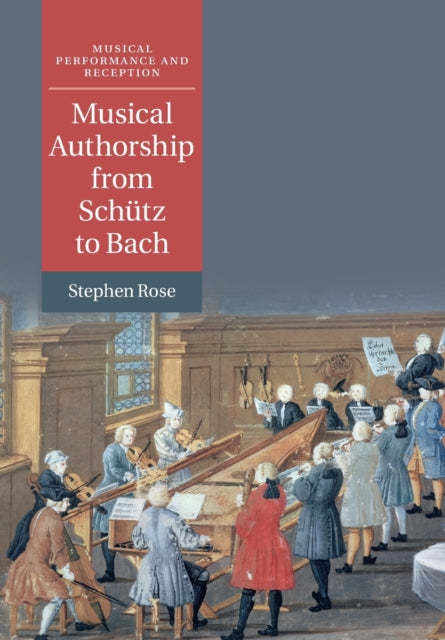
StephenRose
Musical Authorship from Schutz to Bach
Musical Authorship from Schutz to Bach
We can order this item for you. Delivery usually takes about 4 to 6 weeks.
This item is not held in our immediate stock. We will order it for you after checkout.
Estimated delivery: About 4 to 6 weeks
YOU SAVE £2.99
- Condition: Brand new
- UK Delivery times: Usually arrives within 2 - 3 working days
- UK Shipping: Fee starts at £3.89. Subject to product weight & dimension
Bulk ordering. Want 15 or more copies? Get a personalised quote and bigger discounts. Learn more about bulk orders.
Couldn't load pickup availability
- More about Musical Authorship from Schutz to Bach
The term "author" denoted Lutheran musicians in the generations between Heinrich Schütz and Johann Sebastian Bach as a dialogue between authority and individuality. This book explores changing attitudes to the self in the era between Schütz and Bach through an interdisciplinary approach.
Format: Paperback / softback
Length: 259 pages
Publication date: 12 August 2021
Publisher: Cambridge University Press
This book, a part of the Musical Performance and Reception series, delves into the examination of attitudes towards authorship in the musical realm of seventeenth-century German lands. Through a comprehensive analysis of a diverse range of archival materials, musical compositions, philosophical writings, and theological texts, this study sheds light on the concept of creativity during this period and the ways in which individual identity was projected and discerned in printed and manuscript music. By exploring the dynamics of musical ownership and regulation, the book reveals how composers sought the protection of princely authority to safeguard their publications and how town councils attempted to exert control over the compositional endeavors of their church musicians. By framing authorship as a dynamic interplay between authority and individuality, this book employs an interdisciplinary approach to investigate evolving perspectives on selfhood in the era bridging the works of Heinrich Schütz and Johann Sebastian Bach.
The term "author" denoted a specific role for Lutheran musicians in the generations between Heinrich Schütz and Johann Sebastian Bach. During this time, Lutheran musicians were recognized as composers and were expected to adhere to certain standards and conventions in their musical compositions.
One of the key aspects of authorship for Lutheran musicians was the concept of "artistic merit." Composers were expected to demonstrate their skill and creativity in their music, and their works were evaluated based on their artistic merit. This emphasis on artistic merit was a reflection of the broader cultural and intellectual trends of the time, which valued creativity and innovation.
In addition to artistic merit, Lutheran musicians were also expected to adhere to certain ethical and moral guidelines in their compositions. These guidelines were often based on the teachings of the Lutheran church, which emphasized the importance of moral behavior and the sanctity of human life. Composers were expected to avoid any content that could be considered offensive or immoral, and their music was intended to be a tool for promoting Christian values and moral behavior.
Another important aspect of authorship for Lutheran musicians was the concept of "community." Lutheran musicians were part of a larger musical community, and their compositions were intended to be performed and enjoyed by a wide audience. This emphasis on community was a reflection of the social and cultural values of the time, which emphasized the importance of social cohesion and collective identity.
To ensure the quality and integrity of their compositions, Lutheran musicians were often subject to the scrutiny and regulation of musical authorities and other stakeholders. This scrutiny was intended to ensure that the music was in line with the teachings of the Lutheran church and was not offensive or immoral. Musical authorities, such as town councils, were responsible for overseeing the compositional efforts of their church musicians and ensuring that they adhered to the prescribed standards and conventions.
Despite these regulations and guidelines, Lutheran musicians were still able to express their creativity and individuality in their compositions. Many composers during this time developed their unique styles and techniques, and their works were distinguished by their distinctive qualities and characteristics. However, they were also expected to adhere to the broader cultural and intellectual trends of the time, which valued creativity and innovation.
In conclusion, the term "author" denoted a specific role for Lutheran musicians in the generations between Heinrich Schütz and Johann Sebastian Bach. It was a reflection of the broader cultural and intellectual trends of the time, which valued creativity, innovation, ethical and moral behavior, and community. Lutheran musicians were expected to demonstrate their skill and creativity in their music, adhere to certain ethical and moral guidelines, and be subject to the scrutiny and regulation of musical authorities and other stakeholders. Despite these restrictions, Lutheran musicians were still able to express their individuality and creativity in their compositions, and their works continue to be celebrated and studied to this day.
Weight: 450g
Dimension: 171 x 243 x 19 (mm)
ISBN-13: 9781108431286
UK and International shipping information
UK and International shipping information
We deliver throughout the United Kingdom and to 128 countries and territories worldwide, including the United States, Australia, Canada, Germany, Spain and France.