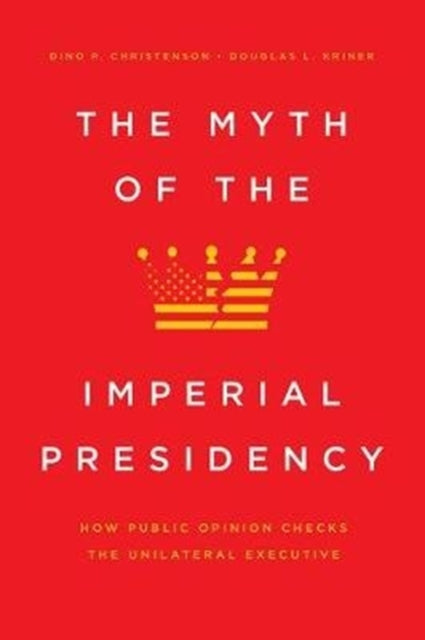
Dino P. Christenson,Douglas L. Kriner,Douglas Kriner
Myth of the Imperial Presidency - How Public Opinion Checks the Unilateral Executive
Myth of the Imperial Presidency - How Public Opinion Checks the Unilateral Executive
YOU SAVE £1.25
- Condition: Brand new
- UK Delivery times: Usually arrives within 2 - 3 working days
- UK Shipping: Fee starts at £2.39. Subject to product weight & dimension
Bulk ordering. Want 15 or more copies? Get a personalised quote and bigger discounts. Learn more about bulk orders.
Couldn't load pickup availability
- More about Myth of the Imperial Presidency - How Public Opinion Checks the Unilateral Executive
Presidents of the United States have shown a startling power to act independently of Congress and the courts, using executive orders and memoranda to take the country to war, abolish slavery, authorize widespread electronic surveillance, shield undocumented immigrants from deportation, and more. This book argues that the strength of unilateral executive action and the steep barriers for Congress and the courts to check it lies in the reactions of everyday Americans. Presidents are emboldened to pursue their own agendas when they enjoy high levels of public support, but constrained when they are down in the polls. Congress and the courts can sway the public's view via their criticism of unilateral policies, but a president who responds only to the narrow base and ignores the mass public could pose a unique threat to checks and balances.
\n Format: Paperback / softback
\n Length: 240 pages
\n Publication date: 29 September 2020
\n Publisher: The University of Chicago Press
\n
Throughout the history of the United States, the nation's presidents have displayed a remarkable ability to act independently of Congress and the courts. Using various tools such as executive orders and memoranda, presidents have taken the country to war, abolished slavery, authorized widespread electronic surveillance, shielded undocumented immigrants from deportation, and more. As a result, executive authority has been accused of veering towards the imperial at times. In this book, Dino P. Christenson and Douglas L. Kriner examine an often-overlooked question: Given the strength of unilateral executive action and the steep barriers for Congress and the courts to successfully check it, what stops presidents from asserting control even more broadly than they already do? The answer, Christenson and Kriner argue, lies in the reactions of everyday Americans. With robust empirical data and compelling case studies, the authors reveal the extent to which domestic public opinion limits executive might. Presidents are emboldened to pursue their own agendas when they enjoy high levels of public support, and constrained when they are down in the polls, as unilateral action could jeopardize future initiatives and render presidents even more politically vulnerable. Although they find little evidence that the public instinctively recoils against the use of unilateral action, Congress and the courts can sway the public's view via their criticism of unilateral policies. Thus, other branches can still check the executive branch through political means. On the whole, as long as presidents are concerned with public opinion, Christenson and Kriner contend that fears of an imperial presidency are overblown. However, a president who responds only to the narrow base and ignores the mass public could pose a unique threat.
Executive Power in the United States
Throughout the history of the United States, the nation's presidents have exhibited a startling power to act independently of Congress and the courts. Using various tools such as executive orders and memoranda, presidents have taken the country to war, abolished slavery, authorized widespread electronic surveillance, shielded undocumented immigrants from deportation, and more. As a result, executive authority
authority has been accused of veering towards the imperial at times. In this book, Dino P. Christenson and Douglas L. Kriner examine an often-overlooked question: Given the strength of unilateral executive action and the steep barriers for Congress and the courts to successfully check it, what stops presidents from asserting control even more broadly than they already do? The answer, Christenson and Kriner argue, lies in the reactions of everyday Americans. With robust empirical data and compelling case studies, the authors reveal the extent to which domestic public opinion limits executive might. Presidents are emboldened to pursue their own agendas when they enjoy high levels of public support, and constrained when they are down in the polls, as unilateral action could jeopardize future initiatives and render presidents even more politically vulnerable. Although they find little evidence that the public instinctively recoils against the use of unilateral action, Congress and the courts can sway the public's view via their criticism of unilateral policies. Thus, other branches can still check the executive branch through political means. On the whole, as long as presidents are concerned with public opinion, Christenson and Kriner contend that fears of an imperial presidency are overblown. However, a president who responds only to the narrow base and ignores the mass public could pose a unique threat.
Public Opinion and the Limits of Executive Might
The power of the presidency in the United States has been a subject of debate for centuries. While the Constitution grants the president significant executive authority, there are limits to what the president can do without the approval of Congress or the courts. One of the most controversial aspects of executive power is the use of unilateral executive action. Unilateral executive action refers to the president's ability to take action without the consent of Congress or the courts. While the president has the authority to act on his own, his actions are subject to legal challenges and may be overturned by the courts.
One of the primary arguments against unilateral executive action is that it undermines the separation of powers. The Constitution divides the government into three branches: the executive, legislative, and judicial. Each branch has its own powers and responsibilities, and the separation of powers is designed to prevent one branch from becoming too powerful. By taking action without the consent of Congress or the courts, the president can bypass the checks and balances that are intended to keep the government in check.
Another argument against unilateral executive action is that it can be used to bypass the democratic process. The president has the power to appoint judges, ambassadors, and other officials who serve in his administration. However, by taking action without the consent of Congress, the president can bypass the confirmation process and appoint officials who may not be qualified or may have conflicts of interest. This can lead to a concentration of power in the hands of a few individuals and undermine the democratic process.
Despite these arguments, unilateral executive action has been used by presidents throughout the history of the United States. Some of the most notable examples include President Abraham Lincoln's Emancipation Proclamation, which abolished slavery in the United States, and President Franklin D. Roosevelt's New Deal, which implemented a series of economic reforms to address the Great Depression.
In recent years, there has been a growing concern about the extent to which the president can assert executive power without the consent of Congress or the courts. Some critics argue that the president has become too powerful and that the checks and balances that are intended to keep the government in check have been eroded. In response, Congress has taken steps. In 2012, Congress passed the Affordable Care Act, which required individuals to purchase health insurance or pay a fine. The law was challenged in the Supreme Court, and the court ruled that the individual mandate was constitutional. However, the court also ruled that the law's Medicaid expansion was unconstitutional, and the law was struck down in 2017.
In 2016, Congress passed the Tax Cuts and Jobs Act, which reduced taxes for individuals and corporations. The law was challenged in the Supreme Court, and the court ruled that the law was constitutional. However, the court also ruled that the law's tax cuts for corporations were unconstitutional, and the law was struck down in 2021.
In conclusion, the power of the presidency in the United States is significant, but there are limits to what the president can do without the approval of Congress or the courts. Unilateral executive action is a controversial topic that has been used by presidents throughout the history of the United States to achieve their goals. While the president has the power to act on his own, his actions are subject to legal challenges and may be overturned by the courts. Critics argue that unilateral executive action undermines the separation of powers, bypasses the democratic process, and concentrates power in the hands of a few individuals. In response, Congress has taken action to limit the president's power, such as passing the Affordable Care Act and the Tax Cuts and Jobs Act. However, the extent to which the president can assert executive power without the consent of Congress or the courts remains a topic of debate.
\n Weight: 418g\n
Dimension: 153 x 229 x 19 (mm)\n
ISBN-13: 9780226704364\n \n
This item can be found in:
UK and International shipping information
UK and International shipping information
UK Delivery and returns information:
- Delivery within 2 - 3 days when ordering in the UK.
- Shipping fee for UK customers from £2.39. Fully tracked shipping service available.
- Returns policy: Return within 30 days of receipt for full refund.
International deliveries:
Shulph Ink now ships to Australia, Belgium, Canada, France, Germany, Ireland, Italy, India, Luxembourg Saudi Arabia, Singapore, Spain, Netherlands, New Zealand, United Arab Emirates, United States of America.
- Delivery times: within 5 - 10 days for international orders.
- Shipping fee: charges vary for overseas orders. Only tracked services are available for most international orders. Some countries have untracked shipping options.
- Customs charges: If ordering to addresses outside the United Kingdom, you may or may not incur additional customs and duties fees during local delivery.