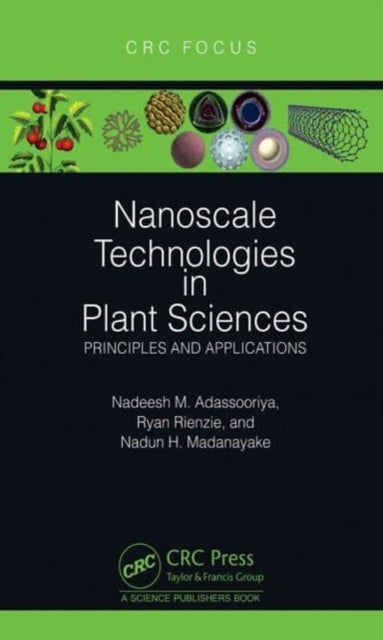
NadeeshM. Adassooriya,RyanRienzie,NadunH. Madanayake
Nanoscale Technologies in Plant Sciences: Principles and Applications
Nanoscale Technologies in Plant Sciences: Principles and Applications
💎 Earn 250 Points (£2.50) on this item.
We can order this item for you. Delivery usually takes about 4 to 6 weeks.
This item is not held in our immediate stock. We will order it for you after checkout.
Estimated delivery: About 4 to 6 weeks
YOU SAVE £2.97
- Condition: Brand new
- UK Delivery times: Usually arrives within 2 - 3 working days
- UK Shipping: Fee starts at £2.39. Subject to product weight & dimension
Bulk ordering. Want 15 or more copies? Get a personalised quote and bigger discounts. Learn more about bulk orders.
Couldn't load pickup availability
- More about Nanoscale Technologies in Plant Sciences: Principles and Applications
Nanotechnology fundamentals, nanomaterial synthesis, characterization, nanoparticle intake and translocation in plants, impact on seed germination and plant growth, nanodelivery systems, and nanosensors for plant disease diagnosis, and toxic impacts of nanomaterials on plants are discussed.
Format: Hardback
Length: 108 pages
Publication date: 27 April 2023
Publisher: Taylor & Francis Ltd
Nanotechnology is a rapidly evolving field that encompasses the synthesis, characterization, and application of nanomaterials. These tiny particles, which range in size from a few nanometers to several micrometers, possess unique properties that make them highly valuable in various industries, including electronics, medicine, and agriculture.
Nanomaterials can be synthesized using a wide range of methods, including bottom-up and top-down approaches. Bottom-up synthesis involves the gradual assembly of nanomaterials from smaller molecules or atoms, while top-down synthesis involves the direct manipulation of larger molecules or materials to produce nanomaterials.
One of the key challenges in nanotechnology is the characterization of nanomaterials. This involves using a variety of techniques, such as scanning electron microscopy (SEM), transmission electron microscopy (TEM), X-ray diffraction (XRD), and Raman spectroscopy, to determine the size, shape, and structure of nanomaterials.
Nanomaterials have the potential to revolutionize various industries, including agriculture. For example, nanomaterials can be used to enhance the efficiency of fertilizers, pesticides, and herbicides, improving crop yields and reducing environmental impact. Nanomaterials can also be used to improve the quality of food by reducing the presence of harmful bacteria and viruses.
In addition to agriculture, nanotechnology has applications in medicine. Nanomaterials can be used to deliver drugs to specific cells or tissues, improving the effectiveness of treatments and reducing side effects. Nanomaterials can also be used to diagnose and treat diseases, such as cancer and Alzheimer's disease.
However, the use of nanomaterials also raises concerns about their toxic impacts on plants and the environment. Nanomaterials can be harmful to plants in several ways, including by interfering with their growth and development, causing damage to their cells and tissues, and disrupting their natural processes.
To address these concerns, researchers are developing new methods for the safe and efficient use of nanomaterials in agriculture and other industries. This includes the use of biodegradable and non-toxic nanomaterials, as well as the development of nanosensors and nanodelivery systems that can target specific cells or tissues without harming other parts of the plant or organism.
In conclusion, nanotechnology is a rapidly evolving field that has the potential to revolutionize various industries, including agriculture and medicine. While nanomaterials have many benefits, it is important to ensure that their use is safe and environmentally responsible. By developing new methods for the characterization and delivery of nanomaterials, researchers can help to maximize the benefits of nanotechnology while minimizing its toxic impacts.
Weight: 274g
Dimension: 142 x 224 x 13 (mm)
ISBN-13: 9781032387925
This item can be found in:
UK and International shipping information
UK and International shipping information
UK Delivery and returns information:
- Delivery within 2 - 3 days when ordering in the UK.
- Shipping fee for UK customers from £2.39. Fully tracked shipping service available.
- Returns policy: Return within 30 days of receipt for full refund.
International deliveries:
Shulph Ink now ships to Australia, Belgium, Canada, France, Germany, Ireland, Italy, India, Luxembourg Saudi Arabia, Singapore, Spain, Netherlands, New Zealand, United Arab Emirates, United States of America.
- Delivery times: within 5 - 10 days for international orders.
- Shipping fee: charges vary for overseas orders. Only tracked services are available for most international orders. Some countries have untracked shipping options.
- Customs charges: If ordering to addresses outside the United Kingdom, you may or may not incur additional customs and duties fees during local delivery.