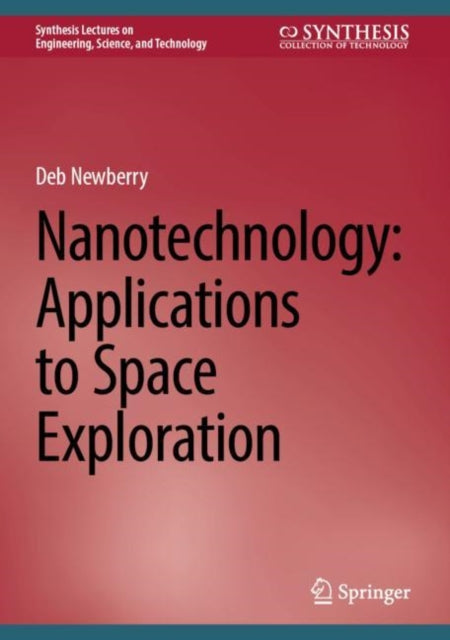
Deb Newberry
Nanotechnology: Applications to Space Exploration
Nanotechnology: Applications to Space Exploration
💎 Earn 185 Points (£1.85) on this item.
We can order this item for you. Delivery usually takes about 4 to 6 weeks.
This item is not held in our immediate stock. We will order it for you after checkout.
Estimated delivery: About 4 to 6 weeks
YOU SAVE £7.83
- Condition: Brand new
- UK Delivery times: Usually arrives within 2 - 3 working days
- UK Shipping: Fee starts at £2.39. Subject to product weight & dimension
Bulk ordering. Want 15 or more copies? Get a personalised quote and bigger discounts. Learn more about bulk orders.
Couldn't load pickup availability
- More about Nanotechnology: Applications to Space Exploration
Nanotechnology has resulted in a synergy of discoveries and innovations that may lead to leaps in space exploration and improve life on Earth. This book is a must for people in the "space" industry and nanotechnology arena who need to understand the challenges of space exploration and nano-scale implications for the future.
Format: Hardback
Length: 97 pages
Publication date: 04 January 2024
Publisher: Springer International Publishing AG
The convergence of space exploration and the increasing understanding of the world at the atomic and molecular levels has led to a remarkable synergy of discoveries and innovations, known as nanotechnology. This convergence has the potential to revolutionize our understanding of the universe and our place within it.
One of the most exciting implications of nanotechnology is the possibility of exploring beyond the surface of the Earth. With the development of advanced spacecraft and propulsion systems, we may be able to travel to distant planets and explore their unique environments and geological features. This could lead to the discovery of new life forms, the expansion of our knowledge of the universe, and the potential for human colonization of other worlds.
In addition to its potential for space exploration, nanotechnology has the potential to improve life on Earth. By developing new materials and technologies that are more efficient, sustainable, and affordable, we may be able to address some of the most pressing global challenges, such as climate change, poverty, and healthcare. For example, nanotechnology may be used to create new renewable energy sources, develop sustainable agriculture practices, and create new medical treatments that are more effective and less invasive.
However, the development and application of nanotechnology also present significant challenges. One of the biggest challenges is ensuring the safety and ethical implications of nanotechnology. As nanomaterials become increasingly small and complex, it becomes difficult to predict their behavior and potential impacts on human health and the environment. There is also the risk of unintended consequences, such as the creation of new weapons or the disruption of natural ecosystems.
To address these challenges, it is important to engage in ongoing research and development in nanotechnology. This includes developing new safety protocols and regulations, as well as investing in education and public awareness to promote responsible and ethical use of nanotechnology. It is also important to collaborate with other scientific disciplines, such as biology, chemistry, and physics, to ensure that nanotechnology is developed in a way that is compatible with the natural world and promotes human well-being.
In conclusion, the convergence of space exploration and nanotechnology has the potential to revolutionize our understanding of the universe and our place within it. While there are significant challenges to be addressed, ongoing research and development in nanotechnology can help us to realize the full potential of this exciting field. By working together to promote responsible and ethical use of nanotechnology, we can create a better future for ourselves and for generations to come.
The convergence of space exploration and the increasing understanding of the world at the atomic and molecular levels has led to a remarkable synergy of discoveries and innovations, known as nanotechnology. This convergence has the potential to revolutionize our understanding of the universe and our place within it.
One of the most exciting implications of nanotechnology is the possibility of exploring beyond the surface of the Earth. With the development of advanced spacecraft and propulsion systems, we may be able to travel to distant planets and explore their unique environments and geological features. This could lead to the discovery of new life forms, the expansion of our knowledge of the universe, and the potential for human colonization of other worlds.
In addition to its potential for space exploration, nanotechnology has the potential to improve life on Earth. By developing new materials and technologies that are more efficient, sustainable, and affordable, we may be able to address some of the most pressing global challenges, such as climate change, poverty, and healthcare. For example, nanotechnology may be used to create new renewable energy sources, develop sustainable agriculture practices, and create new medical treatments that are more effective and less invasive.
However, the development and application of nanotechnology also present significant challenges. One of the biggest challenges is ensuring the safety and ethical implications of nanotechnology. As nanomaterials become increasingly small and complex, it becomes difficult to predict their behavior and potential impacts on human health and the environment. There is also the risk of unintended consequences, such as the creation of new weapons or the disruption of natural ecosystems.
To address these challenges, it is important to engage in ongoing research and development in nanotechnology. This includes developing new safety protocols and regulations, as well as investing in education and public awareness to promote responsible and ethical use of nanotechnology. It is also important to collaborate with other scientific disciplines, such as biology, chemistry, and physics, to ensure that nanotechnology is developed in a way that is compatible with the natural world and promotes human well-being.
In conclusion, the convergence of space exploration and nanotechnology has the potential to revolutionize our understanding of the universe and our place within it. While there are significant challenges to be addressed, ongoing research and development in nanotechnology can help us to realize the full potential of this exciting field. By working together to promote responsible and ethical use of nanotechnology, we can create a better future for ourselves and for generations to come.
Weight: 372g
Dimension: 240 x 168 (mm)
ISBN-13: 9783031486449
Edition number: 1st ed. 2024
This item can be found in:
UK and International shipping information
UK and International shipping information
UK Delivery and returns information:
- Delivery within 2 - 3 days when ordering in the UK.
- Shipping fee for UK customers from £2.39. Fully tracked shipping service available.
- Returns policy: Return within 30 days of receipt for full refund.
International deliveries:
Shulph Ink now ships to Australia, Belgium, Canada, France, Germany, Ireland, Italy, India, Luxembourg Saudi Arabia, Singapore, Spain, Netherlands, New Zealand, United Arab Emirates, United States of America.
- Delivery times: within 5 - 10 days for international orders.
- Shipping fee: charges vary for overseas orders. Only tracked services are available for most international orders. Some countries have untracked shipping options.
- Customs charges: If ordering to addresses outside the United Kingdom, you may or may not incur additional customs and duties fees during local delivery.