Gary Rosenshield
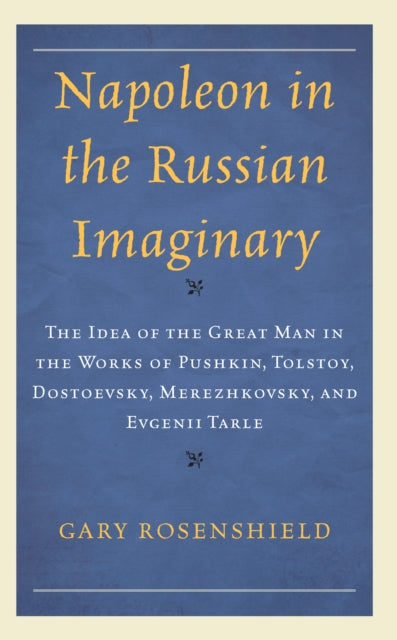
Napoleon in the Russian Imaginary: The Idea of the Great Man in the Works of Pushkin, Tolstoy, Dostoevsky, Merezhkovsky, and Evgenii Tarle
Napoleon in the Russian Imaginary: The Idea of the Great Man in the Works of Pushkin, Tolstoy, Dostoevsky, Merezhkovsky, and Evgenii Tarle
💎 Earn 451 Points (£4.51) on this item.
We can order this item for you. Delivery usually takes about 4 to 6 weeks.
This item is not held in our immediate stock. We will order it for you after checkout.
Estimated delivery: About 4 to 6 weeks
- Condition: Brand new
- UK Delivery times: Usually arrives within 2 - 3 working days
- UK Shipping: Fee starts at £2.39. Subject to product weight & dimension
Bulk ordering. Want 15 or more copies? Get a personalised quote and bigger discounts. Learn more about bulk orders.
Couldn't load pickup availability
- More about Napoleon in the Russian Imaginary: The Idea of the Great Man in the Works of Pushkin, Tolstoy, Dostoevsky, Merezhkovsky, and Evgenii Tarle
Napoleon's legacy continues to fascinate both admirers and detractors, particularly in Russia. Napoleon in the Russian Imaginary explores how Russia's greatest writers responded to the idea of the Great Man as an agent of transformational change, focusing on Napoleon's desire for world conquest and unbridled ambition. Russian writers saw this as potentially determining the spiritual and moral fate of future generations, and engaged in a creative dialogue to confront each other about this idea.
Format: Hardback
Length: 244 pages
Publication date: 15 April 2023
Publisher: Lexington Books
Napoleon, a captivating figure in European history, continues to fascinate both his admirers and detractors due to his pivotal role in the late 18th and early 19th centuries, spanning the French Revolution and the vast empire he created through military conquest. Napoleon in the Russian Imaginary delves into the response of Russia's foremost writers, including poets, novelists, critics, and historians, to the concept of the Great Man as an agent of transformative change, particularly in the person and career of Napoleon.
Following Napoleon's defeat at Waterloo in 1815 and his subsequent exile to St. Helena, a re-evaluation of Napoleon's person, stature, and historical significance took place in much of Europe. As thinkers and writers witnessed the gradual reestablishment of repressive regimes throughout Europe, they began to question Napoleon's legacy. However, in Russia, this re-evaluation had to wait until Napoleon's death in 1821.
When it did occur, it continued to occupy the imagination of Russia's greatest writers for over 130 years. While Napoleon's invasion of Russia and subsequent defeat had a profound impact on Russian culture and history, for Russian writers, the most significant aspect was the universal significance of Napoleon's desire for world conquest and the idea of unbridled ambition that he embodied. Russian writers saw this as potentially determining the spiritual and moral fate of future generations.
What is particularly fascinating is the creative dialogue that Russian writers engaged in, addressing each other and responding to their predecessors. Each succeeding writer took up the challenge of confronting the idea of ambition and world conquest, building upon the insights and perspectives of his predecessors. This intellectual exchange resulted in a rich tapestry of writings that explored the complexities of ambition, power, and the human condition.
Through their writings, Russian writers sought to understand the implications of Napoleon's legacy for their own country and the world. They debated the merits and demerits of ambition, questioning whether it was a force for good or evil. They explored the consequences of unchecked ambition, both in terms of personal gain and the broader impact on society.
Some Russian writers celebrated Napoleon as a hero, admiring his military prowess and his vision for a unified Europe. They saw him as a symbol of national pride and a champion of the underdog. Others, however, condemned him as a tyrant, criticizing his disregard for human rights and his expansionist policies.
Regardless of their stance, Russian writers recognized the power of ambition and the potential for it to shape the course of history. They saw Napoleon as a cautionary tale, warning against the dangers of unchecked power and the need for moderation and balance.
In conclusion, Napoleon in the Russian Imaginary offers a unique perspective on the legacy of Napoleon in Russian culture and history. Through the creative dialogue of Russian writers, we gain insight into the complex and multifaceted response to the idea of the Great Man and the universal significance of ambition. This exploration of the human condition continues to resonate with readers today, reminding us of the enduring power of history and the importance of confronting our own ambitions and desires.
Weight: 535g
Dimension: 238 x 156 x 24 (mm)
ISBN-13: 9781666925227
This item can be found in:
UK and International shipping information
UK and International shipping information
UK Delivery and returns information:
- Delivery within 2 - 3 days when ordering in the UK.
- Shipping fee for UK customers from £2.39. Fully tracked shipping service available.
- Returns policy: Return within 30 days of receipt for full refund.
International deliveries:
Shulph Ink now ships to Australia, Belgium, Canada, France, Germany, Ireland, Italy, India, Luxembourg Saudi Arabia, Singapore, Spain, Netherlands, New Zealand, United Arab Emirates, United States of America.
- Delivery times: within 5 - 10 days for international orders.
- Shipping fee: charges vary for overseas orders. Only tracked services are available for most international orders. Some countries have untracked shipping options.
- Customs charges: If ordering to addresses outside the United Kingdom, you may or may not incur additional customs and duties fees during local delivery.