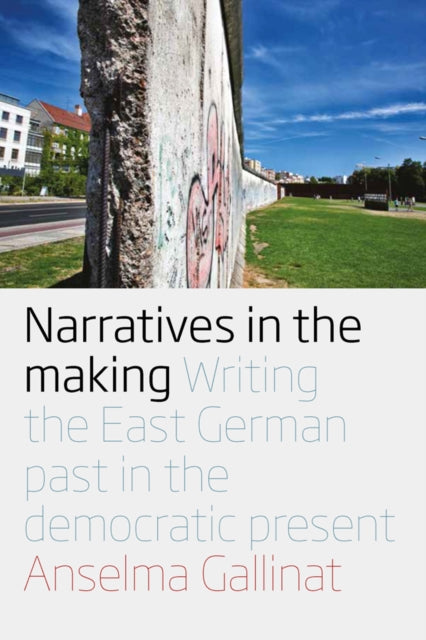
Anselma Gallinat
Narratives in the Making: Writing the East German Past in the Democratic Present
Narratives in the Making: Writing the East German Past in the Democratic Present
We can order this item for you. Delivery usually takes about 4 to 6 weeks.
This item is not held in our immediate stock. We will order it for you after checkout.
Estimated delivery: About 4 to 6 weeks
YOU SAVE £4.85
- Condition: Brand new
- UK Delivery times: Usually arrives within 2 - 3 working days
- UK Shipping: Fee starts at £3.89. Subject to product weight & dimension
Bulk ordering. Want 15 or more copies? Get a personalised quote and bigger discounts. Learn more about bulk orders.
Couldn't load pickup availability
- More about Narratives in the Making: Writing the East German Past in the Democratic Present
The historical narrative of East Germany is still evolving, with public funded organizations casting the GDR as a dictatorship and a regional newspaper offering a more ambivalent perspective. This memory work shapes citizenship and democracy in the present.
Format: Paperback / softback
Length: 242 pages
Publication date: 11 June 2021
Publisher: Berghahn Books
Even after three decades have passed since the fall of the Berlin Wall, the historical narrative of East Germany remains somewhat fluid in the public consciousness of Germany. The country continues to struggle with the enduring legacies of the Cold War, shaping its societal dynamics and attitudes. This captivating ethnography delves into the contrasting approaches taken by two distinct local institutions in one eastern German state when addressing the legacies of the GDR (German Democratic Republic). While publicly funded organizations tend to portray the GDR as a dictatorship, a prominent regional newspaper offers a more nuanced and reader-oriented perspective, influenced by the experiences and concerns of its audience. As author Anselma Gallinat demonstrates, the process of shaping memories, initially initiated during significant regime changes, inevitably impacts citizenship and democracy in the present.
The fall of the Berlin Wall in 1989 marked a pivotal moment in European history, symbolizing the end of the Cold War and the reunification of Germany. However, the legacy of the GDR, the communist state that existed in East Germany until 1990, continues to be a subject of debate and discussion in German society. This ethnography explores the contrasting perspectives of two local institutions in one eastern German state regarding the GDR's legacy.
On the one hand, publicly funded organizations, such as museums and historical societies, tend to present a one-sided narrative that portrays the GDR as a totalitarian regime that suppressed freedom and human rights. These institutions often rely on government funding and support, which may influence their interpretation of history. They may highlight the negative aspects of the GDR's regime, such as the Berlin Wall, the Stasi (secret police), and the lack of political and economic freedom.
On the other hand, a regional newspaper, known for its independent reporting and reader engagement, offers a more nuanced and complex perspective on the GDR's legacy. The newspaper's editorial team takes into account the experiences and concerns of its readers, who lived through the GDR's regime. The newspaper may provide a broader range of viewpoints, including those of ordinary citizens, activists, and politicians who played a role in shaping the GDR's history.
The ethnography highlights the importance of memory work in shaping public perceptions and understanding of history. It shows how the narratives presented by different institutions can influence how individuals perceive and interpret the past. It also emphasizes the need for a balanced and nuanced approach to history, one that considers a variety of perspectives and sources.
The GDR's legacy is complex and multifaceted, encompassing political, economic, social, and cultural aspects. The ethnography explores these different dimensions, providing insights into the experiences of ordinary citizens, activists, and politicians who lived through the GDR's regime. It also examines the political and economic challenges that the country faced after the fall of the Berlin Wall, including the process of reunification and the transition to a market-oriented economy.
The ethnography raises important questions about the role of institutions in shaping historical narratives and the responsibility of journalists and historians to provide accurate and unbiased information to the public. It also highlights the ongoing struggle of German society to come to terms with the legacies of the Cold War, including the impact of the GDR on its citizens and the broader European context.
In conclusion, this ethnography provides a valuable contribution to the study of the GDR's legacy in German society. It offers a nuanced and complex perspective on the legacy of the GDR, challenging the one-sided narratives that are often presented in public institutions. By examining the experiences and perspectives of different individuals and institutions, the ethnography sheds light on the complex and multifaceted nature of the GDR's history and its impact on contemporary German society.
Weight: 366g
Dimension: 151 x 230 x 18 (mm)
ISBN-13: 9781800730083
UK and International shipping information
UK and International shipping information
We deliver throughout the United Kingdom and to 128 countries and territories worldwide, including the United States, Australia, Canada, Germany, Spain and France.