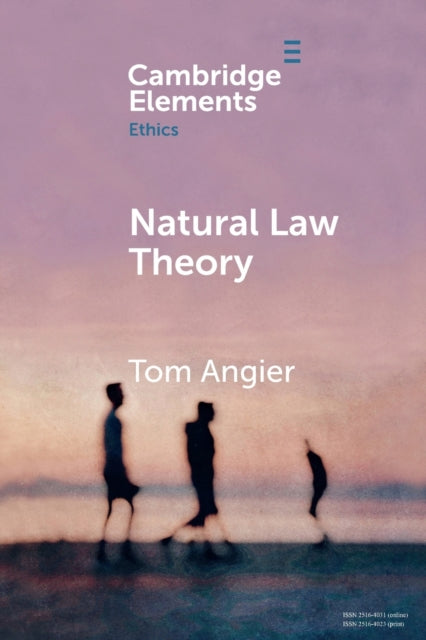
TomAngier
Natural Law Theory
Natural Law Theory
💎 Earn 84 Points (£0.84) on this item.
We can order this item for you. Delivery usually takes about 4 to 6 weeks.
This item is not held in our immediate stock. We will order it for you after checkout.
Estimated delivery: About 4 to 6 weeks
YOU SAVE £1.01
- Condition: Brand new
- UK Delivery times: Usually arrives within 2 - 3 working days
- UK Shipping: Fee starts at £3.89. Subject to product weight & dimension
Bulk ordering. Want 15 or more copies? Get a personalised quote and bigger discounts. Learn more about bulk orders.
Couldn't load pickup availability
- More about Natural Law Theory
Natural law theory has a long history, dating back to Plato, Aristotle, the Stoics, and Aquinas. Two alternative traditions, namely, utilitarianism and contractualism, rival the Aristotelian tradition. A via negativa approach can be used to discover natural law norms, illustrated by three experiments. Challenges to natural law methodology include the fact/value distinction and Darwinian evolutionary biology. A new natural law theory attempts to revise natural law thought in light of these challenges, but it is criticized for failing to address them adequately.
Format: Paperback / softback
Length: 75 pages
Publication date: 16 September 2021
Publisher: Cambridge University Press
The history of natural law theory is a rich and complex subject that spans centuries, encompassing the works of influential thinkers such as Plato, Aristotle, the Stoics, and Aquinas. In this essay, we will explore the development of natural law theory, its rival traditions, and the methodology used to discover natural law norms.
Section 1: The History of Natural Law Theory
Plato: Plato, one of the most influential philosophers of ancient Greece, is considered the founder of Western natural law theory. In his works, such as the Republic and the Laws, Plato argued that the natural world is governed by a set of universal moral principles that apply to all individuals and societies. These principles are based on the idea of the "good," which is defined as the ultimate goal of human existence and the source of all moral value.
Aristotle: Aristotle, Plato's student, built upon his teacher's ideas and developed a comprehensive system of natural law theory. In his works, such as the Nicomachean Ethics and the Politics, Aristotle argued that the natural world is governed by a set of universal moral principles that apply to all individuals and societies. These principles are based on the idea of the "good," which is defined as the ultimate goal of human existence and the source of all moral value.
The Stoics: The Stoics, a group of ancient Greek philosophers, believed that the natural world is governed by a set of impersonal moral laws that apply to all individuals and societies. These laws are based on the idea of "virtue," which is defined as the harmonious integration of one's desires and beliefs with the natural world. The Stoics believed that individuals could achieve virtue by living according to these moral laws and that this would lead to a happy and fulfilling life.
Aquinas: Aquinas, a Catholic philosopher and theologian, developed a comprehensive system of natural law theory that is based on the teachings of Aristotle and the Bible. In his works, such as the Summa Theologica and the Summa contra Gentiles, Aquinas argued that the natural world is governed by a set of universal moral principles that apply to all individuals and societies. These principles are based on the idea of the "good," which is defined as the ultimate goal of human existence and the source of all moral value.
Section 2: Alternative Traditions of Natural Law
Two alternative traditions of natural law have emerged in recent years, which are rivals to the Aristotelian tradition. These traditions are the "conservative" tradition and the "progressive" tradition.
The conservative tradition of natural law is based on the idea that natural law is a set of timeless moral principles that apply to all individuals and societies. The conservative tradition emphasizes the importance of tradition, stability, and the rule. The conservative tradition also emphasizes the importance of the natural law tradition's historical roots, which include the works of Plato, Aristotle, and Aquinas.
The progressive tradition of natural law is based on the idea that natural law is a set of evolving moral principles that apply to all individuals and societies. The progressive tradition emphasizes the importance of social justice, equality, and human rights. The progressive tradition also emphasizes the importance of the natural law tradition's historical roots, which include the works of Plato, Aristotle, and Aquinas.
Section 3: A Via Negativa Approach to Natural Law Norms
A via negativa approach to natural law norms is a method that involves identifying the negative consequences of certain actions and then inferring the moral principles that would prohibit those actions. This approach is based on the idea that the natural world is governed by a set of universal moral principles that apply to all individuals and societies.
To illustrate the cogency of this method, we will consider three experiments in being.
Experiment 1: The Experiment of the Golden Rule
The Experiment of the Golden Rule involves asking individuals to imagine that they are in a situation where they are being treated unfairly by another individual. The individual is then asked to imagine what they would want the other individual to do in the same situation. The individual is then asked to imagine what they would want the other individual to do in the same situation.
Experiment 2: The Experiment of the Just War
The Experiment of the Just War involves asking individuals to imagine that they are in a situation where they are being attacked by another individual or group. The individual is then asked to imagine what they would want the other individual or group to do in the same situation. The individual is then asked to imagine what they would want the other individual or group to do in the same situation.
Experiment 3: The Experiment of the Universal Declaration of Human Rights
The Experiment of the Universal Declaration of Human Rights involves asking individuals to imagine that they are in a situation where they are being treated unfairly by another individual or group. The individual is then asked to imagine what they would want the other individual or group to do in the same situation. The individual is then asked to imagine what they would want the other individual or group to do in the same situation.
Section 4: Challenges to Natural Law Methodology
Two seminal challenges to natural law methodology have been raised in recent years. These challenges are the fact/value distinction in metaethics and Darwinian evolutionary biology.
The fact/value distinction in metaethics is a distinction between facts and values. Facts are objective and can be observed and measured, while values are subjective and can be interpreted and valued differently by different individuals. The fact/value distinction in metaethics has been used to argue that natural law norms cannot be derived from empirical observations of the natural world.
Darwinian evolutionary biology is a theory of evolution that explains the development of species over time through natural selection. Darwinian evolutionary biology has been used to argue that natural law norms cannot be derived from empirical observations of the natural world.
Section 5: A New Natural Law Theory
A new natural law theory has been proposed in response to the two challenges above. This theory is an attempt to revise natural law thought in light of the fact/value distinction in metaethics and Darwinian evolutionary biology.
The new natural law theory proposes that natural law norms can be derived from a combination of empirical observations of the natural world and philosophical reasoning. The new natural law theory also proposes that natural law norms can be derived from a combination of empirical observations of the natural world and philosophical reasoning.
Section 6: Conclusion and Reflections
In conclusion, natural law theory is a rich and complex subject that spans centuries of philosophical inquiry. The history of natural law theory encompasses the works of influential thinkers such as Plato, Aristotle, the Stoics, and Aquinas. In this essay, we have explored the development of natural law theory, its rival traditions, and the methodology used to discover natural law norms.
Two alternative traditions of natural law have emerged in recent years, which are rivals to the Aristotelian tradition. These traditions are the "conservative" tradition and the "progressive" tradition. The conservative tradition of natural law is based on the idea that natural law is a set of timeless moral principles that apply to all individuals and societies. The progressive tradition of natural law is based on the idea that natural law is a set of evolving moral principles that apply to all individuals and societies.
A via negativa approach to natural law norms is a method that involves identifying the negative consequences of certain actions and then inferring the moral principles that would prohibit those actions. This approach is based on the idea that the natural world is governed by a set of universal moral principles that apply to all individuals and societies.
Two seminal challenges to natural law methodology have been raised in recent years. These challenges are the fact/value distinction in metaethics and Darwinian evolutionary biology.
A new natural law theory has been proposed in response to the two challenges above. This theory is an attempt to revise natural law thought in light of the fact/value distinction in metaethics and Darwinian evolutionary biology.
In conclusion, natural law theory is a rich and complex subject that spans centuries of philosophical inquiry. The history of natural law theory encompasses the works of influential thinkers such as Plato, Aristotle, the Stoics, and Aquinas. In this essay, we have explored the development of natural law theory, its rival traditions, and the methodology used to discover natural law norms. The fact/value distinction in metaethics and Darwinian evolutionary biology are two seminal challenges to natural law methodology that have been raised in recent years. A new natural law theory has been proposed in response to these challenges, which is an attempt to revise natural law thought in light of the fact/value distinction in metaethics and Darwinian evolutionary biology.
Weight: 110g
Dimension: 152 x 228 x 8 (mm)
ISBN-13: 9781108706391
UK and International shipping information
UK and International shipping information
We deliver throughout the United Kingdom and to 128 countries and territories worldwide, including the United States, Australia, Canada, Germany, Spain and France.