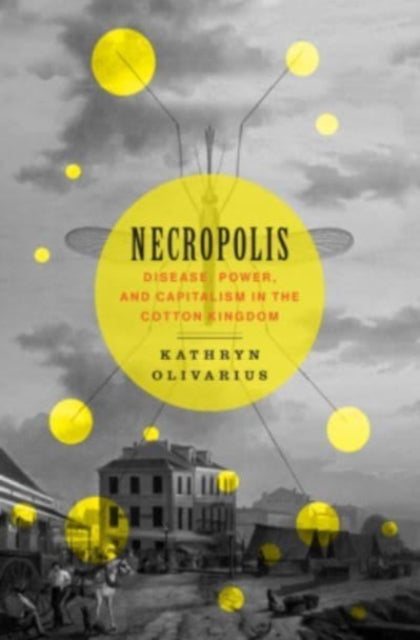
Kathryn Olivarius
Necropolis: Disease, Power, and Capitalism in the Cotton Kingdom
Necropolis: Disease, Power, and Capitalism in the Cotton Kingdom
💎 Earn 82 Points (£0.82) on this item.
YOU SAVE £14.51
- Condition: Brand new
- UK Delivery times: Usually arrives within 2 - 3 working days
- UK Shipping: Fee starts at £2.39. Subject to product weight & dimension
Bulk ordering. Want 15 or more copies? Get a personalised quote and bigger discounts. Learn more about bulk orders.
Couldn't load pickup availability
- More about Necropolis: Disease, Power, and Capitalism in the Cotton Kingdom
In antebellum New Orleans, yellow fever epidemics killed as many as 150,000 people during the nineteenth century. Disease was thought to be a great leveler of humanity, but acquiring immunity from the scourge of yellow fever magnified the brutal inequities of slave-powered capitalism. Kathryn Olivarius' analysis shows that white survivors could leverage their immunity as evidence of their biological dues, while enslaved Blacks saw the social and monetary value of their acclimation accrue to their white owners. Immunity conferred opportunity and privilege on whites, while it relegated enslaved people to the most grueling labor.
Format: Hardback
Length: 352 pages
Publication date: 03 May 2022
Publisher: Harvard University Press
Disease is often seen as a universal leveller of humanity, but in the antebellum city of New Orleans, acquiring immunity from the yellow fever scourge exacerbated the brutal inequalities inherent in slave-powered capitalism.
New Orleans, situated at the crossroads of America's slave and cotton kingdoms, was also the epicenter of devastating yellow fever epidemics that claimed the lives of up to 150,000 people during the 19th century. With limited knowledge of mosquito-borne viruses and inadequate public health infrastructure, individuals' only defense against the disease was to "get acclimated" by surviving the illness. Approximately half of those who contracted yellow fever succumbed to its devastating effects.
Repeated outbreaks of yellow fever further reinforced New Orleans's strict racial hierarchy by introducing a new hierarchy, known as "immunocapital," as described by Kathryn Olivarius in her groundbreaking analysis. White survivors of the disease could leverage their immunity as proof of their biological worth and pursue economic and political advancement. In contrast, enslaved Blacks faced a different reality. While immunity protected them from yellow fever, it also served as embodied capital, with the social and monetary value of their acclimation accruing to their white owners. While immunity bestowed opportunities and privileges on whites, it relegated enslaved people to the most arduous and exploitative labor.
The question of good health, who possesses it and who lacks it, and the underlying political dimensions are inseparable. Necropolis, a novel that delves into the history of New Orleans during the 19th century, vividly illustrates how powerful white Orleanians, ostensibly immune to yellow fever, pushed the boundaries of this politics to extreme levels. They constructed a society that capitalized on mortal risk, equating perceived immunity with creditworthiness and reliability. Rather than attempting to curb yellow fever through sanitation or quarantines, immune white Orleanians capitalized on the chaos and disruption caused by the disease. This approach, known as immunological dissonance, allowed them to exploit the vulnerabilities of others while maintaining their own perceived immunity.
Necropolis sheds light on the complex interplay between disease, immunity, and power, highlighting the ways in which historical circumstances shaped the lives and fortunes of different groups in New Orleans. It serves as a cautionary tale, reminding us of the enduring legacies of inequality and the importance of addressing the root causes of health disparities in our society.
Dimension: 235 x 156 (mm)
ISBN-13: 9780674241053
This item can be found in:
UK and International shipping information
UK and International shipping information
UK Delivery and returns information:
- Delivery within 2 - 3 days when ordering in the UK.
- Shipping fee for UK customers from £2.39. Fully tracked shipping service available.
- Returns policy: Return within 30 days of receipt for full refund.
International deliveries:
Shulph Ink now ships to Australia, Belgium, Canada, France, Germany, Ireland, Italy, India, Luxembourg Saudi Arabia, Singapore, Spain, Netherlands, New Zealand, United Arab Emirates, United States of America.
- Delivery times: within 5 - 10 days for international orders.
- Shipping fee: charges vary for overseas orders. Only tracked services are available for most international orders. Some countries have untracked shipping options.
- Customs charges: If ordering to addresses outside the United Kingdom, you may or may not incur additional customs and duties fees during local delivery.