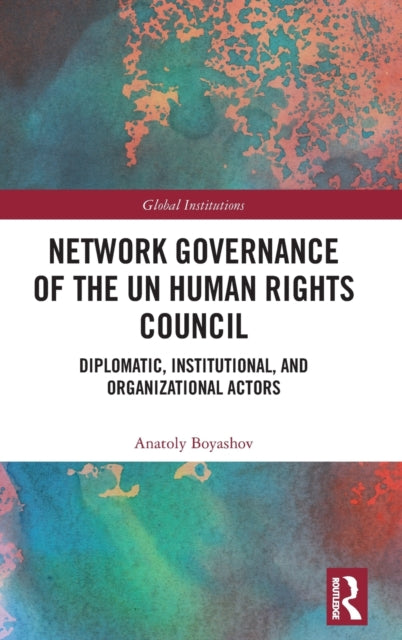
AnatolyBoyashov
Network Governance of the UN Human Rights Council: Diplomatic, Institutional, and Organizational Actors
Network Governance of the UN Human Rights Council: Diplomatic, Institutional, and Organizational Actors
💎 Earn 811 Points (£8.11) on this item.
We can order this item for you. Delivery usually takes about 4 to 6 weeks.
This item is not held in our immediate stock. We will order it for you after checkout.
Estimated delivery: About 4 to 6 weeks
YOU SAVE £9.63
- Condition: Brand new
- UK Delivery times: Usually arrives within 2 - 3 working days
- UK Shipping: Fee starts at £3.89. Subject to product weight & dimension
Bulk ordering. Want 15 or more copies? Get a personalised quote and bigger discounts. Learn more about bulk orders.
Couldn't load pickup availability
- More about Network Governance of the UN Human Rights Council: Diplomatic, Institutional, and Organizational Actors
This book explores how international organizations' structures have become complex, why states choose to join networks alongside non-state actors, and how this involvement provides better communication capacities. It studies the UN Human Rights Council and its diplomatic, institutional, and organizational networks, focusing on visible stakeholders, the institutional setting, and multilateral negotiations on human rights violations.
Format: Hardback
Length: 170 pages
Publication date: 01 July 2022
Publisher: Taylor & Francis Ltd
International organizations have undergone a remarkable transformation in their structures, becoming increasingly complex and multifaceted. This book delves into the underlying reasons why states choose to join networks of international organizations alongside non-state actors. While granting participation rights to non-state actors, states have actively established intricate connections with them. In turn, international organizations have played a crucial role in enhancing the sustainability of these complex networks.
The author posits that involvement in international organizations facilitates improved communication capabilities, leading actors, whether governmental or non-governmental, to occupy advantageous structural positions. These positions include being a leader, connecting to numerous actors, or acting as a broker, bridging isolated subgroups within a network. Through a comprehensive study of the United Nations Human Rights Council (HRC) and the diverse diplomatic, institutional, and organizational networks that participate in it, the author explores the most visible stakeholders, the institutional setting of the HRC, and the multilateral negotiations on the prevention of human rights violations from 2010 to 2019.
This volume is of immense interest to scholars, students, and practitioners engaged in the study of international organizations, networks, foreign policy, the United Nations, and the HRC. It offers valuable insights into the evolving dynamics of global governance and the role of international organizations in addressing pressing human rights challenges.
Weight: 490g
Dimension: 234 x 156 (mm)
ISBN-13: 9781032060460
UK and International shipping information
UK and International shipping information
We deliver throughout the United Kingdom and to 128 countries and territories worldwide, including the United States, Australia, Canada, Germany, Spain and France.